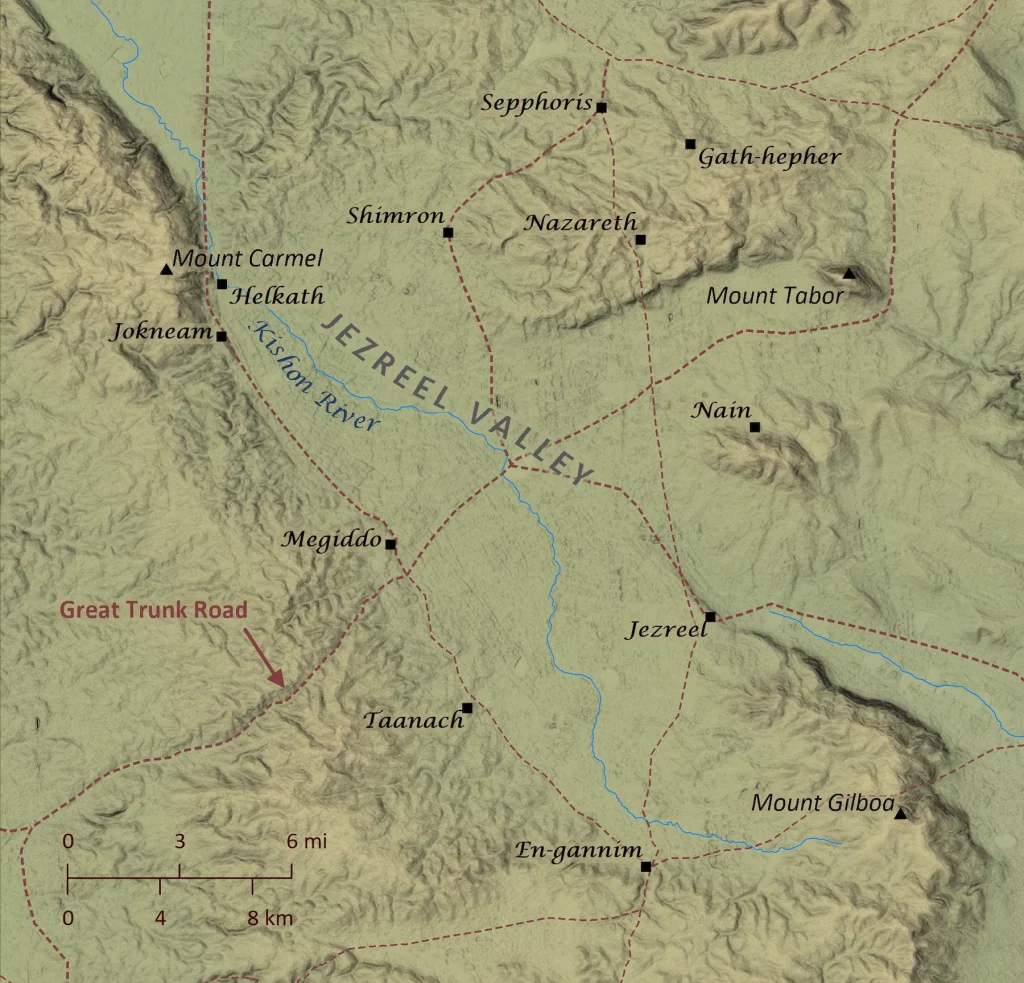
From https://thebiblesays.com/en/maps/535692-jezreel-valley-kishon – This map shows the Jezreel Valley and the Kishon River, a broad and fertile corridor in northern Israel between Mount Carmel, Mount Tabor, and Mount Gilboa. The valley was strategically important because major travel routes, including the Great Trunk Road, passed through it, connecting the coast, Galilee, and inland regions. Important biblical sites such as Megiddo, Taanach, Jezreel, En-gannim, and Mount Carmel appear on the map, showing why this area was often a place of conflict and movement. The Jezreel Valley is closely connected to several major events, including Deborah and Barak’s victory over Sisera near the Kishon River, Saul’s final battle near Mount Gilboa, and later events involving Ahab, Jezebel, Naboth, and Jehu at Jezreel.
From ChatGPT on 10/21/2026.
The Bible mentions the Kishon River primarily in the story of Deborah and Barak in Judges 4–5, while the Jezreel Valley is associated with several battles and events involving Israel, the Canaanites, the Philistines, and later Israelite kings.
One important distinction: the Bible sometimes names a location directly, sometimes refers to it by a nearby city or landmark, and sometimes describes an event occurring in the valley without using the modern geographical name Jezreel Valley. The list below separates direct references from passages that provide important geographical context.
1. Bible verses that name the Kishon River
The name Kishon occurs in five verses, with six occurrences of the name in the Hebrew text. These are the direct references identified by the Hebrew concordance.
| Scripture | Context |
|---|---|
| Judges 4:7 | Deborah tells Barak that Sisera and his army will be drawn to the Kishon River and delivered into his hand. |
| Judges 4:13 | Sisera assembles his chariots and troops from Harosheth-hagoyim to the Kishon River. |
| Judges 5:21 | Deborah’s victory song celebrates the Kishon sweeping away the enemy. |
| 1 Kings 18:40 | Elijah orders the prophets of Baal taken to the Kishon and killed following the contest on Mount Carmel. |
| Psalm 83:9 | A prayer asks God to defeat Israel’s enemies as God defeated Sisera and Jabin at the Kishon. |
Additional geographical reference: Joshua 19:11 describes a brook east of Jokneam, which some Bible reference works identify with the Kishon. That identification is less direct than the five verses above.
2. Bible verses that explicitly name the Valley of Jezreel
The expression Valley of Jezreel occurs explicitly in three verses.
| Scripture | Context |
|---|---|
| Joshua 17:16 | The descendants of Joseph explain that the Canaanites occupying the valley, including those near Beth-shean, have iron chariots. |
| Judges 6:33 | The Midianites, Amalekites, and eastern peoples gather and camp in the valley before Gideon’s campaign. |
| Hosea 1:5 | Hosea uses the Valley of Jezreel as the setting for a prophecy that Israel’s military power will be broken. |
3. Other important verses about the Jezreel region
These passages refer to the city of Jezreel, the surrounding territory, or events associated with the broader valley. The distinction matters because Jezreel is both a city and the name associated with a larger geographical area.
| Scripture | Geographical or historical significance |
|---|---|
| Joshua 19:17–18 | Lists Jezreel among the towns in the territory allotted to Issachar. |
| Judges 4:12–16 | Describes Barak’s battle against Sisera; read alongside the explicit Kishon references in Judges 4:7, 13 and 5:21. |
| Judges 7:1–25 | Describes Gideon’s campaign against the Midianites in the region of the Jezreel Valley. |
| 1 Samuel 29:1 | Israel camps near a spring in Jezreel while the Philistines assemble at Aphek. |
| 1 Samuel 31:1–7 | Describes the Philistine defeat of Israel on Mount Gilboa and the subsequent flight of Israelite forces. |
| 2 Samuel 4:4 | Mentions Mephibosheth, son of Jonathan, in a narrative that refers to the political aftermath of Saul’s death. |
| 1 Kings 18:45–46 | After the contest on Mount Carmel, Ahab travels to Jezreel as heavy rain arrives. |
| 1 Kings 21:1–29 | Relates Naboth’s vineyard, located in Jezreel, and the conflict between Naboth, Ahab, and Jezebel. |
| 2 Kings 9:14–37 | Describes Jehu’s revolt, the deaths of Joram and Jezebel, and events in Jezreel. |
| 2 Kings 10:1–11 | Continues the account of Jehu’s destruction of Ahab’s royal house. |
| Hosea 1:4–5 | Connects the name Jezreel with the judgment against the dynasty of Jehu and the northern kingdom of Israel. |
For the geographical context of these passages, see the Bible concordance for Jezreel and the Valley of Jezreel reference.
4. The most useful passages to read together
If your goal is to understand the Kishon River and Jezreel Valley in the setting of ancient Israel’s battles, I recommend starting with these four groups:
- Joshua 17:16–18 — the Canaanite presence and iron chariots in the valley.
- Judges 4:1–24 and 5:1–31 — Deborah, Barak, Sisera, and the Kishon River.
- Judges 6:33–7:25 — Gideon’s campaign in the Valley of Jezreel.
- 1 Kings 18:40–46 — Elijah, the Kishon River, Mount Carmel, and Ahab’s journey to Jezreel.
Together, these passages connect the river, the valley, the surrounding highlands, and the major military and political events associated with this part of ancient Israel.
