Below is my script for the CU Preaching Lab at the end of the Preaching and Teaching course taught by Rob Couch in Spring 2025. My chosen scripture, upon which the sermon is to focus, is Micah 6:6-8.
2025-05-21, 6 am
Good evening. I’m looking forward to sharing with you what I’ve learned about my new friend, Micah. Micah, who was a prophet in the time of King Hezekiah and Isaiah. The great part of one of his metaphors is he tells us 4 things Yahweh does not want and 3 things he does require of us. We’ll get to those lists soon.
This was 700 years before Jesus, but I’m confident Jesus read Micah and enjoyed those stories. To fully understand and appreciate his stories, as Chapter 6 is a play with roles. I believe we need to understand who Micah is, what he does, where he is living, and most importantly, the times he’s living in. Those were very, very turbulent times. But most of us, 2,700 years later, do not have much of a concept of his world. He thinks the reader does understand because in his first verse of Chapter 1, he quickly identifies himself and jumps into the first metaphor in verse 2.
Look at the very first verse in Chapter 1. The word of the LORD that came to Micah of Mo’resheth in the days of Jotham, Ahaz, and Hezeki’ah, kings of Judah, which he saw concerning Sama’ria and Jerusalem.
That is all he tells us, but it is more than many others. He expects you to already know the situation. There is some great information about him we can unpack and use it to figure out what he thinks the reader knows.
He cites who he is, and where he’s from, and when he’s there; at the time of these three kings (750-686), and then he cites Samaria and Jerusalem. This is the time of the divided monarchy. Samaria is in the Northern Kingdom. Micah is 25 miles from Jerusalem in the Southern Kingdom. Samaria in the Northern Kingdom, is very much a part of his story.
So, I want to share with you that story, and ask you to think of it as a play that will be acted out by actors who are cities and countries. We need to set the stage.
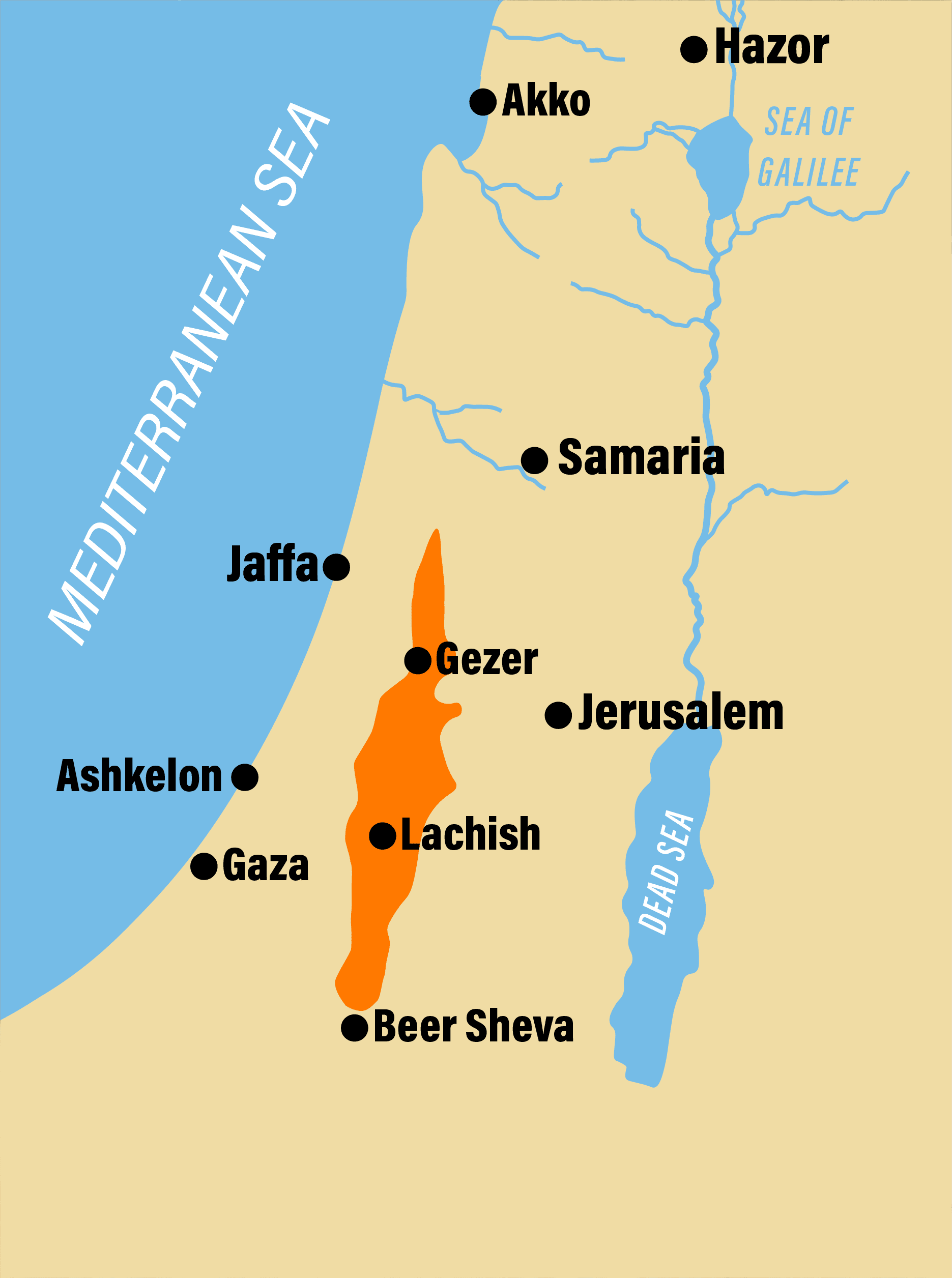
At this point, if we only want to know the bottom line and jump to Chapter 6, we miss Micah’s life, the stage, we miss the setting. In this case, the stage for me is this map behind me, and I want to go through that with you real quickly, so we have a feel for where he is in relation to Jerusalem, where he is in relation to the Northern Kingdom and the Southern Kingdom, the deadly impact of Assyria and how all that plays into what is popularly called the Covenant Lawsuit, which we will read. That’s Chapter 6. Patience, we will get there.
So, let’s look at the map and make sure we’re all in the same place. And I’m sure all of you recognize it well. You have the Mediterranean on one side, the sort of frame on that side, and on the right, on the east side, is the Sea of Galilee, Jordan River, and the Dead Sea.
And importantly for this story is the dividing line between the Northern Kingdom and the Southern Kingdom. And of course, we have in the Northern Kingdom, where the capital is Samaria.
But in this case, he’s currently talking about cities, because he cites Jerusalem, and he cites Samaria. So, Samaria for him is maybe the full Northern Kingdom, maybe just the capital of Samaria, because the problem, again, in what is really a 150-year period of intense turmoil for Israel and Judah, begins with the Assyrians, who were just barely off the map up here, invading the Northern Kingdom and destroying the villages, killing many people, hauling many people out, dispersing them throughout the other parts of Assyria and the countries they conquered, and bringing new people back in. So, Samaria is destroyed,
Many from the northern kingdom fled south to the southern kingdom. Jerusalem doubled in size with many families living outside the walls as there was no room inside. The same had to happen in Lachish and Moresheth. Refugees who surely brought their sheep and goats and their own sacred books of the Torah that were very similar to the books read by Micah and others in the Southern Kingdom
But the Southern Kingdom knows surely Assyria is coming for them one day. King Hezekiah works to get ready to repell them at least in Jerusalem. As expected the Assyrians, 14 years later, do attack the Southern Kingdom. But in that 14-year period, some very significant things happened.
We all remember the story of Hezekiah, who demolished the high places, and stopped pagan worship. He also destroyed a lot of the worship sites and altars for Yahweh, the God of Israel, the God of Judah, the God that we worship. Why? To consolidate worship to Jerusalem. That meant everybody has to do sacrifices, they have to go to Jerusalem, or the festivals have to go to Jerusalem. And part of what that did, it unified the country getting ready for the Assyrian attack, and also brings the revenue streams, such sacrifices and taxes, to Jerusalem. The funding allowed for improved fortification of Jerusalem and fortified other cities. One of those cities is Lochish. It’s here.
Lochish is a large city fortified with walls. Immediately north of Lochish is Moresheth, which, you remember, that’s where Micah comes from. That’s where he lives, next to the second largest City in Judah.
Although archeologists do not agree they have found Moresheth, and it’s larger than what we originally thought, and it was fortified by a wall. Regardless, Micah does not appear, at this point, at least to me, as the “small-town country prophet” that some modern texts portray him as…because his book is smaller he is a minor prophet.
Most importantly, he was surely a friend and contemporary of Isaiah. Some scholars think he was younger than Isaiah, Isaiah being like a mentor. Wouldn’t it have been neat when Micah was in Jerusalem, sitting and talking to Isaiah, for us to sit on the sidelines. That would be something.
That is the setting where Micah found himself talking to people, prophesying about what’s coming and how they need to obey God’s commands and comply with the covenant. Surely like all prphets he is standing outside of the city gates of Lockish, which has a major gate, and of course Jerusalem does as well. Also likely under trees talking to the refugees from the Northern Kingdom and in the Jerusalem Temple.
And he’s trying to get them to listen, and he’s telling this story. Sharing what Yahweh says through stories, through metaphors. And chapter 6 is one of the famous metaphors, which is THE Covenant Lawsuit.
It starts off with the prosecuting attorney, who is Micah, who is God’s, Yahweh’s advocate.
Hear what the LORD says: Arise, plead your case before the mountains, and let the hills hear your voice. Hear, you mountains, the controversy of the LORD, and you enduring foundations of the earth; for the LORD has a controversy with his people, and he will contend with Israel. “O my people, what have I done to you? In what have I wearied you? Answer me!
And all attention turns to the people and their advocate where there is no defense. All we hear is whining and is there anything I can do to get out of this???
The people respond — “With what shall I come before the LORD, and bow myself before God on high? Shall I come before him with burnt offerings, with calves a year old? Will the LORD be pleased with thousands of rams, with ten thousand rivers of olive oil? Shall I give my first-born for my transgression, the fruit of my body for the sin of my soul?”
Look at these four. The first and last are both sacrifices. The second and third are both gifts.
The prosecuting attorney again speaks, and all attention turns to Micah.
He has shown you, mortal, what is good. And what does the Lord require of you but to do justice, to love kindness, and to walk humbly with your God?
There are only three things Yahweh requires of them. There are four things he does not want.
This is a very intense story, a pointed metaphor. Micah’s message from Yahweh of what is good and what is required. I believe it is important that Micah is talking about relationships. Not gifts, and certainly not sacrifices. That’s the kind of worship Yahweh desires.
A lifetime of faithful steps in the right direction, every day. Sounds like Jesus, doesn’t it? I’m sure Jesus read and loved Micah as would any good rabbi.
Next time you hear “Love God. Love People. Change the World” think about how those three commands are like Micah’s three commands; Do mercy/Changes the world; have kindness in your heart/Love People, and walk humbly/Love God. OK, Micah has them in a different order but not too bad for 2,700 years ago.
Final thoughts and a suggestion:
There are seven more verses in the portrayal of the lawsuit where Micah relates what how Yahweh has already begun to smite them and lists what will happen to the people for their failures. I encourage you to read that as I hope this portrayal of Micah’s world will lure you into reading his short book and the stories of the other prophets.
You shall sow, but not reap; you shall tread olives, but not anoint yourselves with oil; you shall tread grapes, but not drink wine.
As a final thought, the prophets are surely the books Jesus read. If you ever wondered what did Jesus think about, what did he study, then read the prophets.
Let’s pray.
Our father, thank you for Micah, his lessons and especially the covenant lawsuit. As we walk from here tonight and into the future, we commit to walk humbly with you, with mercy in our hands, and kindness in our hearts. Amen and amen.
Yahweh wants us to walk with justice in our hands, kindness in our hearts, and humility in our steps.
- OPENING – One of my favorite TV shows when I was growing up was Perry Mason. I enjoyed the courtroom scenes with the Judge, the complainant, and the defendant.
The complainant often had a contract with the defendant and was upset the defendant did not keep their end of the deal.The prophet Micah uses the courtroom setting with Yahweh as the complainant and the people being the accused. The hills and mountains are the judge and hear the case. During the hearing, Micah Yahweh’s advocate, reminds the people what Yahweh said: there are four things Yahweh does not want and three things Yahweh wants. We’ll get to those things in a minute. - First it is always good to know your prophet and what is going on in his world. Micah was traditionally thought of as a small-town country prophet in the time of the big-city prophet Isaiah. Surely they talked at festivals when Micah was in Jerusalem. I would liked to have been on the sidelines for those conversations. So, if we take info from his book and other historical information we will find we know some important things about him.
- Go with me back 600 years before Jesus.
- Micah grew up and lived in Moresheth, (More-sheth ), a fortified town only 15 miles from Lachish (Lake-ish) another fortified city and the second largest City in the Southern Kingdom in the 8th century. He was on two major trade routes; the east-west and the north-south. Living there and next to Lachish, he would have been well aware of trade and business operations, society’s issues, and politics.
- DRAW THE MAP — Where was he in Judah? Note the cities, the mountains and Shepaleh region. (shep-helah)
- Micah likely taught his prophecies like others at city gates to both common people and leaders. He was not a priest supporting the temple cult and their business model.
His messages targeted societal injustices and called for repentance, often confronting the elite classes directly. Similarly, Isaiah, who had access to the royal court in Jerusalem, addressed kings and officials, delivering messages that combined both judgment and hope. What did he not like? His teachings were not supportive of city life, the temple cult and the high places he witnessed after walking the 20 miles to Jerusalem for the festivals, dragging his best sheep or goat to be sacrificed, and the priests taking their 10% and collecting taxes. That was 20 miles uphill, 1,400 ft above Moresheth.
- What was happening in his society?
- He lived in that turbulent 150-year period that began with the death-pangs of the Kingdom of Israel (the Northern Kingdom) at the hands of Assyria in the late 8th century B.C. and ended with the Babylonian destruction of the Kingdom of Judah (the Southern Kingdom) in 586 B.C.
- King Hezekiah — Micah was active in the time of King Hezekiah and the king’s consolidation of worship to Jerusalem. Surely Micah’s local worship was in some way negatively impacted. We know he did not like Jerusalem as in Chapter 1:5b he says: “And what is the high place of Judah? Is it not Jerusalem?”
Walking to Lachish and Jerusalem — Given the King’s destruction of sacred places outside the Jerusalem temple, the people in Micah’s town had to begin going to Jerusalem for festivals and sacrifices.That was a two-day walk uphill–a 1500-foot rise [from ~El. 920 to ~El. 2,460].Consider if you were in Gatlinburg and had to load up your donkey with water and food and drag your very best sheep or goat to be sacrificed for your sins and make them all walk for two days to the top of the Smoky Mountains.- Assyrians attacked Israel/Northern Kingdom, and Refugees came South —That was the time of the Assyrians attacking the Northern Kingdom and many moving south. They were cousins with the same language and their sacred writings were very similar.
- Assyrians invaded Judah/Southern Kingdom and destroyed Lachish in 701 BCE and other towns. Then attacked Jerusalem. The prophet Micah (1:10–15) lists the towns of the Shephelah, (shep-helah), including Lachish, that the Assyrians devastated.
Lachish was Sennacherib’s field headquarters at the time of its destruction.
- Micah knows that how the people are living will not lead to good things.
- Micah’s teaching —One of his most famous teachings today is known now as the Covenant Lawsuit, preserved in Chapter 6. Picture his telling this metaphor at the city gates of Lachish or under the trees of Moresheth, playing all the roles in his description of the courtroom drama. [What does that tell us: Michah had listened well in his Preaching and Teaching class, as he knew how to use a metaphor.]
Listen to him tell the people what was coming. Visualize the proceedings of the Court with Yahweh, the complainant, and the hills and mountains as the judge.I am reading from Chapter 6.
- THE PROSECUTING ATTORNEY — Hear what the LORD says: Arise, plead your case before the mountains, and let the hills hear your voice. Hear, you mountains, the controversy of the LORD, and you enduring foundations of the earth; for the LORD has a controversy with his people, and he will contend with Israel. “O my people, what have I done to you? In what have I wearied you? Answer me! There is no defense, only whining and worse ending with a sarcastic tone.
- THE PEOPLE “With what shall I come before the LORD, and bow myself before God on high?
- Shall I come before him with burnt offerings, with calves a year old?
- Will the LORD be pleased with thousands of rams,
- with ten thousand rivers of olive oil?
- Shall I give my first-born for my transgression, the fruit of my body for the sin of my soul?“
- Notice: the first and fourth are sacrifices, and the other two are gifts.
- THE PROSECUTING ATTORNEY — He has shown you, O [mortal], what is good; and what does the LORD require of you but to do justice, and to love kindness, and to walk humbly with your God?
THE MOST IMPORTANT PART OF HIS METAPHOR – WHAT DOES YAHWEH WANT? ONLY THREE THINGS:to do justice or do what is right, i.e. Change the Worldto love kindness and i.e. Love Peopleto walk humbly with him i.e. Love God
- Let’s step outside the courtroom as the fourth offering sounds way outside what we think we know…Offering to sacrifice my firstborn for my sins!!! Whoa. Where did that come from? Micah knew that infant sons and daughters were being sacrificed for the parents’ sin just outside Jerusalem on the south side of the Hinnom Valley (Gehenna). Micah repeats Yahweh’s position that he does not want them to sacrifice someone, as that will not gain forgiveness for their sins.
- Closing/PAUSE: That is a very intense story, a metaphor. But, what is Michah’s message from Yahweh? You just walk – day by day, step by step – with Yahweh beside you. Yahweh wants us to walk with justice in our hands, kindness in our hearts, and humility in our steps. What is important is it is about relationships. Not gifts and certainly not sacrifices. That’s the kind of worship He desires—a lifetime of faithful steps in the right direction, every day.
- Sounds like Jesus: I am sure Jesus read and loved Micah as would any good rabbi.
I hope this feeble but hopefully humble description of Micah and his world will interest you in the many books that Jesus read. I hope you will read Micah and compare what he shares Yahweh wants from us with what Jesus said Yahweh wants. Love God, Love People, and Change the World. You will find they are the same.- Let’s Pray — Our Father, thank you for Micah and the lessons in his story of the Covenant Lawsuit. As we walk from here tonight and into the future, we commit to walking humbly with you, doing mercy, and being kind. If we don’t then we will see you in court and be reminded of the only three actions you require. Amen and Amen.