New Testament Political Figures Confirmed by Lawrence Mykytiuk at BAR *** See below the link to Paul Davidson’s page and family tree.
Extract – In order to understand who the political figures were in the New Testament, we must have a basic grasp of one particular family of rulers—the Herodian family, which was nestled under the wing of the Roman Empire and protected by its military might and served as its regional surrogates. This family consisted of Herod the Great (r. 47–4 B.C.E., initially ruling Galilee only and later all of Roman Palestine, called Palaestina) and his descendants (some also had Herod as part of their name). He was a politically talented son of Antipater II, the son of Antipater I (or Antipas), an Idumean noble. (Idumeans were descendants of the ancient Edomites, who lived south of Israel.) Herod the Great advanced his political career by currying favor with Roman leaders, especially Julius Caesar and Caesar Augustus. It was this Herodian family that persecuted or executed many people, whether ordinary Jews, John the Baptist, Jesus or some of Jesus’ earliest followers.
Selected Members of the Herodian Family and Roman Governors Who Are Significant in New Testament Events
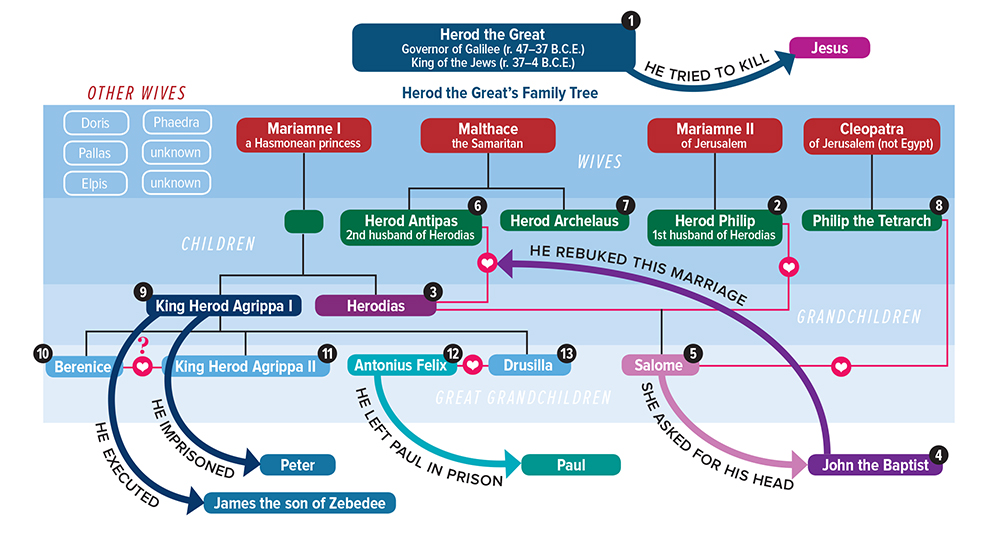
The family tree includes only the Herodian family members in the New Testament plus most of the Roman governors it mentions. It is not a complete family tree. Boldface in the narrative statements below signifies the person is referred to in the New Testament.
All below was extracted from his article. The numbered lines refer to the numbers in the family tree above.
Earlier Outcomes: Attempt to kill the infant Jesus, execution of John the Baptist, and the trial of Jesus
1. Herod the Great, founder of the dynasty, tried to kill the infant Jesus by the “slaughter of the innocents” at Bethlehem.
2. Herod Philip, uncle and first husband of Herodias, was not a ruler.
3. Herodias left Herod Philip to marry his half-brother Herod Antipas, Tetrarch of Galilee & Perea.
4. John the Baptist rebuked Antipas for marrying Herodias, his brother’s wife, while his brother was still alive—against the law of Moses.
5. Salome danced for Herod Antipas and, at Herodias’s direction, requested the beheading of John the Baptist. Later she married her great-uncle Philip the Tetrarch.
6. Herod Antipas, Tetrarch of Galilee &: Perea (r. 4 B.C.E.–39 C.E.), was Herodias’s uncle and second husband. After Salome’s dance and his rash promise, he executed John the Baptist. Much later he held part of Jesus’ trial.
7. Herod Archelaus, Ethnarch of Judea, Samaria and Idumea (r. 4 B.C.E.–6 C.E.), was replaced by a series of Roman governors, including Pontius Pilate (r. 26–36 C.E.).
8. Philip the Tetrarch of northern territories (r. 4 B.C.E.–34 C.E.) later married Herodias’s daughter Salome, his grandniece.
Later Outcomes: Execution of James the son of Zebedee, imprisonment of Peter to execute him, and the trial of Paul
9. King Herod Agrippa I (r. 37–44 C.E.) executed James the son of Zebedee and imprisoned Peter before his miraculous escape.
10. Berenice, twice widowed, left her third husband to be with brother Agrippa II (rumored lover) and was with him at Festus’s trial of Paul.
11. King Herod Agrippa II (r. 50–c. 93 C.E.) was appointed by Festus to hear Paul’s defense.
12. Antonius Felix, Roman procurator of Judea (r. 52–c. 59 C.E.), Paul’s first judge, left him in prison for two years until new procurator Porcius Festus (r. c. 60–62 C.E.) became the second judge, and Paul appealed to Caesar.
13. Drusilla left her first husband to marry Roman governor Felix.
In addition, see Paul Davidson’s post on his blog site here. He also has an extensive family tree linked from there that is also in my directory Herod and Sons.
