This page is very long and contains extracts, summaries, and links by various scholars including Hendle, Ehrman, Nichols, McClelland, Baden, and Collins.
Links to Articles at BAS
- “Exodus Itinerary Confirmed by Egyptian Evidence,” Krahmalkov, Charles R., Biblical Archaeology Review 20.5 (1994): 54–62.
- “Exodus Evidence: An Egyptologist Looks at Biblical History,” Biblical Archaeology Review 42.3 (2016): 31–37.
- Taking the Biblical Text Apart by Richard Elliott Friedman
“Exodus – A book of memories” by Ronald S. Hendel.
(Bible Review 18.4, 2002, pp. 38–45, 52; expanded in JBL 120 [2001])
Hendle’s paper was summarized on 8/27/2026 by Claude.ai below and a PDF copy is in his directory in Dropbox.
Central Thesis Hendel argues that the Exodus narrative is best understood not as straightforward history nor as pure fiction, but as collective memory — a blend of authentic historical residue, folklore, ideological shaping, and narrative artistry, transmitted orally and then textually over centuries. The past and present are interwoven in this memory, making the Exodus what he calls “a past continuous” rather than a fixed, punctual event.
The Nameless Pharaoh Hendel opens with the puzzle of why the Exodus pharaoh is never named. He suggests this isn’t necessarily forgetfulness but may be a deliberate (or at least functional) feature of the tradition — an unnamed pharaoh allows the memory of oppression to be claimed by many groups within early Israel, not just those who literally fled Egypt.
Historical Background: Egyptian Domination of Canaan Drawing on Egyptian sources — the Amarna letters, royal inscriptions from Thutmose III, Amenhotep II, Thutmose IV, and Ramesses II/III — Hendel documents that Canaan was under Egyptian imperial control for centuries, during which slaves were extracted as tribute, taken as prisoners of war, deported en masse, or sold for financial reasons. He concludes that many segments of the population that became “early Israel” likely carried real memories of Egyptian bondage, even if they had no direct experience of a single dramatic escape. This diffuse, shared experience — not one specific event — became crystallized into the Exodus story.
The Plagues Hendel treats the plagues largely as products of Israelite folklore and imagination, but notes possible echoes of real phenomena: a devastating epidemic (paralleled by the role of disease-gods like Resheph and Nergal) and natural calamities like hail and locusts, which also appear together in a Syrian treaty-curse text (the Sefire inscription), suggesting shared West Semitic literary conventions.
Moses as Mediator Hendel considers Moses’ name (Egyptian in origin) and his marriage to a Midianite woman as the two biographical details most likely to be historically genuine, since both go against Israel’s own ideological grain (the “criterion of dissimilarity”). Everything else about Moses is too entangled with legend and theology to isolate historically. Hendel’s larger interpretive move is to read Moses as a mediator figure — straddling categories like slave/free, Egyptian/Israelite, human/divine intermediary — whose ambiguous, “no-man’s-land” death and burial site (like the unlocated Sinai/Horeb) mirrors the way collective memory needs indeterminacy to remain universally shared.
Conclusion The Exodus, for Hendel, is a “congeries of paradigms” — a memory shaped by real imperial history (Egyptian control of Canaan), transposed and generalized into a foundational national myth of deliverance from oppression, one that has continued to resonate from Second Isaiah to Nelson Mandela.
Spoiler Alert – Moses Didn’t Write This by Ross K. Nichols TV
Ross’ lesson is about the chronology of the 40 years and how the telling of those years spans Exodus to Numbers to the end of the time that is told in Deuteronomy. Ross points out anachronisms in those books where events are related out of order time-wise. He also points out places where the authors are speaking about what is happening and how an event leads to one much later in time that the authors know. His first case is related in the following paragraphs.
Exodus 16:31-35 is about the manna Jehovah provided. The author knows they did eat it for 40 years until they came unto the borders of Canaan; i.e. the author is writing about what DID happen. The author also records that Aron put it before the Testimony. But the manna arrived just after they came out of the sea and long before they reached Mt. Sinai and received the Testimony.
Exodus 16:31-35 — And the house of Israel called the name thereof Manna: and it was like coriander seed, white; and the taste of it was like wafers made with honey. 32 And Moses said, This is the thing which Jehovah hath commanded, Let an omerful of it be kept throughout your generations, that they may see the bread wherewith I fed you in the wilderness, when I brought you forth from the land of Egypt. 33 And Moses said unto Aaron, Take a pot, and put an omerful of manna therein, and lay it up before Jehovah, to be kept throughout your generations. 34 As Jehovah commanded Moses, so Aaron laid it up before the Testimony, to be kept. 35 And the children of Israel did eat the manna forty years, until they came to a land inhabited; they did eat the manna, until they came unto the borders of the land of Canaan.
Below is a summary by Claude.ai of a Youtube Short by Dan McClellan titled How scholars know Moses didn’t write Exodus. The transcript is in his directory in Dropbox.
Summary by Claude.ai
In this short video transcript, biblical scholar Dan McClellan argues that Moses could not have written the book of Exodus for a key linguistic reason: the Hebrew language simply didn’t exist yet during the time period Exodus depicts.
His main points:
- Hebrew as a distinct language didn’t emerge until the late 11th or early 10th century BCE, when South Canaanite began splitting into regional dialects (Ammonite, Moabite, Edomite, and Hebrew).
- Even then, it was an early form of Hebrew — whereas Exodus is written in a more developed form of the language.
- Historical narrative prose in alphabetic writing doesn’t appear until around the mid-9th century BCE at the earliest, yet that’s the dominant style of Exodus, placing its composition no earlier than ~850 BCE.
- Scholars believe Exodus likely began taking shape in the 8th century BCE and reached its familiar form during the exilic period.
McClellan’s conclusion is that Exodus was written centuries after the events it describes and is therefore unlikely to be historical, with its language alone being sufficient evidence that Moses — or any contemporary eyewitness — could not have been its author.
For more on the evolution of Hebrew, go to the post on this site titled Evolution of Biblical Hebrew as a Language and Writing
Exodus is a Greek word and means “the road out” per Bart.
Claude.ai’s summary of Lecture 2 of his Finding Moses series at BSA
Summary: Bart Ehrman, Lecture 2, Exodus 2, “The Early Life of Moses” (Finding Moses)
Overview
Ehrman covers Moses’ story from Exodus 1 through the burning bush in Exodus 3. He pairs the narrative with a critical look at its plausibility, its parallels in ancient literature, and the divine name.
1. Setup: From Slavery to Salvation (Exodus 1)
- The Israelites, 70 descendants of Abraham, entered Egypt to escape famine. Ehrman jokingly calls this the “Enodus.” “Exodus” is a Greek word meaning “road out.”
- They multiplied rapidly, so an unnamed Pharaoh enslaved them. He feared revolt, or an alliance with a foreign invader (Ex 1).
- When enslavement failed to curb growth, he ordered the two Hebrew midwives to kill all newborn boys. They evaded the order, and he then ordered all Egyptians to do it.
2. Is the Basic Scenario Plausible?
- Yes, in general. Egyptian and Canaanite records show Canaanites migrating to Egypt during drought and famine. Some became slaves or labor on building projects.
- The specifics are problematic, according to Ehrman:
- Chronology. Exodus 6 gives three generations from Levi to Moses (Levi, Kohath, Amram, Moses). Exodus 12:40 says Israel was in Egypt 430 years: “Now the time that the children of Israel dwelt in Egypt was four hundred and thirty years” (ASV). Even at 40 years per generation, that is about 160 years.
- Numbers. Exodus 12:37 gives 600,000 soldier-age men, implying at least 2.5 million people. Two midwives for that population is absurd. Egypt’s total population in the 13th century BCE is usually estimated at only 4 to 5 million.
- Pharaoh’s strategy. Killing all the boys would have destroyed his own slave labor force. It also conflicts with 600,000 men surviving to adulthood.
3. Moses’ “Auspicious Beginning” (Exodus 2)
- A Levite couple hides their baby son. After about three months the mother places him in a bitumen-sealed papyrus basket among the reeds of the Nile.
- His sister Miriam watches. Pharaoh’s daughter finds him and adopts him. Miriam arranges for his own mother to nurse him.
- Moses is thus raised as an Egyptian royal. Providence is implied, though God is never explicitly mentioned.
4. The Sargon Parallel
- Ehrman notes that the “miraculous beginning” motif is common in the ancient world. The closest parallel is the birth legend of Sargon of Akkad: a secret birth to a high priestess, a reed basket sealed with bitumen, a river, adoption by the irrigator Aki, work in a date grove, and the favor of the goddess Ishtar.
- He also mentions Romulus and Remus, and Jesus (a miraculous birth plus escape from a ruler’s threat).
5. Moses as a Young Man and Midian
- Moses kills an Egyptian taskmaster who was beating a Hebrew, then flees to Midian.
- He marries the daughter of a Midianite priest, who is called both Reuel and Jethro. Ehrman reads this as evidence of different sources, since the text gives no sign of two names for one man.
- Moses becomes a shepherd.
6. The Burning Bush (Exodus 3)
- At Horeb, “the mountain of God,” Moses sees a bush that burns without being consumed. The mountain also has two names (Horeb and Sinai), which Ehrman again ties to the sources J, E, D and P.
- The “angel of the Lord” speaks as Yahweh himself. This shows how closely the angel is identified with God as his representative.
- God commissions Moses to demand Israel’s release.
7. The Divine Name
- Moses asks God’s name (Ex 3:14): “And God said unto Moses, I AM THAT I AM: and he said, Thus shalt thou say unto the children of Israel, I AM hath sent me unto you” (ASV).
- The Hebrew can also be rendered “I will be what I will be” or “I cause to be what I cause to be.” Ehrman says its exact meaning is unclear. The author clearly links the name Yahweh to the verb “to be.”
- Increasing transcendence. Ehrman traces God becoming more transcendent across the Hebrew Bible: strolling in Eden, speaking face to face with Abraham, revealing a private name to Moses, and becoming far more remote at Sinai.
- The Tetragrammaton. The name is four consonants (YHWY, usually pronounced “Yahweh”). Jewish tradition avoids pronouncing it and substitutes Adonai (“Lord”) or “the Name.”
8. Preview
- Moses confronts Pharaoh with ten plagues. Pharaoh relents, then changes his mind and pursues Israel, leading to the Red Sea event.
Core Takeaway
Ehrman accepts that the broad picture of Canaanites migrating to Egypt and being enslaved there is historically plausible. He argues that the narrative’s chronology, numbers and logic raise real problems. He also reads Moses’ birth story as a standard ancient legend-type, with Sargon as the key parallel. Finally, he reads the doublets (Reuel/Jethro, Horeb/Sinai) as signs of multiple underlying sources.
Source: Bart D. Ehrman, Finding Moses, Lecture 2, “The Early Life of Moses” (Bart Ehrman Blog/BSA course transcript, as provided).
Slides from Lesson 3: The Exodus of Bart’s “Finding Moses” series at BSA. Below are issues Bart points out with the stories in Exodus.
The Divine Set-Up
- The Demand for a Long Weekend (Exod. 3:18)
- The (Ambivalently) Recalcitrant Pharaoh (Exod. 4:21; Exod. 7:3; but Exod. 8:32)
- The Divine Logic
- So that my wonders will be seen (Exod. 11:9)
- So that I will gain glory for myself over Pharaoh (Exod. 14:4)
- The Obvious Theological Question
- Pharaoh and God’s relentless will [Kills Pharaoh’s children] (see Exod. 4:21-23; Whoa! To whom is this fair?
The Plagues Against Egypt
- To Convince Pharaoh?
- To Demonstrate the Power of Yahweh! (see Exod. 10:1-2)
- Sequence (chs. Exod. 7-12)
- Blood, from all the water
- Frogs, everywhere
- Gnats, from all the dust
- Flies, swarms and swarms
- Livestock, all of it
- Boils, humans and animals
- Hail, everything in the fields
- Locusts, everywhere eating everything
- Darkness, complete blackout for three days
- Kills Firstborn, the last straw
A Plague of Problems
- A Key Example: Bloody Water
- All the Water turned to Blood (Exod. 7:19). Egyptian magicians did the same! (Exod. 7:22) [Problem is the magicians turned it to blood, but it was already blood?]
- Then, a week later … Exod. 8:6, frogs [everywhere, came out of the water…that had been turned to blood?]
- A Perennial Favorite: Those Poor Cattle – [Problem the cattle are killed three times]
- The Death of the Egyptian Livestock (5th plague; Exod. 9:6)
- The Death of the Egyptian Livestock (7th plague, hail; Exod. 9:19-21)
- The Death of the Egyptian Livestock (10th plague, kills first-born of the livestock; Exod. 12:29)
The Passover Feast
- In Preparation: Instructions for the Feast (Exod. 11 and Exod. 12)
- Puzzle in the Plot: Goshen (Exodus 8:22; Exod. 9:26)?
- What Egyptian Neighbors? (Genesis 11:2 says they do not live with the Egyptians)
- And Why Spread the Blood? Wouldn’t God know which houses have the Jews?
- Lesson for the Liturgy
- Israelite Worship: Re-enacting an Act of God
- Cf. Sabbath (Genesis 1)
The Story: Escape and Destruction
- Pharaoh’s Change of Mind [after his first born is killed by God] Exod. 12:29-31
- Pharaoh’s Re-change of Mind [to bring them back] Exod. 14:5
- The Numbers of Escapees
- About 600,000 Men (Exod. 12:37)
- Or More
- Num. 1:45-47 603,550 soldiers + 23,000 Levites
- Not Counting Elders, women, children, or the “mixed crowd” (Exod. 12:38).
- Or animals
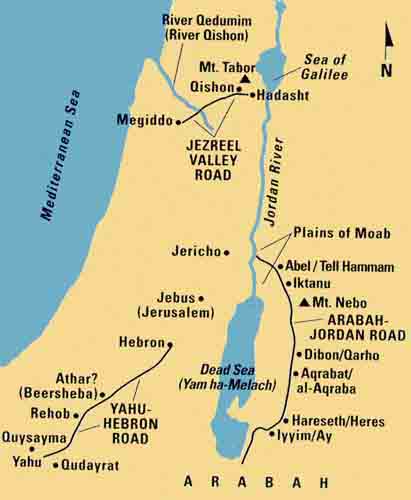
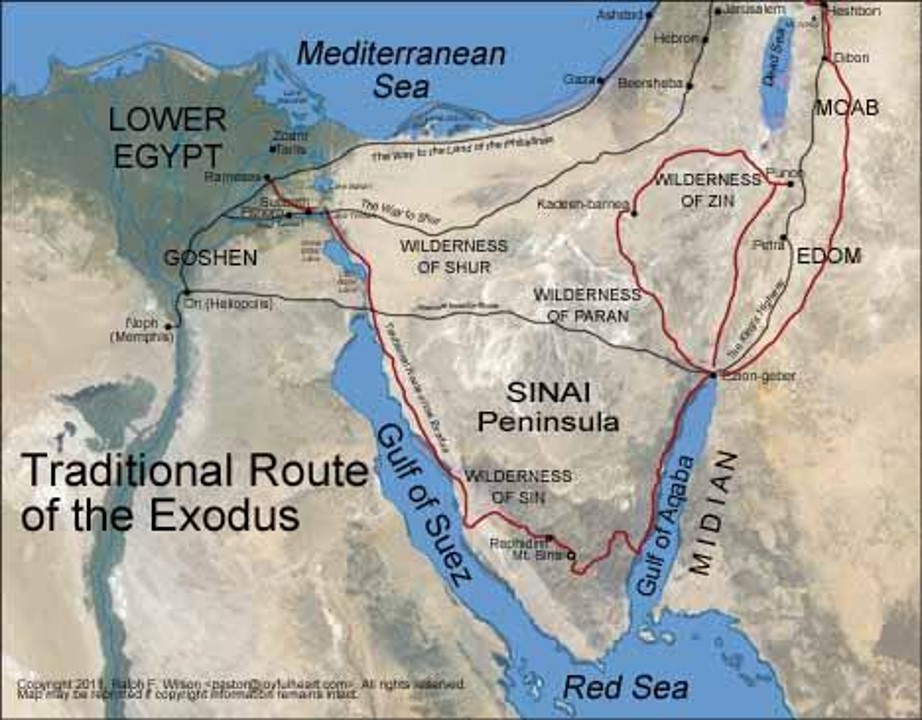
- The Route (Map)
- Sea of Reeds (Yam Suph) Not the Red Sea
- See Baden-Collins video below related to Chapters 14 and 15:
- Note Chapt. 15 has what is believed to be a very old poem/hymn about Pharaoh’s destruction in a sea (not a specific body of water) but the Israelites are not present. Was it added?
- a little bit after that Miriam gets in on the ACT. She seems to be lacking originality because it sounds very much like what Moses sings the entire song. Then Miriam and the women sing sort of in a call and response fashion and they start in and we get the first couple of verses of the very song that Moses just sang. Why do we have that repetition? From the ASV – 20: “And Miriam the prophetess, the sister of Aaron, took a timbrel in her hand; and all the women went out after her with timbrels and with dances. 21 And Miriam answered them, [with the same two lines as in the opening of Moses’ song]
- See Baden-Collins video below related to Chapters 14 and 15:
- The Escape and Event at the Sea (chs. 12-14)!
- Baden/Collins extract – RE: Chap. 14 –It’s a little confusing if you try to read through the story as it stands in the text. I think it’s actually very difficult to know exactly where the people are in relation to the Egyptians; what Moses is doing; what God is doing; how the waters are moving; when the waters are moving; and exactly where anybody is when anybody dies. The reason for this, as we’ve seen elsewhere, is we really have … where two stories have been intertwined—and one of them is the Priestly account.
- The Song of the Sea
Narrative Lessons
- Who is our Master? (Yahweh, not Pharaoh; Lev. 25:42, 55)
- What Kind of Master is He? (Powerful and Jealous)
- How Then Shall We Live?
- Toward God (Exod. 20:2)
- Toward Others (even the “alien”) (Exod. 23:4-9)
- The Theological Claim (The God Who Intervenes) …[saves his people]
- The Theological Problem (The God Who Intervenes)… [for his people but destroys the first born and the whole army.]
Red Sea or Reed Sea?
The very name Yam Suf (reed sea) implies a marshlike setting rather than the open sea, yet images of the sea prevail in the poetic fragment in Ex 15:1–12, 18, which is widely considered to be the oldest unit in these two chapters. Christine Elizabeth Hayes. Introduction to the Bible (The Open Yale Courses Series) (p. 114). Yale University Press. Kindle Edition.
Alternatively — Red Sea or Reed Sea? How the mistake was made and what yam sûp really means by Bernard F. Batto at BAS. A Claude.ai summary of the article is in a post on this site here.
From BAR
What are these tantalizing scraps of evidence for Exodus? Each detail is outlined by eminent scholars of Egyptian and biblical history and archaeology in this BAS Library Special Collection. You can read all of these eye-opening articles from the pages of Biblical Archaeology Review:
- Israelites Found in Egypt
By Manfred Bietak - How Reliable Is Exodus?
By Alan R. Millard - Pharaoh’s Workers: How the Israelites Lived in Egypt
By Barbara Lesko and Leonard Lesko - Let My People Go and Go and Go and Go
By Abraham Malamat - Exodus Itinerary Confirmed by Egyptian Evidence
By Charles R. Krahmalkov - Three Ways to Look at the Ten Plagues
By Ziony Zevit - Red Sea or Reed Sea? – See paragraphs above with the link to a summary.
By Bernard F. Batto
Conversation between Dr. Baden (bio here) and Dr. John Collins.
For the YouTube Playlist of Collins and Baden Exodus Study click here or use the links below to go directly to each video. We watched these for the first time in mid-March 2025 and learned a lot as well as enjoyed their conversations.
2 Exodus 1-6: The Burning Bush
5 Exodus 14-15: The Crossing of the Sea
As part of this video there is a PDF Study Guide Crossing of the Sea and in the Bible/Exodus directory in DropBox. It is extensive and very good.
7 Exodus 21-23: The Book of the Covenant
8 Exodus 32-34: The Golden Calf
When does the Bible say the Exodus occured? See The Biblical Dates of the Exodus. Extract below.
The Biblical Dates Permalink
We’ve collected a few dates; let’s put them in a table:
| Biblical Passage | Derived Biblical Date |
|---|---|
| 1 Kings 6:1 (LXX) | 1406 BCE |
| 1 Kings 6:1 (MT) | 1446 BCE |
| Acts 13:17-21 (Paul) | 1536 BCE |
| Narratives – Adding the Judge and others time. | 1596 BCE |
With all of the above in mind, a few things should be obvious:
- Far from there being a single “biblical” date for the Exodus, we can extract from the Bible (at least) 4 different dates. And, by definition, each of them are “biblical”.
- The dates we can derive aren’t even close – it’s not like they’re all off by a year or two, there’s a spread of almost 200 years between the dates.
