Extract Bart provided here from his NT Textbook.
The Gospel of Mark – AT A GLANCE
- Mark was written in Greek, around 70 c.e.
- Its anonymous author was a Greek-speaking Christian, probably living outside of Palestine, who had heard numerous stories about Jesus before writing his account for his Christian community.
- The Gospel begins with Jesus being baptized as an adult; and at the outset, it reveals his character as the Son of God who leads, teaches, heals, and casts out demons with authority—but who is nonetheless opposed by Jewish religious leaders.
- The Gospel stresses that Jesus’ character and destiny were misunderstood by virtually everyone with whom he came in contact.
- For Mark, Jesus was not to come in power to overthrow the forces of evil aligned against God and his people. He came to suffer and die at the hands of these forces.
- But Mark indicates that God had the last say. After Jesus’ suffering and death in Jerusalem, God raised him from the dead, and an angelic messenger announced that he would meet his followers in Galilee.
The Genius of Mark – Bart Ehrman’s Course
Below is part of the transcript of the end of Lesson 4 of Bart Ehrman’s The Genius of Mark course at BSA. The transcripts are in his directory in DropBox. Dr. Ehrman explains what he views as the pivotal sequence in Mark’s book that hinges on Mark’s themes of the mysterious Jesus with his repeated commands to “Don’t tell anyone” followed by the repeated question “Don’t you understand”. His slide below provides the sequence and scripture references.
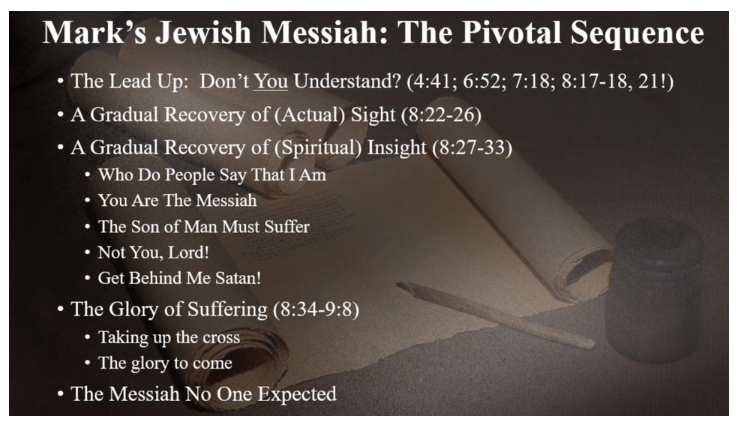
The Lead Up: In Mark 8:17-18, Jesus asked them, “Don’t you yet understand?” Verse 21, “Don’t you yet understand?” This is happening repeatedly. He keeps saying, “Don’t you understand?” No, they don’t understand. And right after that last one, chapter 8:21, when he says, “Don’t you yet understand,” is when we start getting the pivotal sequence.
The very next verse is a verse of Jesus healing somebody. This is the only healing story in the Gospels of the New Testament where Jesus can’t heal somebody on the spot. It happens in stages. So there’s this blind man they bring up to Jesus. They ask him to heal him. And Jesus takes some spittle and rubs it on the man’s eyes and he says, Okay. Can you see now? And the man says, “Well, I can see people walking around, but they look like trees.” In other words, he can only see them very dimly. They don’t look like people. I don’t know how he knows what people would look like, but he doesn’t think it’d be like this. And so he’s partially healed. And so then Jesus takes him and looks intently at him, and he heals him. This is a story of somebody who has no sight who gradually gains his sight until he can see clearly. This is a metaphorical story. Mark means it happened, but it has a broader implication.
Right after this, the very next verse, Jesus is with his disciples walking in the region of Caesarea Philippi up in Galilee, and he asks them, “Who do people say that I am?” Okay, here it is. The first time Jesus wants to know, “Who do people think I am?” Now, you know, the reader knows who Jesus is, and Mark knows who Jesus is. The demons know who he is. God knows who he is. Jesus knows who he is. Here, he asks, “Who do people say that I am?” And the disciples say, “Well, some say that you’re Elijah, that you’re John the Baptist, come back from the dead. Some say you’re John the Baptist, come back from the dead. By this time, John the Baptist has been killed. Some say you’re reincarnated Elijah, some say you’re one of the prophets and Jesus says, who do you say that I am? And Peter replies, you are the Messiah. Peter, presumably representing the disciples, you are the Messiah. And you think, finally somebody got it.
He took half of the book, but now somebody does understand that Jesus is a Messiah, except for what happens next. In the next verse, Jesus responds, first he says, “Don’t tell anyone,” of course, but then he says, “The Son of Man must go to Jerusalem and suffer and be executed, and on the third day rise from the dead.” He gives his first passion prediction. And how does Peter respond to Jesus saying he has to go to Jerusalem and die? “Oh no, not you, Lord.” Peter says it can’t happen. Wait a second. He just said he’s the Messiah. Yes, right. He thought he was the Messiah, as in the Jewish Messiah, as in someone who will drive out the Romans and set up a kingdom in Jerusalem. Jesus isn’t talking about going to Jerusalem to take over. He’s talking about going to Jerusalem to be killed and Peter says, “No, no, no, Lord. I just said you’re the Messiah.” And Jesus’ response is, “Get behind me, Satan.” You are thinking of the things of humans, not the things of God. He calls Peter, Satan,
In Mark’s Gospel, the Messiah has to suffer and die and then be raised from the dead. That’s what the Messiah is. Do the disciples get it? Well, they don’t yet. They’ve got the part that he’s the Messiah, but they don’t know what it means. And if you don’t know what it means, then you don’t really understand that Jesus is the Messiah. Jesus then, once he says, “Get behind me Satan”, he goes on to deliver a little discourse about what it means to be a follower of his. The disciples appear to think that it means ruling with him. Wow, “we’re your followers, you’re going to rule, you take over the kingdom, great, okay, which province do I get?”
Jesus then says, get behind me. He turns to the crowd with his disciples and he says, “If anyone wants to become my followers, let them deny themselves and take up their cross to follow me. For those who want to save their life will lose it, and those who lose their life for my sake and the sake of the gospel will save it. For what will it profit a person to gain the whole world and forfeit their life. To follow Jesus does not mean to follow him to glory. It means to follow him to the cross.
This is Mark’s teaching of the Messiah. This is a Messiah that no one expected. A Messiah who dies for others, who dies and then is raised from the dead. A Messiah who is crushed by the enemy instead of one who rules the enemy.
See the post at this site, Mark’s Geographical & Jewish Law Issues.
Gospel of Mark: Summary of the Book of Mark.
Article by Marko Marina, Ph.D. dated April 3rd, 2024. This is a great summary hitting the main points in Ehrman’s course. Posted to Bart’s Blog.
This article embarks on a scholarly yet accessible journey through the Gospel of Mark, aiming to illuminate its major themes, historical context, and the distinct portrayal of Jesus as both Messiah and suffering servant.
One of Marko’s Concluding Remarks: Unlike the synoptic counterparts—Matthew and Luke—Mark presents a Jesus who embodies both the power of the Messiah and the vulnerability of the suffering servant, a duality that speaks to the heart of the Christian message.
From Wikipedia here.
Modern Bible scholars (i.e. most critical scholars) have concluded that the Gospel of Mark was written by an anonymous author rather than by Mark.[28][29][30][31] For instance:
- the author of the Gospel of Mark knew very little about the geography of the region (having apparently never visited it),[32][33][34][35] [See my post here]
- “was very far from being a peasant or a fisherman”,[32]
- was unacquainted with Jewish customs (unlikely for someone from Palestine),[34][35] [Extracts from the footnotes:]
- (1) 34 – the Gospel’s lack of understanding of Jewish laws (1:40–45; 2:23–28; 7:1–23), incorrect Palestinian geography (5:1–2, 12–13; 7:31), and concern for Gentiles (7:24–28:10) (e.g. Marcus 1999: 17–21)]
- (2) 35 – The author of the Gospel does not seem to be too familiar with Palestinian geography. […] Is it unlikely that a native of Palestine, as John Mark was, would have made such errors?
- was probably “a Hellenized Jew who lived outside of Palestine”.[36]
- Mitchell Reddish does concede that the name of the author might have been Mark (making the gospel possibly homonymous), but the identity of this Mark is unknown.[35] Similarly, “Francis Moloney suggests the author was someone named Mark, though maybe not any of the Marks mentioned in the New Testament”.[37] The Routledge Encyclopedia of the Historical Jesus takes the same approach: the author was named Mark, but scholars are undecided who this Mark was.[34]
Mark has a doctrine of atonement. Christ has to die for you. Luke has a doctrine of forgiveness.
My thought – Atonement is based on the need for a sacrifice to make amends with God. But, God does not want sacrifices per the scriptures cited on my page here.
See Routledge Encyclopedia here.
Here is the handout for Lesson 5 from Mark Goodacre’s course on BSA, Mysteries of the Synoptics. Hilites are mine.
Short ending of Mark
Several witnesses, including four uncial Greek manuscripts of the seventh, eighth, and ninth centuries (L Ψ 099 0112), as well as Old Latin k, the margin of the Harclean Syriac, several Sahidic and Bohairic manuscripts, and not a few Ethiopic manuscripts, continue after verse eight with small variations.
Starting in the 19th century, textual critics have commonly asserted that Mark 16:9–20, describing some of the disciples’ encounters with the resurrected Jesus was added after the original autograph. Mark 16:8 stops at the empty tomb without further explanation. The last twelve verses are missing from the oldest manuscripts of Mark’s Gospel. The style of these verses differs from the rest of Mark suggesting they were a later addition. In a handful of manuscripts, a “short ending” is included after 16:7, but before the “long ending”, and exists by itself in one of the earliest Old Latin codices, Codex Bobiensis. By the 5th century, at least four different endings have been attested.
Irenaeus, c. 180, quoted from the long ending, specifically as part of Mark’s Gospel. The 3rd-century theologian Origen quoted the resurrection stories in Matthew, Luke, and John but failed to quote anything after Mark 16:8, suggesting that his copy of Mark stopped there, but this is an argument from silence. Eusebius and Jerome both mention the majority of texts available to them omitted the longer ending. Critics are divided over whether the original ending at 16:8 was intentional, whether it resulted from accidental loss, or even the author’s death. Those who believe that 16:8 was not the intended ending argue that it would be very unusual syntax for the text to end with the conjunction “gar” (γαρ), as does Mark 16:8, and that thematically it would be strange for a book of good news to end with a note of fear (εφοβουντο γαρ, “for they were afraid”). Some of those who believe that the 16:8 ending was intentional suggest a connection to the theme of the “Messianic Secret”. This abrupt ending is also used to support the identification of this book as an example of closet drama.
Semitic Language in Mark from Larry Hurtado’s Blog, February 4, 2018
It is interesting that Mark has more Semitic words/expressions (mainly Aramaic) than any of the other Gospels. What are we to make of this? Some might suggest that these are the residue of an Aramaic original. But there is nothing that corroborates this, and a good deal that makes it improbable.
In preparing a conference paper on the ritual use of Jesus’ name in earliest Christian exorcism and healing, two instances of Mark’s “Semitisms” came up again for consideration: the expression “talitha koum” in the raising of the girl in Mark 5:41, and the expression “ephphatha” in the healing of the deaf and mute man in 7:34, both expressions unique to Mark.
Read More. Note that Bart Ehrman holds the late Larry Hurtado in high regard. Read Bart’s comments here.
To Be Continued… The Many Endings of the Gospel of Mark By Michael W. Holmes
How does Mark end? Extracted from here.
At least nine versions of the ending of Mark can be found among the 1,700 surviving ancient Greek manuscripts and early translations of the gospel.
Form 1 ends with the three frightened women fleeing the scene.
This short form is found in two of the oldest (fourth century), most complete and most famous Greek biblical manuscripts:e Codex Sinaiticus, which was discovered by the 19th-century German adventurer and scholar Constantin von Tischendorf in St. Catherine’s Monastery at the foot of Mt. Sinai (for which it is named), and which is now in the British Library, and Codex Vaticanus, in the Vatican Library.1
The only other Greek witness with exactly this form of chapter 16 is a 12th-century copy of Matthew and Mark.2 We also have copies of Syriac, Sahidic Coptic and Armenian translations dating as early as the fourth century that preserve this short form.f
This short ending was well known in the days of the early church historian Eusebius of Caesarea (c. 260–340). Eusebius wrote:
The accurate copies conclude the story according to Mark in the words of the young man seen by the women and saying to them, “Do not be afraid. You seek Jesus…for they were afraid.” For the end is here in nearly all the copies of Mark.3
Form 2 is an intermediate form, consisting of Mark 16:1–8 plus two sentences: And all that had been commanded them they told briefly to those around Peter. And afterward Jesus himself sent out through them, from east to west, the sacred and imperishable proclamation of eternal salvation.
Form 3 is the long form. There are actually two variants of this form, which we’ll call 3a and 3b. Form 3a consists of chapter 16:1–8 (ending with the women fleeing) plus verses 9–20. Form 3b occurs in several manuscripts that include the long form (Mark 16:1–20) but indicate (in different ways) that this longer ending might not be original. In five medieval manuscripts, the long form is accompanied by asterisks or obeli (the – symbol), marks traditionally used by ancient scholars to indicate suspect or spurious material.
Form 4 is an expanded version of the long form. It consists of Mark 16:1–20, with an additional passage inserted after verse 14. In Mark 16:14, Jesus upbraids the 11 for failing to believe those who said they had seen him resurrected. In the inserted passage, the disciples make excuses for themselves:…
Our final form, Form 5, is a combination forms that appears in several manuscripts in four variations, which is how we get a total of nine different versions of Mark.
Anachronism in the “Render unto Caesar…” pericope.
This anachronism of coinage is significant because the denarius is absolutely essential to the pericope in Mark; the emperor’s portrait prompts Jesus’ response to his opponents’ challenge. It is Caesar’s coin because it depicts his title and profile. If such coins were exceedingly uncommon for decades after Jesus’ death, it would stand to reason that the pericope in its Marcan form derives from that later period. The matter cannot be resolved by supposing that Mark accidentally named an incorrect denomination in narrating an otherwise historical anecdote: Syon notes that other coins with the emperor’s profile rarely circulated in prewar Judea—a policy of respectful of aniconism. One might therefore assent to Syon’s suggestion that “the author [of Mark], writing in the post-70 c.e. period—when denars were already common enough—assumed that denars had circulated under Tiberius as well. This anachronism creates obvious problems for a prewar composition that locates Mark in the southern Levant.
Citation – The Date of Mark’s Gospel apart from the Temple and Rumors of War: The Taxation Episode (12:13-17) as Evidence by CHRISTOPHER B. ZEICHMANN in the The Catholic Biblical Quarterly Vol. 79, No. 3 (July 2017), pp. 422-437 (16 pages)https://www.jstor.org/stable/26648401
Dr. Thomas G. Long: Mark 7
Dr. Thomas G. Long preached for 20 minutes on Mark 7 and then shared the process he used to create the sermon at “Working Preacher Presents: The Craft of Preaching” on Oct. 4, 2016, at Luther Seminary. The 20-minute sermon is excellent.
