4100-2900 BCE – The Uruk Period
The Ubaid Period (c. 5000-4100 BCE) when the so-called Ubaid people first inhabited the region of Sumer is followed by the Uruk Period (4100-2900 BCE) during which time cities began to develop across Mesopotamia and Uruk became the most influential. The Uruk Period is divided into 8 phases from the oldest, through its prominence, and into its decline based upon the levels of the ruins excavated and the history which the artifacts found there reveal. The city was most influential between 4100-c.3000 BCE when Uruk was the largest urban center and the hub of trade and administration.
In precisely what manner Uruk ruled the region, why and how it became the first city in the world, and in what manner it exercised its authority is not fully known.
Citation – Mark, J. J. (2011, April 28). Uruk. World History Encyclopedia. Retrieved from https://www.worldhistory.org/uruk/
Early Dynastic I
Between the Uruk Period and the Early Dynastic Period, the rivers around the region of the city of Shuruppak overflowed, causing severe flooding from the southern plains up through the north. This event, which severely disrupted the society, is considered the origin of the Great Flood story as reimagined as the gods’ wrath in the Eridu Genesis and the Atrahasis, the Mesopotamian works now recognized as the inspiration for the famous tale of Noah and his ark from the Bible. The exact date of the flood is contested but most scholars set it at c. 2900 BCE.
The cities which existed before the flood were:
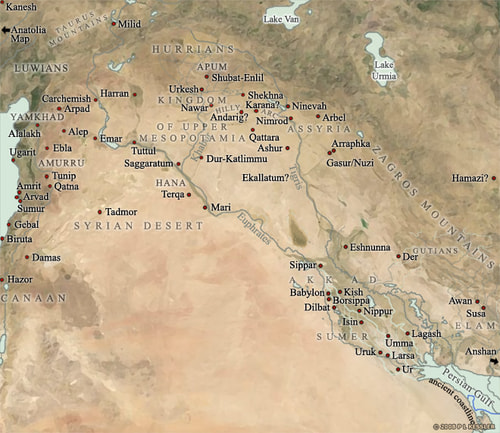
- Eridu
- Bad-tibira
- Larsa
- Sippar
- Shuruppak
The cities established after the flood were:
Citation – Mark, J. J. (2019, October 09). Early Dynastic Period (Mesopotamia). World History Encyclopedia. Retrieved from https://www.worldhistory.org/Early_Dynastic_Period_(Mesopotamia)/
2900-2334 BCE – Early Dynastic Period (Mesopotamia)

- The Early Dynastic Period of Mesopotamia is the modern-day archaeological term for the era in Mesopotamian history – 2900-2334 BCE – during which some of the most significant cultural advances were made including the rise of the cities, the development of writing, and the establishment of governments.
- This era was preceded by the Uruk Period (4100-2900 BCE) when the first cities were established in the region of Sumer (southern Mesopotamia) and succeeded by the Akkadian Period (2334-2218 BCE) when Mesopotamia was conquered by Sargon of Akkad (r. 2334-2279 BCE) and ruled by him and his successors as the Akkadian Empire.
Citation – Mark, J. J. (2019, October 09). Early Dynastic Period (Mesopotamia). World History Encyclopedia. Retrieved from https://www.worldhistory.org/Early_Dynastic_Period_(Mesopotamia)/
Mesopotamian Science and Technology developed during the Uruk Period (4100-2900 BCE) and Early Dynastic Period (2900-1750 BCE) of the Sumerian culture of southern Mesopotamia. The foundation of future Mesopotamian advances in scientific/technological progress was laid by the Sumerians who first explored the practice of the scientific hypothesis, engaged in technological innovation, and created the written word, developed mathematics, astronomy and astrology, and even fashioned the concept of time itself.
Citation – Mark, J. J. (2019, October 11). Mesopotamian Science and Technology. World History Encyclopedia. Retrieved from https://www.worldhistory.org/Mesopotamian_Science/
Hurrians and Mitanni Empires’ Influence

by Simeon Netchev
- The Hurrians began appearing as a distinct cultural and linguistic group in northern Mesopotamia and the Zagros Mountains during the Middle Bronze Age.
- Hurrians in the Mitanni Empire (ca. 1550–1350 BCE): The Mitanni Kingdom emerged as a Hurrian-dominated political entity, with its peak spanning northern Syria and southeastern Anatolia.
- By the 12th century BCE, the Hurrians largely disappeared as a distinct group, their territories absorbed into rising powers such as the Assyrian Empire.
