From Searching for the “Original” Bible. Do the Dead Sea Scrolls help? By Emanuel Tov
Were the nations divided according to the number of the sons of God? Did God have sons? (Deuteronomy 32:8)
The first 43 verses of Deuteronomy 32 comprise the beautiful poem of Moses. Deuteronomy 32:8 in the King James Version reads: “When the Most High divided to the nations their inheritance, when he separated the sons of Adam, he set the bounds of the people according to the number of the children of Israel.”
“The Most High” then divides the nations according to the “number of the children of Israel” of which there were “70” (the number of the descendants of Jacob who went down to Egypt). That is, the number of the nations equaled the number of the children of Israel. Each of the 70 nations had its own god. In the next verse we read that YHWH, the personal name of the God of Israel, received Israel as “his portion.” There seems to be no connection, however, between the number of the nations of the world and the number of the children of Israel.
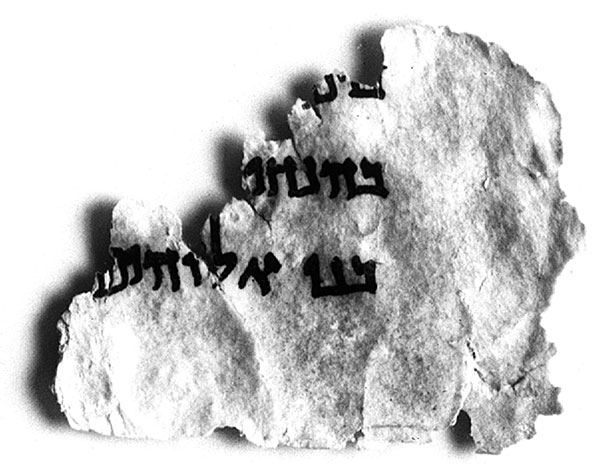
We should therefore take a serious look at a different reading found in the Qumran scroll 4QDeutj; according to that text, the nations were divided “according to the number of the sons of Elohim (God).” In this reading, which is also reflected in the Septuagint, “the Most High” divided the nations according to the number of the sons of Elohim. This reading seems more logical than that of the Masoretic Text. It seems even more logical that the original text referred to the Canaanite god El rather than the Israelite Elohim. In its probable original wording, reconstructed from 4QDeutj1 and the Septuagint, the Song of Moses originally referred to an assembly of the gods in which “the Most High (‘Elyon) fixed the boundaries of peoples according to the number of the sons of the God (El).” The next verse stresses that the Lord, YHWH, kept Israel for himself. Within this supposedly original context, ‘Elyon and El need not be taken as epithets (appellations) of the God of Israel, but as names of the gods known from the Canaanite and Ugaritic divine assembly.
This obviously bothered a scribe of an early text, now reflected in the Masoretic Text; he did not feel at ease with this polytheistic picture and replaced “sons of El” with “the sons of Israel,” thus giving the text a different direction by the change of a single word. Another scribe, the source of the Qumran scroll, changed El to Elohim, God, which is a natural development since both words are used in Hebrew texts as “God.” If this reasoning is correct—it is no more than speculation—a Qumran fragment together with the Septuagint helps us to recover the original text in one important detail, but one that may be embarrassing to a modern reader (and even to ancient ones), referring as it does to the division of the nations according to “the sons of God.”
Tov, Emanuel. “Searching for the ‘Original’ Bible,” Biblical Archaeology Review 40.4 (2014): 48–53, 68.
