See the very good article from BAS When the Sons of God Cavorted with the Daughters of Men by Ronald S. Hendel, Summer 1987. The PDF is in his directory in Dropbox. Dr. Hendel speaks of much more than the title implies. He shows how the Hebrew relates to similar Canaanite stories as well as how later translators changed the text to not use “the sons of God”.
In addition, see The Nephilim and the Sons of God, Unlike Hercules, Achilles, and Perseus, demigods were seen more negatively by ancient Israelites by John Drummond, in BAS November 27, 2025
The intro paragraphs are inserted below.
If someone asked you to name the origin of a story about gods who take human wives and then give birth to a race of semidivine heroes, you might answer: It’s a Greek myth, or perhaps a Norse legend, or maybe a folktale from Africa or India. Surely this story couldn’t come from the sacred scriptures of Judaism and Christianity. Or could it?
In fact, it is one of the seldom-told stories in the Hebrew Bible. The passage from Genesis 6:1–4 is short enough to quote in full:
“When mankind began to multiply on the face of the earth, and daughters were born to them, the Sons of Goda saw that the daughters of men were beautiful, and they took wives of them, from any whom they chose. And Yahweh said, ‘My spirit will not be strong1 in man forever, for indeed he is but flesh. His lifetime will be 120 years.’ The Nephilim were on the earth in those days, and also afterwards, when the Sons of God mated with the daughters of men and they bore children for them: these were the heroes of old, the men of renown.”
For thousands of years this story has scandalized readers of the Bible, and for good reason. The story appears to go against the grain of our traditional understanding of biblical religion.
The article speaks to the issue of “Sons of God” and “Sons of Israel” in relation to translation issues where the translators appear be to hiding what they did not agree with.
…
The contradiction does not appear in all Bibles, however. Look at the Revised Standard Version (RSV), for example. There we read in Deuteronomy 32:8 that the borders of the peoples (or nations) are fixed, not according to the number of the sons of Israel, but “according to the number of the Sons of God.” This reading is based on the Greek Septuagint, a Bible translation made in the third century B.C. for Jews living in Alexandria who could not read Hebrew. The modern RSV translators decided that in this case the Septuagint, rather than the received Hebrew text (known as the Masoretic text), has preserved the original reading.5 Bible translations that adhere to the received Hebrew text, however, read “sons of Israel” instead of “Sons of God.”
“Sons of God” in Aramaic Deuteronomy fragment suggests that “Sons of Israel” in received Hebrew text was later substitution to “clean up” the story.
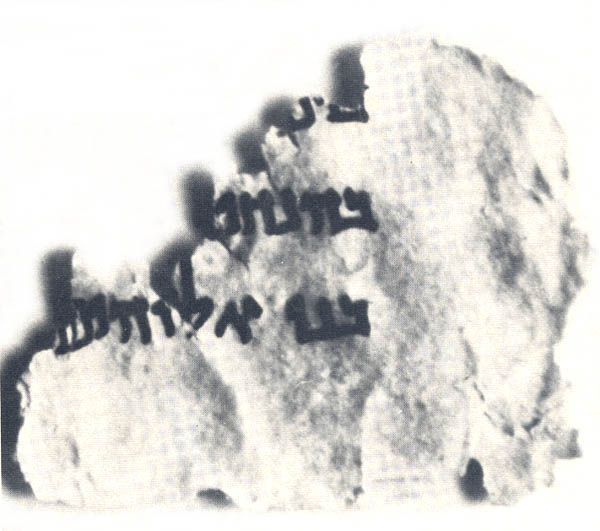
Recently a fragmentary text from among the Dead Sea Scrolls was found to contain Deuteronomy 32:8. Written in late Herodian script (late first century B.C. to early first century A.D.), this fragment is now our earliest Hebrew text of Deuteronomy 32:8; the last phrase in the verse in this fragment clearly reads “the Sons of God,” not “the sons of Israel.” This reading, preserved in Greek in the Septuagint but not in the received Hebrew text, seems rather clearly to be the authentic original reading.
Apparently, somewhere along the line in the transmission of the standard rabbinic Bible someone felt the need to clean up the text by literally rewriting it and substituting “sons of Israel” for the original “Sons of God” in Deuteronomy 32:8.
Now that we have established the correct text of Deuteronomy 32:8, we can use it to complete our portrait of the Sons of God. According to this passage in Deuteronomy, the Sons of God were not only present at the beginning of the world, but also figured importantly in the division of the nations. According to the following verse, Yahweh chose Israel as his own portion, implying that each of the other deities, the Sons of God, also received a nation to rule over. This would make sense of the division of the nations according to the number of the Sons of God. We can see in this passage an indication that the Sons of God at one time played a far more important role in the early history of humanity than is generally remembered in the biblical traditions.
[Note to Self: Likely then Jesus’ reading of Deuteronomy 32:8 would have been the “Sons of God” and he could have viewed himself as one of them.]
…
In the myths, epics and ritual texts from Ugarit, the phrase “the Sons of God” (banuµ Õili or banuµ Õili–mi) occurs frequently. In the Canaanite pantheon, the chief god is El, whose name literally means “God.” He and his wife Asherah are the father and mother of the gods. The phrase “the Sons of God” can be translated literally as “the Sons of El.”
The beûneÆ ÕeµliÆm are found not only in Ugaritic texts, but also in Phoenician inscriptions of the eighth to seventh centuries B.C.6 and in an Ammonite inscription of the ninth century recently found in Amman, Jordan.7 So the concept of the Sons of God pervades Canaanite lore over an extended period of time.
The Canaanite roots of the Sons of God allow us a glimpse into the antiquity of these figures and make it clear that these are indeed divine beings. The Israelite use of the term derives from the body of traditional lore inherited from the Canaanites. The concept of the Sons of God as well as the stories about them doubtless goes back to Canaanite time.
In Israelite tradition the Sons of God are the lesser deities who accompany Yahweh in his heavenly assembly.8 Their sphere of activity is restricted in comparison to that of their Canaanite forebears; this, of course, is due to the fact that in Israelite worship Yahweh had subsumed the essential functions of the other gods. Only in a few passages are the activities of the Sons of God prominent. These passages, especially Genesis 6:1–4 and Deuteronomy 32:8, reflect traditions that are quite early. Indeed, these two passages would be quite at home among the Ugaritic mythological texts, except that the chief god is Yahweh rather than El!
…
The Genesis flood occurs to punish human evil, to redress a cosmic imbalance.
In the story in Genesis 6:1–4, the divine response to the cosmic imbalance represented by the Sons of God mating with the daughters of men is likewise to limit human lifespan: “My spirit will not be strong in man forever [says Yahweh in Genesis 2:3], for indeed, he is but flesh. His lifetime will be 120 years.”
The punishment a decree of a limited lifespan, is directed at humans, however, not at the Nephilim.
…
Closing Paragraph — The stories proceed in a dialectical fashion, generating oppositions and resolving them, all the while sketching a transition from a mythical “nature” to human “culture,” from an era when humans are naked and immortal to an era of clothing, mortality, hard labor and nations—the era of the present world. Genesis 6:1–4 fits snugly into this context—the repetition of mythological transgressions of boundaries and the slow building up of the limitations of the human world.
MLA Citation
Hendel, Ronald S. “When the Sons of God Cavorted with the Daughters of Men,” Bible Review 3.2 (1987): 8–13.
