This post contains Claude.ai’s summary of the BAS article “Tell Qasile: Harbor Town from the Days of the Judges“ by Amihai Mazar, Biblical Archaeology Review 52.3, 2026. Amihai Mazar is Professor Emeritus in the Institute of Archaeology at the Hebrew University of Jerusalem. During his career, he has led many excavations, including at Tell Qasile. Tell Qasile shows a Philistine-founded community that rapidly merged with Canaanite culture, evident in its eclectic cult objects, temple design, and houses. Its cause of destruction and political status remain uncertain.
Overview
Mazar presents Tell Qasile, a small Iron Age I port town on the Yarkon River in modern Tel Aviv, as a case study in how Philistine immigrants lived outside the major Philistine cities and how they interacted with local Canaanites.
Site and History
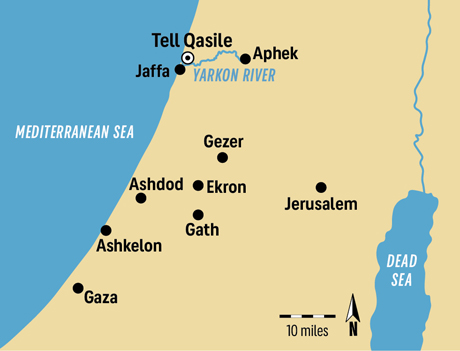
- Founded in the second half of the 12th century BCE, the town flourished for over 150 years, coinciding with the biblical period of the Judges and early monarchy. Its biblical name, if any, is unknown.
- The location, about a mile from the Mediterranean, offered one of the few natural river ports on the southern Levantine coast.
- Benjamin Mazar began excavations in 1948, the first academic dig in the State of Israel. Amihai Mazar’s 1970s-80s excavations uncovered the sacred area and more residential structures.
- Excavators concluded the Philistines founded the town, based on Philistine-style painted pottery in the earliest strata.
The Temples (Strata XII-X)
- Three successive small temples were built atop one another, none larger than ordinary houses. They varied considerably in plan, suggesting no fixed temple tradition, yet kept the same orientation and holy-of-holies position.
- Stratum XII: a simple mudbrick single-room building with a raised platform and a courtyard used for animal sacrifice and ritual meals.
- Stratum XI: a new temple with a niche as its holy of holies, a room of offerings (ivory cosmetic box, beads, a Triton shell trumpet), and an added small shrine. A later favissa pit held a female-shaped libation vessel and a lion-shaped cup in Philistine style.
- Stratum X: the largest temple, with two cedar columns (probably imported from Lebanon), plastered benches, and a raised cultic platform. Finds included an Egyptian-style ceramic shrine model with two female figures, bird-decorated offering bowls, cylindrical stands, a hippopotamus-faced “trick vase” similar to Cypriot examples, and pomegranate vessels.
- The deity or deities worshiped are unknown because no inscriptions were found. The cult objects blend Philistine, Cypriot, and Canaanite traditions, often with original forms.
- Unlike many isolated Canaanite temples, these stood within the residential quarter, suggesting priests and temples were more integrated into daily life.
Domestic Architecture and Society
- Early houses had raised central hearths, a Philistine type with Aegean/Cypriot roots and a marker of Philistine origins.
- Stratum X houses were mostly “four-room” types, which Mazar argues were not an Israelite ethnic marker but a regional “fashion of the day” suited to agrarian conditions.
- Philistine painted pottery, hearths, cult figurines, and pork consumption (per an unpublished faunal study) point to Philistine founding. Over time the Philistine and Canaanite populations intermingled into a blended, apparently egalitarian community, since house sizes were similar.
Economy and Politics
- The town likely traded with Philistia, early Israelite hill settlements, Egypt, Phoenicia, and Cyprus.
- Mazar prefers to see it as an independent community of farmers and merchants, though domination by Gezer or a Philistine city can’t be ruled out.
Destruction and Aftermath
- Around 1000 BCE the town was destroyed by a human-caused fire. Benjamin Mazar proposed David’s conquest of the Jaffa/Yarkon region, but the Bible doesn’t mention such a campaign, so the cause is uncertain.
- Mazar notes that the imported cedar columns lend modest support to the biblical accounts of cedar arriving via Jaffa for Solomon’s Temple (1 Kings 6; 2 Chr 2:15), though he calls 2 Chronicles a late source of doubtful historicity.
- The town was rebuilt on a smaller scale, the temples were abandoned, and the site was finally abandoned in the early 9th century BCE.
Sidebar: “The Qasile Ostraca: Solomonic Shipments or Fantastic Forgeries?” (Marek Dospěl)
Two ostraca reportedly found on the surface in 1945-46 mention oil shipments “belonging to the king” and “gold of Ophir” belonging to Beth-Horon. If genuine, they would document the site’s administration under Judah. However, their script and language raise authenticity doubts. They are two of only three inscriptions from the site, the third (a seal) is almost certainly a modern forgery, and the same person was reportedly involved in finding at least two, possibly all three.
Key Takeaway
Tell Qasile shows a Philistine-founded community that rapidly merged with Canaanite culture, evident in its eclectic cult objects, temple design, and houses. Its cause of destruction and political status remain uncertain.
