This post is follow up to the post and Genesis 49-50 with scholar’s insights into the cave, whose buried there, and more.
Prompt to ChatGPT: In Genesis 49, Jacob wants to be buried in Machpelah. Where is that?
Response: Machpelah is traditionally identified with a burial cave at Hebron, in the southern hill country of Canaan—roughly 30 km (19 miles) south of Jerusalem.
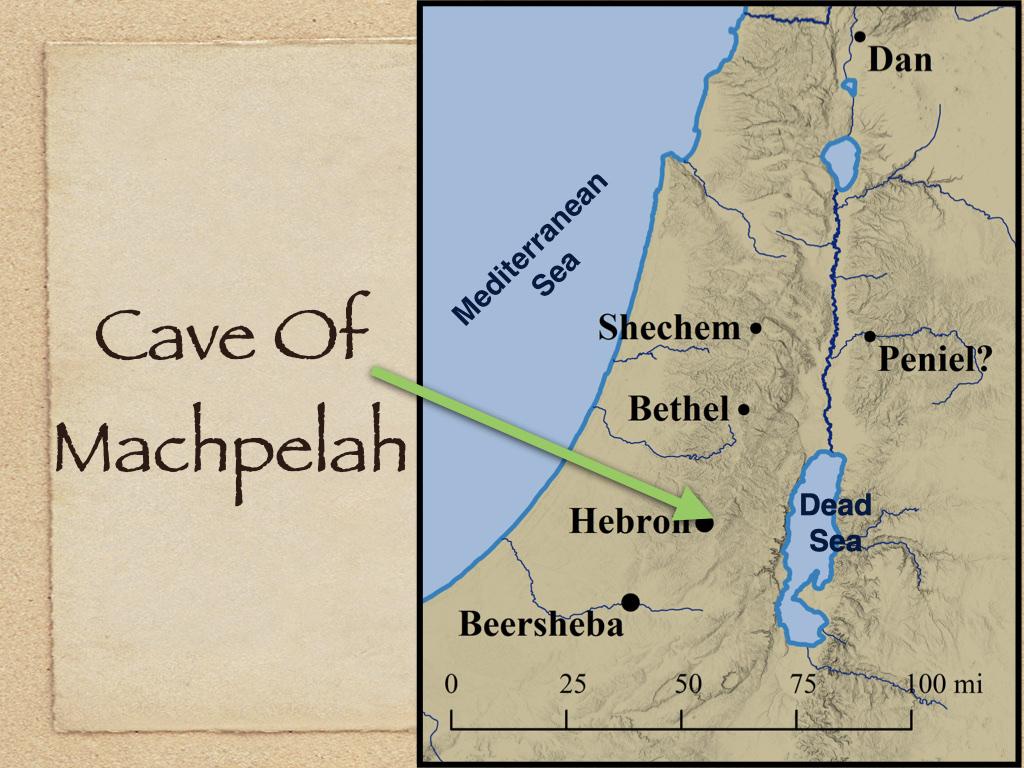

What Genesis says about its location
Genesis 49 gives a surprisingly precise chain of geographical identification:
“Bury me with my fathers in the cave which is in the field of Ephron the Hittite, the cave which is in the field of Machpelah, before Mamre, in the land of Canaan…”
— Genesis 49:29–30, ASV
It then identifies the occupants:
- Abraham and Sarah
- Isaac and Rebekah
- Leah
- and now Jacob — Genesis 49:31; 50:13. (Bible Gateway)
Genesis 23 provides the original purchase story. Abraham buys the field and cave of Machpelah from Ephron the Hittite specifically as a family burial place. Genesis 23:19 says Sarah was buried there at Mamre, “which is Hebron.” (Bible.org)
So the biblical geographical sequence is essentially:
Canaan → Hebron → Mamre → field of Machpelah → cave
Where is it today?
The traditional location is in the heart of modern Hebron (al-Khalil), in the West Bank. The site is enclosed by the massive Herodian-period structure now known as the Cave of the Patriarchs / Haram al-Khalil, which contains the Ibrahimi Mosque and a synagogue area.
The actual cave is underneath the structure and is not ordinarily accessible for archaeological examination. The identification of the modern site with the biblical Machpelah is therefore traditional rather than archaeologically demonstrated. The name Machpelah occurs only in Genesis, and the biblical text itself doesn’t give modern coordinates. (Bible Gateway)
An important point for your Genesis 49–50 question
There is an interesting source-critical issue here that fits directly with the questions we’ve been examining about Genesis 48–50.
Genesis 49:29–33 and 50:12–13 present one version:
Jacob → instructs all his sons → burial in Machpelah → sons carry him to Canaan → bury him there.
But Genesis 50:1–11 presents another narrative in which:
Jacob → Joseph organizes the funeral → Egyptians accompany the procession → they stop at Goren-ha-Atad → extensive mourning occurs → Joseph returns to Egypt.
A number of critical scholars understand these as two originally distinct traditions that have been combined by the final editor of Genesis. In particular, the Machpelah burial instructions and their fulfillment are commonly associated with the Priestly (P) material, while the Goren-ha-Atad account is associated with the non-Priestly/J tradition. David Ben-Gad HaCohen’s discussion summarizes this source-critical distinction particularly clearly. (TheTorah.com)
That means Machpelah isn’t merely a geographical detail in Genesis 49. It is part of the Priestly presentation of Jacob’s death that firmly connects Jacob—and therefore Israel—to Canaan and the ancestral burial place, even though the family has been living in Egypt.
And that becomes especially significant when Genesis 50 is read alongside Genesis 47–49.
Prompt: Where was Joseph buried?
Joseph is said to have been buried in Shechem, in the hill country of central Canaan—not in the family tomb at Machpelah.
Genesis ends with Joseph’s bones being carried out of Egypt:
“And Joseph took an oath of the children of Israel, saying, God will surely visit you, and ye shall carry up my bones from hence.”
— Genesis 50:25, ASV
Then, much later, Joshua 24:32 reports:
“And the bones of Joseph, which the children of Israel brought up out of Egypt, buried they in Shechem, in the parcel of ground which Jacob bought of the sons of Hamor the father of Shechem…”
— Joshua 24:32, ASV
Where is Shechem?
Shechem was located in the central hill country of Canaan, between Mount Gerizim and Mount Ebal, at the site of modern Nablus.
There is an important geographical connection here:
| Burial | Location | Biblical significance |
|---|---|---|
| Abraham & Sarah | Machpelah, near Hebron | Ancestral burial place |
| Isaac & Rebekah | Machpelah | Ancestral burial place |
| Jacob | Machpelah | Rejoins ancestors |
| Joseph | Shechem | Joseph’s special connection to his family’s earlier Canaanite territory |
Why Shechem is particularly interesting

Joseph’s burial at Shechem is significant because Genesis 33:18–19 says Jacob purchased land at Shechem from the sons of Hamor. Joshua 24:32 explicitly identifies that property as the place where Joseph’s bones were buried.
So there is a deliberate geographical distinction:
Jacob → Machpelah/Hebron
Joseph → Shechem
That fits something we’ve been seeing in Genesis 48–50: Joseph’s story is increasingly connected to the future territorial identity of Israel in Canaan. Ephraim and Manasseh inherit Joseph’s status as tribes, while Joseph himself ultimately comes to rest at Shechem.
There is also a fascinating chronological issue: Genesis never actually tells us that Joseph was buried at Shechem. It only says that Joseph made the Israelites swear to take his bones with them. The specific burial at Shechem appears in Joshua 24:32, which is a later Israelite tradition. Critical scholars therefore treat the relationship between the Genesis Joseph tradition and the Joshua account as an important question of literary development and tradition history.
If you want, I can also explain why Joseph is buried at Shechem rather than Machpelah, and what critical scholars think that tells us about the different Israelite traditions behind Genesis and Joshua.
Yes. This opens up a particularly interesting source-critical issue, because Joseph’s burial at Shechem may preserve a different geographical tradition about the patriarchal family from the one represented by Genesis 49–50’s Machpelah account.
The basic distinction
The final biblical story gives us two different burial locations:
- Jacob: Machpelah near Hebron — Genesis 49:29–33; 50:12–13.
- Joseph: Shechem — Joshua 24:32.
Genesis does not say Joseph was buried at Shechem. Instead, at his death Joseph makes the Israelites swear:
“God will surely visit you; and ye shall carry up my bones from hence.”
— Genesis 50:25, ASV
Joshua then supplies the conclusion:
“And the bones of Joseph, which the children of Israel brought up out of Egypt, buried they in Shechem…”
— Joshua 24:32, ASV
Joshua explicitly connects the burial plot with land Jacob had purchased from the sons of Hamor, making it an inheritance of Joseph’s descendants. (Bible Gateway)
Why Shechem matters
Shechem isn’t an arbitrary location. It is one of the most important places in the northern Israelite tradition.
Genesis 33:18–19 says that Jacob came to Shechem and purchased a parcel of land there. Genesis 48:22 then has Jacob give Joseph a particular piece of land at Shechem:
“Moreover I have given to thee one portion above thy brethren…”
— Genesis 48:22, ASV
The Hebrew word translated “portion” is shekem, which is also the name Shechem. Scholars have therefore discussed whether Genesis 48:22 contains a deliberate wordplay connecting Joseph with Shechem. A recent scholarly treatment notes that the term can mean “shoulder” or “portion,” while its association with the place-name Shechem is also possible. (MDPI)
So there is a coherent geographical chain:
Jacob → purchases land at Shechem → gives Joseph a portion there → Joseph’s descendants inherit it → Joseph’s bones are eventually buried there.
That is quite different from the Hebron/Machpelah tradition.
The really interesting critical-scholarship issue
Some scholars have argued that there may once have been an older northern patriarchal tradition centered on Shechem, in which Jacob and Joseph were particularly associated with that location.
One scholarly reconstruction, discussed in a University of California Press study, proposes that an older Jacob tradition placed Jacob and Joseph at Shechem, while a later Priestly tradition increasingly centralized the patriarchal burials at Hebron/Machpelah. The study specifically notes the tension between the Shechem tradition and the Hebron tradition. (UC Press E-Books Collection)
This would help explain something you’ve been noticing in Genesis 48–50:
| Tradition | Important location | Patriarchal emphasis |
|---|---|---|
| Shechem/northern tradition | Shechem | Jacob and Joseph |
| Hebron/Judah tradition | Machpelah | Abraham, Isaac, Jacob |
| Final Genesis | Both | Integrates the traditions |
| Joshua | Shechem | Joseph’s bones and Josephite inheritance |
I would emphasize that this is a scholarly reconstruction, not an established fact. The biblical texts as we have them deliberately preserve both locations.
There is an especially revealing problem in Genesis 50
Genesis 50:13 says:
“And his sons carried him into the land of Canaan, and buried him in the cave of the field of Machpelah…”
— Genesis 50:13, ASV
But Genesis 50:25–26 immediately ends the book with Joseph’s bones still in Egypt, awaiting the future return to Canaan.
So the two endings have a striking structural contrast:
Jacob:
Egypt → elaborate procession → Canaan → Machpelah
Joseph:
Egypt → embalmed → coffin → awaits future return to Canaan
Then Joshua completes Joseph’s story:
**Egypt → Exodus → Canaan → Shechem
That makes Joseph’s burial almost a literary bridge between Genesis and Joshua. Joshua 24:32 deliberately takes up the unfinished business of Genesis 50. Modern translations and notes also explicitly cross-reference Genesis 50:24–25 and Joshua 24:32 for this reason. (Bible Gateway)
And there’s an even bigger implication
This may help explain why Joseph’s story and Jacob’s story don’t simply culminate at the same sacred site.
Jacob’s burial at Machpelah emphasizes:
“I belong with Abraham and Isaac and the ancestral family.”
Joseph’s burial at Shechem emphasizes:
“My descendants belong to the land that will become Joseph’s tribal territory.”
That distinction becomes particularly meaningful because Shechem is in the territory associated with Joseph’s descendants—especially Manasseh and Ephraim. Joshua 24:32 explicitly says the land became an inheritance of Joseph’s descendants. (Bible Gateway)
So I would read the final Genesis–Joshua sequence this way:
Abraham → Machpelah → ancestral identity
Isaac → Machpelah → ancestral identity
Jacob → Machpelah → ancestral identity
Joseph → Shechem → territorial/tribal identity
And that distinction fits remarkably well with the transition from Genesis, the book of the ancestors, to Joshua, the book of Israel possessing the land.
There is also a fascinating complication: Acts 7:15–16 appears to confuse or combine the Genesis/Joshua burial traditions, saying that Jacob and the patriarchs were brought back to Shechem and buried in the tomb Abraham bought. That creates another layer of evidence for how different Jewish traditions understood these patriarchal burials. (Bible Gateway)
If we’re following the Genesis 48 → 49 → 50 → Exodus 1 thread we’ve been examining, this makes Joseph’s burial location especially important: Shechem may be one of the clues to an older northern Israelite layer underneath the final Genesis narrative.
