The italicized text below are extracts from the very good post here by Ephraim Stern titled the same as this post. The pdf of that post is embedded at the bottom of this page.
His post discusses at length:
- other places of worship outside the Jerusalem temple despite the king’s rulings.
- the different names of the deities and
- the similarities between the consorts’ names and common paraphernalia used in worship.
- Presents locations where Yaweh’s female consort is cited in ancient artifacts.
Opening paragraph – The Bible imagines the religion of ancient Israel as purely monotheistic. And doubtless there were Israelites, particularly those associated with the Jerusalem Temple, who were strict monotheists. But the archaeological evidence (and the Bible, too, if you read it closely enough) suggests that the monotheism of many Israelites was far from pure. For them, Yahweh (the name of the Israelite god) was not the only divinity. Some Israelites believed that Yahweh had a female consort. And many Israelites invoked the divinity with the help of images, particularly figurines. I call this Israelite religion pagan Yahwism.
While Yahweh was the god of the Israelites, other nations had their own national gods. [Bullet formatting below is by this web guy.]
- The chief god of the Phoenicians was Ba‘al.
- For the Philistines, the chief god was at first Dagon and later also Ba‘al (Judges 16:23; 2 Kings 1:2).
- For the Ammonites it was Milkom.
- For the Moabites, Chemosh.
- For the Edomites, Qos.
- And for the Israelites and Judahites—Yahweh.
- Except for the Edomite god Qos, who appears only in the archaeological record, all of these gods are mentioned in the Bible (1 Kings 11:5, 7, 33).
Interestingly, while each nation’s chief god had a distinctive name, his consort, the chief female deity, had the same name in all these cultures: Asherah or its variants Ashtoreth or Astarte. (As we shall see, this was even true of Yahweh’s consort.)
Not only was the female consort the same, the various nations used the same cult objects, the same types of incense altars made of stone and clay, the same bronze and clay censers, cult stands and incense burners, the same chalices and goblets and the same bronze and ivory rods adorned with pomegranates. It was easy to take cult vessels of one deity and place them in the service of another one—and this was commonly done. For example, in the ninth-century B.C.E. stela erected by Mesha, the king of Moab, he describes himself as the “son of Chemosh,” and tells how he defeated the Israelites (see also 2 Kings 3:4–27). He then brags, “[I] took t[he ves]sels of Yahweh, and I hauled them before the face of Chemosh.”
Cult installation sites cited in the Bible and elsewhere:
- The Bible itself mentions sanctuaries at sites such as Dan, Shechem, Shiloh, Bethel and Beersheba,…
- A cultic installation dedicated to Yahweh must have existed at Judahite Nebo in Moab during the ninth century B.C.E.: In his stela, Mesha claims to have taken from Nebo the vessels of Yahweh that he later used in a sanctuary dedicated to the Moabite god Chemosh.
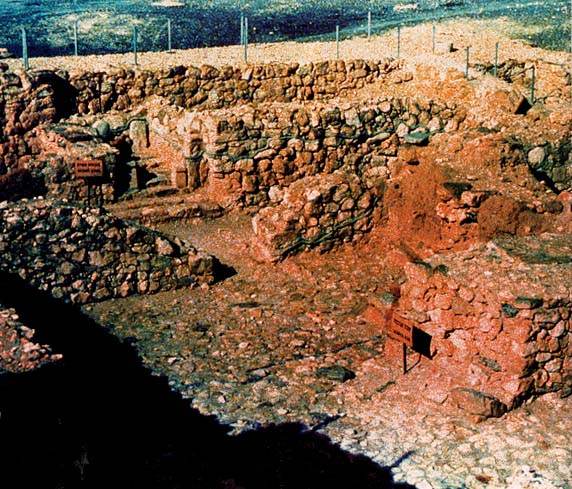
- A complete Judahite sanctuary has been uncovered in the fortress of Arad in southern Judah.a Despite scholarly disputes as to precisely when it was built and when it was destroyed, it is clear that the Arad sanctuary was in service simultaneously with the Jerusalem Temple and was probably in use during most of the monarchy. It consisted of three parts—a courtyard, a heikhal, or main hall, and a debir, or holy of holies, which was ascended by three steps. In the debir was a massebah, or standing stone. Two additional masseboth were embedded in the wall of the holy of holies. On the third step two limestone incense altars were found, with remains of burnt material on top, probably incense. In the temple courtyard stood a large animal altar. Other cult centers have been uncovered in Israelite Megiddo and Judahite Lachish, both dating to the tenth century B.C.E.
Cult installations have also been excavated in several Israelite and Judahite fortresses. One—at Vered-Jericho—was reported in these pages some time ago.b The excavator, Avi Eitan, interpreted the installation as a bamah, or high place. More recently, Itzhaq Beit-Arieh reported on cult platforms ascended by steps, found adjacent to the gates of two fortresses near Arad, ‘Uza and Radum.1 - In addition, a large four-horned altar and a bamah were excavated at Beersheba2. Stone stairs at the fortress of Mesad-Michmash, on Judah’s northern border, have been interpreted as leading up to a bamah.3
We are thus led to the inevitable conclusion that between the foreign pagan practices and the pure monotheism of Yahwism there existed a cult that may be called pagan Yahwism or perhaps more accurately, Yahwistic paganism. Of course in the background was the central monotheistic cult practiced in the Jerusalem Temple by its priests and preached by the Biblical prophets. And some of the kings of Judah—especially Hezekiah and Josiah—made efforts to centralize the monotheistic cult in Jerusalem. But looking at the archaeological evidence, we must conclude that they were less than 100 percent successful. Indeed, until the Babylonian destruction of Judah and the end of the Israelite monarchy in 586 B.C.E., pagan Yahwism was common even in Jerusalem, to say nothing of the rest of Judah.
MLA Citation
Stern, Ephraim. “Pagan Yahwism: The Folk Religion of Ancient Israel,” Biblical Archaeology Review 27.3 (2001): 21–29.
