This post contains Claude.ai’s 1,000-word summary of the article at BAS by Gabriel Barklay, published April 1986, here. The PDF copy is in the BAS directory in Dropbox.
The Garden Tomb: Was Jesus Buried Here? — Summary
Gabriel Barkay’s article examines the archaeological credentials of the Garden Tomb in Jerusalem, one of two sites competing for recognition as the burial place of Jesus, the other being the Church of the Holy Sepulchre.
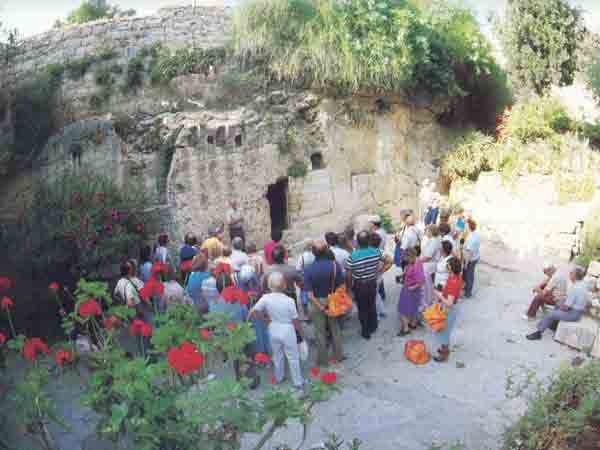
The Garden Tomb is a rock-cut burial cave located just north of Damascus Gate, outside the Old City walls. It was accidentally discovered in 1867 by a peasant and first reported by Conrad Schick, a Jerusalem-based European correspondent for several learned societies. Schick’s early account described it as simply another of Jerusalem’s many burial caves, filled with earth and human bones.
The site gained enormous notoriety in 1883 when General Charles George Gordon — a celebrated British military hero known for campaigns in China and the Sudan — arrived in Jerusalem and identified the nearby hill as Golgotha, the site of the Crucifixion described in the Gospels. Gordon’s identification rested on a fanciful vision of Jerusalem’s topography mapped onto a human skeleton, with the hill north of Damascus Gate representing the skull (Golgotha meaning “the skull” in Aramaic). Though Gordon apparently regarded the cave as Jesus’ tomb, he never directly mentioned it in his writings. His ideas were published posthumously in 1885, gaining widespread attention not for scientific merit but because of his heroic reputation and tragic death at Khartoum. The site became known first as “Gordon’s Tomb” and later the “Garden Tomb,” a name partly inspired by the reference to a garden near the burial site in John 19:41–42.
The debate over the tomb’s authenticity that followed was largely polemical rather than scientific. Protestants generally supported the Garden Tomb’s claim, partly because the Church of the Holy Sepulchre — crowded, dark, and controlled by Eastern Christian denominations — felt culturally alien to them and seemed implausibly located inside what appeared to be ancient city boundaries. Catholics defended the traditional site. In 1894, the Garden Tomb Association purchased the site for £2,000 and developed the peaceful walled garden that exists today. Various small excavations were conducted over the following decades, but their findings were poorly documented and the results were disputed.
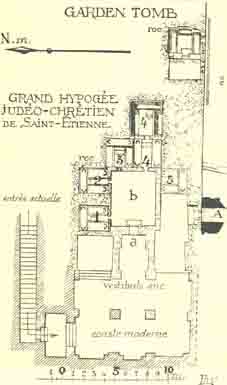
Barkay undertook a fresh archaeological investigation beginning in 1974, applying modern knowledge of burial cave typology to settle the question on scientific grounds. His conclusion is unambiguous: the Garden Tomb was originally hewn during Iron Age II, roughly the eighth to seventh centuries B.C., during the First Temple period. It was reused in the Byzantine period (fifth to seventh centuries A.D.) and therefore could not have served as the tomb of Jesus.
Several independent lines of evidence support this conclusion. [List formatting is mine]
- First, the cave’s layout — two chambers placed side by side rather than one behind the other — is a hallmark of Iron Age tombs, paralleled by the famous Royal Steward’s tomb in Siloam Village and others in Judah, but inconsistent with Second Temple-period burial practices.
- Second, the Garden Tomb lacks every defining feature of Second Temple tombs: there are no burial niches (kokhim), no arcosolia, no sunken floors, and no traces of the comb chisel characteristic of that era.
- Third, Barkay and Amos Kloner’s investigation of the nearby St. Étienne burial complexes confirmed those caves also date to the Iron Age, placing the Garden Tomb within the same ancient cemetery.
- Fourth, no Second Temple-period tomb has ever been found in this immediate area; by that era, Jerusalem’s cemeteries had shifted considerably northward, with the nearest known Second Temple tomb — the “Tombs of the Kings” — located some 600 meters away.
The cave’s inner chamber originally had three rock-cut burial benches arranged in a U-shape along the walls, a classic Iron Age configuration. In the Byzantine period, these benches were carved out to form trough-shaped sarcophagi, and Christian symbols — Greek crosses with the letters IS, CS, alpha, and omega — were painted on the walls in red, all consistent with fifth- or sixth-century Christian practice. Artifacts recovered from the site, including Iron Age oil lamps, a clay animal figurine, and a burnished bowl fragment, further corroborate the original Iron Age date. A channel cut outside the cave entrance — often cited by Garden Tomb advocates as the groove for the rolling stone mentioned in the Gospels — is identified by Barkay as a feature added during the Crusader period, when the area served as a stable complex.
Barkay concludes that the identification of the Garden Tomb as the burial place of Jesus reflects the cultural psychology and Protestant sensibilities of late nineteenth-century Jerusalem far more than any genuine archaeological evidence. The tomb’s serene garden setting continues to attract well over a hundred thousand visitors annually, but the science firmly places its origins in the Iron Age, centuries before the time of Jesus.
MLA Citation for the original article
Barkay, Gabriel. “The Garden Tomb: Was Jesus Buried Here?” Biblical Archaeology Review 12.2 (1986): 40–53, 56–57.
