Scripture Related to Earthquakes
Amos 1:1 The words of Amos, who was among the herdsmen of Tekoa, which he saw concerning Israel in the days of Uzziah king of Judah, and in the days of Jeroboam the son of Joash king of Israel, two years before the earthquake. ASV
Zechariah 14:5 And ye shall flee by the valley of my mountains; for the valley of the mountains shall reach unto Azel; yea, ye shall flee, like as ye fled from before the earthquake in the days of Uzziah king of Judah; and Jehovah my God shall come, and all the holy ones with thee.
1 Samuel 14:15 And there was a trembling in the camp, in the field, and among all the people; the garrison, and the spoilers, they also trembled; and the earth quaked: so there was an exceeding great trembling. [See third sub-bullet below – the battle at Michmash between Saul and the Philistines]
Extracts from BAR’s article Evidence of Biblical Earthquake Discovered in Jerusalem, Sites Across Israel Damaged by Eighth-Century B.C.E. Quake by Nathan Steinmeyer, August 10, 2021.
The quake is also referenced in Zechariah 14:5, where Zechariah compares the devastation wrought by the approaching end of days to the earthquake that shook Judah during the reign of King Uzziah. Given that Zechariah lived two centuries after Amos, the earthquake must have been extreme enough to leave a lasting impression on the Judean consciousness. Indeed, the IAA excavators believe it was “probably one of the strongest and most damaging earthquakes in ancient times.”
Evidence for this powerful eighth-century B.C.E. earthquake has now been discovered in several sites across modern Israel, including Hazor, Gezer, Tel Agol, and Tell es-Safi. The Jerusalem excavation, however, provides the first evidence that the quake impacted the Judean hill country as well.
A June, 2021 analysis of the evidence from the site of Tel Agol in the Jezreel Valley has shed further light on this momentous earthquake. The fortress of Tel Agol, first constructed in the tenth century B.C.E., allowed the Kingdom of Israel to control and watch over the strategic valley. Around the mid-eighth century, large sections of the fortress’s walls were destroyed by what the excavators concluded could only have been an earthquake. Although some sections were rebuilt, the fortress never regained its original prominence.
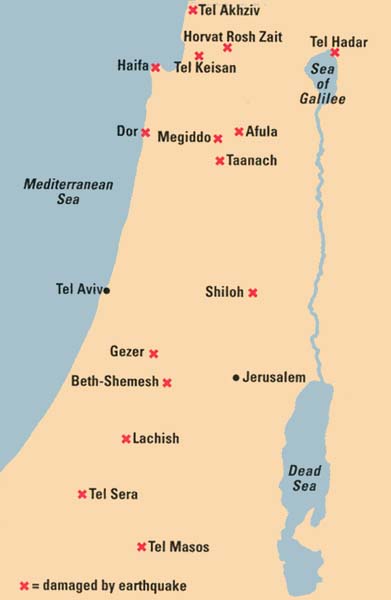
While the eighth-century earthquake itself is now well documented through archaeological evidence, each new discoveryprovides a fuller picture of the quake’s destructive power. The evidence shows that the quake wrought devastation from Hazor in the north to Tell es-Safi in the south, a swath of destruction more than 125 miles long—certainly a powerful and remarkable event that was remembered by the biblical prophets.
Earthquake! Inspiration for Armageddon by Amos Nur, Hagai Ron
Almost 200 of the approximately 400 archaeological sites excavated in Israel show possible evidence of earthquake destruction: fallen columns lying like parallel toothpicks, collapsed walls, crushed skeletons and slipped keystones as well as a regional pattern of destruction (see “How to Recognize an Earthquake”).
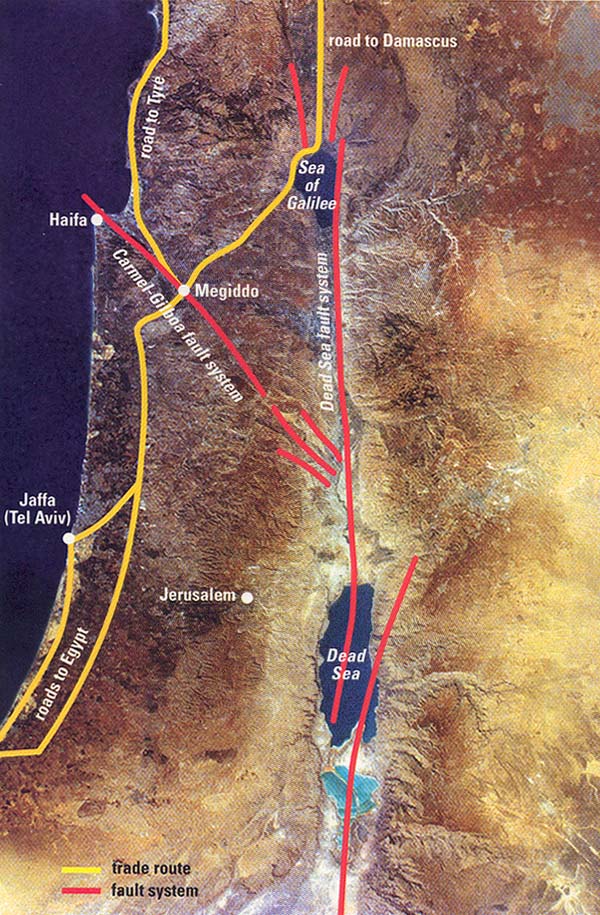
The mound of Megiddo stands at one of the most important topographic gaps in the ancient Near East, a gap that became a traffic bottleneck on the main route between Syria and Egypt. Until the advent of more elaborate road building by Rome, the gap at Megiddo, called the Nahal Iron Pass, was the only route that allowed chariots traveling on the route from Damascus to Egypt to pass through the Carmel-Gilboa mountain range. By controlling this route, Megiddo directed not only the course of trade in the Fertile Crescent but also the march of armies. As the Egyptian pharaoh Thutmose III (1504–1450 B.C.E.) put it, “The capture of Megiddo is the capture of a thousand towns.”1 Earthquake faults are thus responsible for Megiddo’s strategic importance: Traders and armies had no alternative to passing through the gap created at Megiddo.
The strategic topography around Megiddo is created by active faults that cross northern Israel.
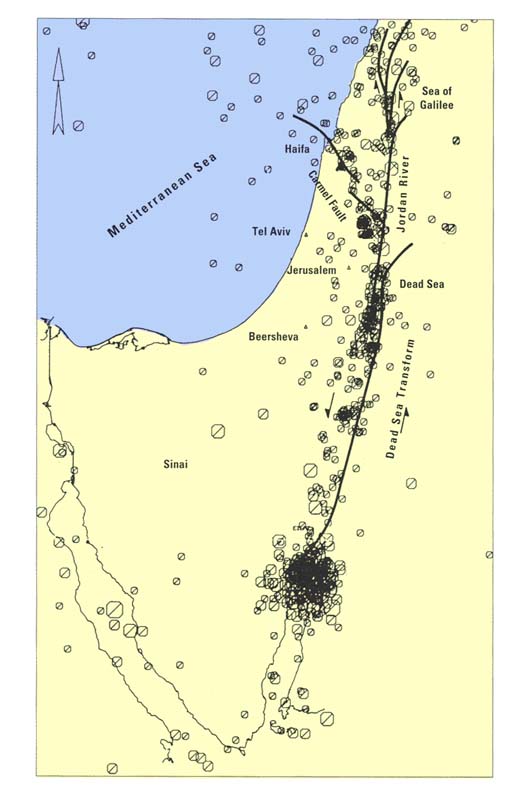
The Carmel-Gilboa faults are only a branch of a longer and, with respect to fault motion, more significant Dead Sea fault system. This system, like the San Andreas in California, accommodates the motion between two plates—the Arabian plate to the east and the Mediterranean plate to the west. The slight separation of the plates here created the Jordan Valley and the Dead Sea depression (which also blocked ancient traffic, thus further enhancing the strategic importance of the Megiddo gap). This contrasts with the Carmel-Gilboa faults, which created a mountain range where the plates are pushed together.
The historical records indicate that there have been no fewer than 11 devastating earthquakes in the Holy Land since 1400 B.C.E.2
These earthquakes occurred in c. 1400 B.C.E., c. 1250 B.C.E., c. 1020 B.C.E., c. 760 B.C.E., 31 B.C.E., 363 C.E., 749 C.E., 1202 C.E., 1546 C.E., 1859 C.E. and 1927 C.E.
- At Megiddo, at least four major destruction levels remain unaccounted for in the prevailing historical record. We believe that three of these layers were caused by earthquakes. These three destruction layers date to between the Late Bronze Age (1550–1200 B.C.E.) and Iron Age I (1200–1000 B.C.E.), precisely when Israel began to emerge in Canaan as a people.
- The first layer, separating Megiddo Stratum IX from the later Stratum VIII, has been tentatively dated to about 1400 B.C.E.c Was this destruction caused by Israelite invaders, as some have suggested? The Bible gives no indication that the Israelites conquered Megiddo. The British archaeologist Kathleen Kenyon, who excavated at Jericho and in Jerusalem, attributed this thick destruction layer to the armies of Thutmose III.3 But we believe an earthquake caused the damage.
- A later destruction level (between Stratum VIIA and Stratum VIB) dates to about 1250 B.C.E. This sudden and total destruction left behind a layer of debris 4 feet deep. Although this destruction has been attributed, alternatively, to both the Israelites and the Philistines, strong evidence suggests that an earthquake caused the devastation—as Graham Davies of Cambridge University has suggested on the basis of fallen walls at Megiddo and the contemporaneous destruction of many other nearby sites.4 On top of this debris was built an unwalled, poorly constructed settlement. This pattern of sudden destruction followed by hasty rebuilding is also characteristic of earthquakes.
- A third, very violent destruction, found in Stratum VIA, dates to between 1130 and 1000 B.C.E. Some archaeologists have attributed this destruction to a conquest of Megiddo by King David’s army. But neither the Bible nor any other text refers to such a battle. It seems far more likely that an earthquake was responsible, as the late archaeologist Aharon Kempinski suggested.5 Indeed, both the enormity of the damage in this destruction level and contemporaneous damage at sites as far south as Tel Masos (near Beer-Sheva) and as far north as the Sea of Galilee suggest that a massive earthquake was responsible. Perhaps this was the earthquake that occurred during the battle at Michmash between Saul and the Philistines (1 Samuel 14:15). The anthropological evidence also suggests that this third, massive destruction level may have been caused by an earthquake.
The most compelling archaeological evidence of destruction by earthquakes is crushed skeletons under collapsed structures. Because the dead are not normally buried under rubble, this evidence is accepted even by those archaeologists who otherwise dismiss earthquakes as important causes of destruction.
Skeletons crushed under fallen walls have been found in many archaeological sites—at Jericho (about 1400 B.C.E.), Beth She‘arim (363 C.E.), Petra (363 C.E.) and Beth-Shean (749 C.E.), to name only a few.
In 1992 the smashed skeleton of a woman (named Doreen by the excavators) was unearthed at the coastal town of Dor, 20 miles west of Megiddo. According to excavator Ephraim Stern, who lives in earthquake-sparse Jerusalem, “[The] woman whose head had been crushed by a stone [was] apparently a casualty of battle.”d But Andrew Stewart, a Dor archaeologist who lives in earthquake-prone California, suggests that Doreen was a victim of an earthquake, not a battle.e His hypothesis is supported by bone-fracture analysis performed by physical anthropologist Patricia Smith, at Hadassah Medical Center in Jerusalem, which indicated that Doreen’s entire body had been crushed suddenly.
Doreen died in about 1020 B.C.E. Contemporaneous devastation has been uncovered at numerous sites in Israel [see map below]. We believe that they were all destroyed by a single earthquake—either on the nearby Carmel fault (with a magnitude of 5.5 to 6.5) or on the more distant Dead Sea fault (with a magnitude of 6.5 to 7.5).
From ChatGPT
Here is a list of Bible verses related to earthquakes, categorized by context:
Old Testament (ASV)
- Natural Disasters & God’s Power
- Exodus 19:18 – “And mount Sinai, the whole of it, smoked, because Jehovah descended upon it in fire: and the smoke thereof ascended as the smoke of a furnace, and the whole mount quaked greatly.”
- Psalm 18:7 – “Then the earth shook and trembled; The foundations also of the mountains quaked And were shaken, because he was wroth.”
- Psalm 77:18 – “The voice of thy thunder was in the whirlwind; The lightnings lightened the world: The earth trembled and shook.”
- Psalm 97:4-5 – “His lightnings lightened the world: The earth saw, and trembled. The mountains melted like wax at the presence of Jehovah, At the presence of the Lord of the whole earth.”
- Judgment & Prophecy
- Isaiah 13:13 – “Therefore I will make the heavens to tremble, And the earth shall be shaken out of its place, In the wrath of Jehovah of hosts, And in the day of his fierce anger.”
- Isaiah 24:19-20 – “The earth is utterly broken, the earth is rent asunder, the earth is shaken violently. The earth shall stagger like a drunken man, and shall sway to and fro like a hammock; and the transgression thereof shall be heavy upon it, and it shall fall, and not rise again.”
- Ezekiel 38:19-20 – “For in my jealousy and in the fire of my wrath have I spoken, Surely in that day there shall be a great shaking in the land of Israel; so that the fishes of the sea, and the birds of the heavens, and the beasts of the field, and all creeping things that creep upon the earth, and all the men that are upon the face of the earth, shall shake at my presence…”
- Joel 2:10 – “The earth quaketh before them; the heavens tremble; The sun and the moon are darkened, And the stars withdraw their shining.”
- Haggai 2:6 – “For thus saith Jehovah of hosts: Yet once, it is a little while, and I will shake the heavens, and the earth, and the sea, and the dry land;”
New Testament (NRSV)
- At Christ’s Death & Resurrection
- Matthew 27:51 – “At that moment the curtain of the temple was torn in two, from top to bottom. The earth shook, and the rocks were split.”
- Matthew 28:2 – “And suddenly there was a great earthquake; for an angel of the Lord, descending from heaven, came and rolled back the stone and sat on it.”
- Book of Acts
- Acts 4:31 – “When they had prayed, the place in which they were gathered together was shaken; and they were all filled with the Holy Spirit and spoke the word of God with boldness.”
- Acts 16:26 – “Suddenly there was an earthquake, so violent that the foundations of the prison were shaken; and immediately all the doors were opened and everyone’s chains were unfastened.”
