The below information was extracted from the Bible Nerds forum at BSA. Emphasis is by this web guy.
OP is Joseph Nobles.
Next Quest for the Historical Jesus: “Armies and Soldiers” by Christopher B. Zeichmann (pp. 284-297), March 28, 2025.
Despite a prevalent focus on military forces and members in the primary texts of the New Testament, scholars almost never discuss the subject in detail. They are certain it was a negative force in the lives of the people, and yet there are positive interactions again and again throughout the texts.
“In this chapter, I would like to suggest briefly two ways the study of the historical Jesus might benefit from recent advances in the study of the militaries of the eastern Mediterranean. First is the counterintuitive insight that there is no monolithic ‘Roman army.’ Rather, there were a variety of military forces in early Roman Palestine – forces that had little in common by way of purpose and demographics. Civilians, including New Testament evangelists and likely the historical Jesus, were cognizant of these distinctions and held differing opinions about such forces, unlike the modern tendency to homogenize them under the aegis of a singular ‘Roman army.’ Second, there has been extensive archaeological work on fortlets, forts, road stations, and other sites where Palestinian solders were located. Discussion of these sites is often monadic, such that their broader significance in relation to each other is unclear. How might we understand the military networks of Palestine in a comparative perspective? What might this indicate about their role in Jesus’s life and death?”
There were three main groups of soldiers in Palestine during the time period. The first and best known were the legionaries. They were “employed by Rome itself. Their allegiances were to the emperor and whichever general they served,” and they were Roman citizens before they were recruited. They almost always spoke Latin and “garrisoned in major imperial cities such as Syria, Belgica, Pannonia, and post-war Judea.” However, the historical Jesus may never have encountered a legionary since they had no reason to be in Galilee or Judea before the first Jewish revolt.
Instead, auxiliaries were the Roman forces Jesus and his followers would have met in Judea or the Decapolis. They roughly equaled the number of legionaries throughout the Empire, but were noncitizens who joined in expectation of becoming a Roman citizen after retirement. They were also recruited from the provinces in which they served, particularly (in the case of Judea) from cities like Caesarea Maritima and Sebaste. In other words, “they were locals.” Only after the first Jewish revolt would these auxiliaries be sent elsewhere in the empire and foreign auxiliaries imported in. They were “significantly less Romanized than legionaries: auxiliary soldiers spoke the lingua franca of Greek along with local languages (e.g., Aramaic).” This means “the soldiers that crucified [Jesus]” were locals.
Finally, there were “royal forces that did not directly serve Rome but were under the authority of a client king.” Many client kingdoms maintained their own armies like “Nabatea, Antipas’s Galilee, and Agrippa I’s Judea.” These soldiers had no expectation of becoming Roman citizens and in Galilee would have been recruited in “Sepphoris and Tiberias …or mustered from rural areas,” and would have spent their entire military careers right in the area (unless lent to Rome for the occasional need close by). The “centurion in Capernaum (Luke 7:1-10)” would have been a royal soldier, as would any soldier he “encountered in Batanea, Perea, and Galilee.
In short, “a unified military structure …did not exist at the time.” Simon James has demonstrated “there was not even a word that communicated the notion of a single, monolithic military in the early Common Era” in Latin, and the same is true of Greek. “Soldiers understood themselves to be clients of their specific general, and individual generals likewise understood themselves to be patrons of their soldiers.” On becoming citizens, soldier commonly chose a name to “align themselves with their generals.” No emperor could even envision being patron of the entire military. Seeing a unified military is a modern anachronism.
In fact, once scholars are aware of the distinctions being made in the New Testament texts, they will need to “attend to the politics of military representation” to guard against the texts’ biases on display concerning different groups of soldiers. Luke especially presents Antipas’s royal soldiers as “capricious and cruel (Luke 23:11)” compared to Pilate’s auxiliaries. The centurion in Capernaum (Matt 8:5-13; Luke 7:1-10) is often cited as Jesus interacting with an avatar of Rome. Matthew and/or Luke may have viewed him thus through an anachronistic lens, but the real centurion could have only been “the principality of a Herodian tetrarch” historically. The same is true of the demons who called themselves Legion in Mark 5:1-10, set in the Decapolis when it was a client kingdom ruled through the power of royal soldiers. “…such subtexts, if they are indeed present in Mark’s Gospel, do not represent Jesus’s politics but must result from a postwar tradition.” The rout of Antipas’s royal soldiers by Aretas in 37 CE also suggests a force more accustomed to policing rather than fighting wars.
Both Josephus and the Christian Gospels give the impression that the military was an urban phenomenon in Galilee and Judea, confined to the largest cities like Caesarea Maritima and Jerusalem. This is flatly contradicted by the archaeological evidence. Rather, the vast majority of soldiers were located in small rural garrisons and seemed to have served as more of a patrolling force than the sort of occupying power they are commonly imagined to be.
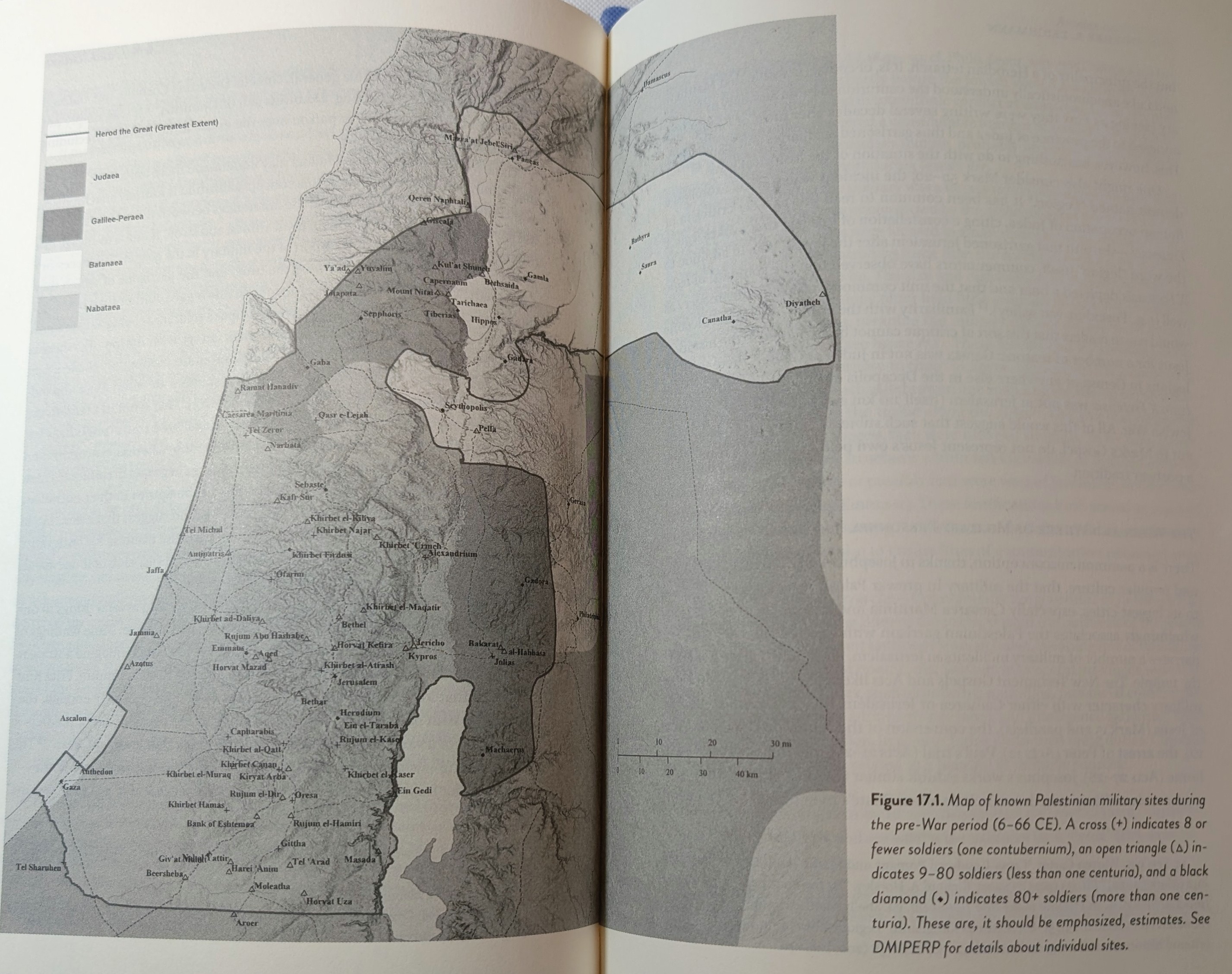
Both Galilee and Judea were relatively peaceful during the time of Jesus, so these soldiers “were typically assigned to other duties, such as policing, patrolling, provincial construction projects (e.g., road paving), administrative labor, and intelligence gathering.” Josephus tells of how Pilate had his auxiliaries infiltrate the demonstrators during the aqueduct incident. [For details see post at this site here] Also, though we only have textual evidence of patrols monitoring foot traffic after the first Jewish revolt, “this was likely practiced before the war as well (see. e.g., Josephus, BJ 2.224-227; AJ 20.105-112).” This would have served at least three purposes relevant to historical Jesus research: “(1) to maintain peace in the province; (2) to mitigate possible rebellions; and (3) to implement policy changes that might have occurred after Varus’s disaster in the battle of the Teutoburg Forest.” Dealing with threats within the territory in question was the main focus of these soldiers, not threats from without. “Strabos in his Geographica implies that Hasmonean tolerance of brigandage was the impetus for Rome’s (temporary) annexation of Judea in the first place.”
In 9 CE, the Roman governor Varus lost three legions, many auxiliary units, and his own life when a failure of intelligence allowed “Germanic tribes united under Arminius” to gain the upper hand in the Teutoburg forest. Rome’s response was empire wide (three legions out of 28 total at the time was a catastrophe). Varus had once been governor of Syria, the closest high-level Roman authority in the area of Judea, and the extensive militarization of the Judean countryside with locally sourced auxiliaries was no doubt intended to maintain intelligence gathering and military communications post-Teutoburg.
“This might prompt us to consider the sine qua non of the historical Jesus: his death by crucifixion at the hands of auxiliaries garrisoned in Judea. It is likely that Pilate had gathered some degree of intelligence regarding Jesus before their encounter in Jerusalem. This supposition is further reinforced by the fact that the Roman administration partially relied on reports from allies for intelligence on enemies and troublemakers beyond their borders. Herodian rulers are a case in point, bearing close relationships with the emperors and their subordinates. In thinking of the historical Jesus, we might not only inquire what kind of person would be crucified, but what kind of person might warrant such intelligence gathering in the eyes of Pilate and the Herodians?”
Disclaimer: The contents of this post are not my original work. I [OP] am summarizing the essays in the recent book Next Quest for the Historical Jesus.
