Below is ChatGPT’s summary of the good article at BAS “How Bad Was Jezebel?” by Janet Howe Gaines (Sept. 18, 2025)
Her shorter article in 2010 is here.
The article “How Bad Was Jezebel?” by Janet Howe Gaines (Sept. 18, 2025) re-examines the biblical portrait of Queen Jezebel and argues that her infamy owes more to the Deuteronomistic historian’s agenda than to clear evidence of depravity.
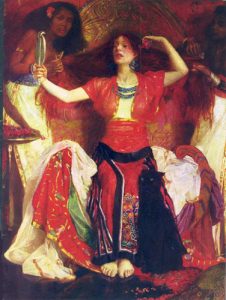
• Biblical Frame – Jezebel, a Phoenician princess married to King Ahab (1 Kings 16:31), appears in scattered passages of 1–2 Kings, part of the Deuteronomistic History whose purpose is to explain Israel’s downfall as punishment for idolatry. As a foreign queen who promotes Baal and Asherah worship, she becomes a convenient symbol of everything the writer wants Israel to reject.
• Religious Conflict – Jezebel remains loyal to her native gods and encourages Ahab to tolerate Baal, provoking the famous Mt. Carmel showdown (1 Kings 18). Elijah slaughters her prophets, yet the narrator condemns only Jezebel’s killings, revealing a double standard.
• Political Context – Her marriage to Ahab was shrewd foreign policy, linking Israel and Phoenicia for trade and security. Raised in an autocratic culture, she expects royal prerogative; this may explain, though not excuse, her orchestration of Naboth’s judicial murder to secure a vineyard (1 Kings 21).
• Character and Voice – Unlike most biblical women, Jezebel speaks boldly, threatens Elijah (1 Kings 19:2), and taunts Jehu as “Zimri, murderer of your master” (2 Kings 9:31). Charges of sexual immorality (2 Kings 9:22) are unsubstantiated; the text itself never shows her as unfaithful.
• Death and Legacy – Knowing Jehu will kill her, she dresses regally, paints her eyes, and confronts him from a window—read as either flirtation or defiant “war paint.” Thrown to her death and eaten by dogs (2 Kings 9:33–37), she nevertheless dies with dignity. Later tradition and even modern culture (e.g., the film Jezebel) amplify accusations of harlotry and sorcery.
• Assessment – The Deuteronomist heaps blame for Israel’s apostasy on Jezebel and excuses Ahab: “There never was anyone like Ahab … at the instigation of his wife Jezebel” (1 Kings 21:25). Gaines argues that, seen without this bias, Jezebel was a formidable, loyal, and courageous queen—foreign, outspoken, and religiously independent, qualities that made her the perfect villain for a monotheistic, patriarchal narrative.
