See the post here with a Claude.ai summary of Morna Weeks’ paper (in DropBox) about Tyndale and his translation. She is a translator and relates the issues they face.
This post contains a summary of a good, historically oriented post as linked. Below that are ChatGPT responses with more info about Tyndale and his translation. In addition:
- For an in-depth treatment, see Professor Morna Hooker’s Tyndale as Translator here. That is the full text of the seventh annual Hertford Tyndale Lecture 19 October 2000. In that extensive work, she says:
- We shall find that the gravest charge brought against Tyndale in his lifetime was not that he was deficient in his understanding of the Greek and Hebrew languages, but that he was a heretic, and had introduced heretical teachings into his translation. It was not the last time that a translation would be condemned outright because of the suspect views of those who produce it. As recently as 1952, in the USA, opponents of the RSV sought to undermine it by accusing its translators of being communists or communist sympathisers; their allegations were treated with the utmost seriousness by Senator Joseph McCarthy.[9]“
- See the post at this site, Tyndale, Shakespeare, and the KJV.
ChatGPT’s Executive Summary of: “William Tyndale & the Translation of the Bible into English” by Russel (June 02, 2025)
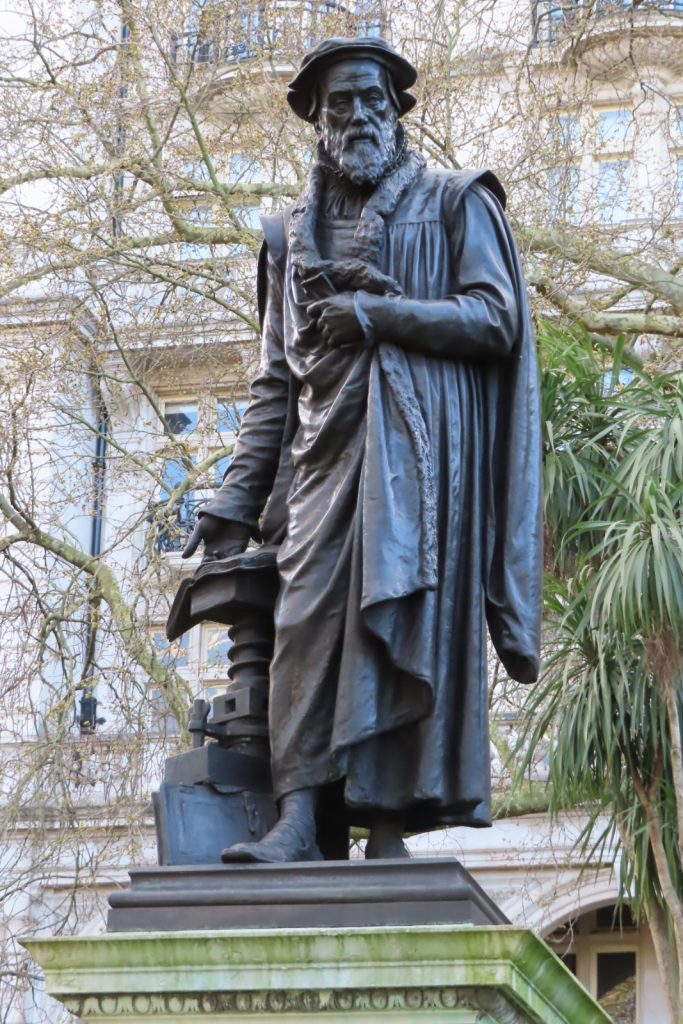
This article commemorates the 500th anniversary of William Tyndale’s translation of the Bible into English, highlighting his groundbreaking role in making Scripture accessible to common people and shaping the English language itself.
William Tyndale, born around 1494 in Gloucestershire, studied at Oxford and Cambridge, becoming fluent in several languages. At Cambridge he encountered the ideas of the Protestant Reformation, likely through Erasmus’s Greek New Testament and reform-minded scholars at the White Horse Inn.
Motivated by the conviction that Scripture should be understood by everyone, Tyndale declared, “I will cause a boy that drives the plough to know more of the Scripture than you do.” After failing to gain official support in England, he went to continental Europe in 1524, where he translated the New Testament directly from Greek. His translation, first printed in 1526 at Worms, introduced many enduring English phrases such as “fight the good fight of faith,” “scapegoat,” and “my brother’s keeper.”
Tyndale’s translation philosophy emphasized both faithfulness to the original Hebrew and Greek and clear English sense, breaking from the Latin Vulgate’s influence on Catholic teaching. Despite being banned and burned in England, his work spread widely through smuggling.
While in exile, Tyndale opposed King Henry VIII’s annulment of his marriage, a stance that increased his danger. Betrayed in 1535, he was imprisoned at Vilvorde and executed in 1536, praying, “Lord, open the King of England’s eyes.”
Ironically, within two years, Henry VIII authorized an English Bible in every church. Tyndale’s translation formed the backbone of later English Bibles, including the 1611 King James Version, which retains about 84% of his New Testament and 76% of his Old Testament phrasing.
In summary:
Tyndale’s linguistic skill, reformist zeal, and courage transformed English Christianity. His translation democratized access to Scripture, defied institutional control, and left an enduring imprint on English faith and language.
Here’s a summary of what critical/academic biblical scholars (and related historians) have said about William Tyndale and his translation work — the strengths, limitations, and debates.
What scholars praise about Tyndale
- Faithfulness to the original languages
- Tyndale went back to Hebrew and Greek sources rather than relying only on the Latin Vulgate. This “return to sources” (ad fontes) is viewed as a major positive move in Reformation translation and exegesis. (Christian Study Library)
- He was concerned with textual accuracy, revising his translation in several editions. Scholars note that he tried to balance what was in the source texts with what would be “proper English.” (tyndale.org)
- Influence on English language & literature
- Tyndale had a deep, lasting influence: many phrases he coined or popularized (e.g. “Let there be light,” “my brother’s keeper,” “fight the good fight”) have passed into ordinary English usage. (Religious Studies Center)
- His translation helped shape what we now call Modern English in terms of syntax, cadence, vocabulary. (SAGE Journals)
- Translation philosophy & style
- Tyndale’s aim was to make Scripture understandable to common people. Scholars note his attempts to use idiomatic, everyday English where possible. (tyndale.org)
- Scholars also observe that he was influenced by rhetoric (classical), not simply linguistic technique — wanting the text to persuade, to move readers. (Society for Classical Studies)
- His work is seen as pioneering in putting “the people” in direct contact with Scripture, not mediated through clergy or in a language few could understand. (Christian Study Library)
- Legacy and cumulative impact
- It’s often argued (and demonstrated via textual analysis) that a large portion of the King James Version’s New Testament (and a significant portion of its Old Testament) is drawn directly (in phrasing, vocabulary, cadence) from Tyndale’s work. (United Church of God)
- Because of this, Tyndale is often called “the father of the English Bible” or its foundational figure. (Christian Study Library)
What scholars criticize or view as limitations/debates
- Translation choices & potential bias
- Tyndale made some choices in wording that were theologically loaded. Examples: choosing “congregation” instead of “church,” “elder” for “priest,” etc. These choices reflect Protestant theological leanings (Reformation-era concerns) and thus can be criticised as moves away from traditional (Catholic) usage. (Christian History Institute)
- Some critics (historical and modern) accuse him of introducing bias, whether in marginal notes or choice of prefaces, or of “Lutheranizing” certain texts. (Christian History Institute)
- Linguistic limitations
- Because Tyndale was working in the early 1500s, manuscript evidence was more limited; some of his source texts might have had variants or lacunae that later more complete manuscripts or better textual criticism have clarified. Thus, some “errors” or less optimal readings stem from the state of textual knowledge in his day. (Christian History Institute)
- English itself was less standardized; spellings, grammar, vocabulary, idioms varied significantly, which sometimes leads modern readers to perceive Tyndale’s English as archaic or awkward in places. There was also the challenge of rendering Hebrew or Greek semantic ranges into English, which doesn’t always have exact equivalents. (Religious Studies Center)
- Reception & authority issues
- Because Tyndale’s translation was unauthorized and at times suppressed, widespread formal acceptance was delayed, creating controversies over his authority, orthodoxy, and legal standing. (Catholic Answers)
- Critics like Thomas More raised concerns that translating Scriptures into vernacular might lead to mistranslation, misinterpretation, and error among lay readers who might lack training. Some of these concerns were theological, some social. (Studentshare)
- Balance of accuracy vs idiomatic readability
- Translators (including Tyndale) have always had to balance how literal or how idiomatic to be. Some scholars think Tyndale sometimes leaned toward rendering sense over literal structure, which could occasionally blur detail. On the other hand, being too literal could make the text clumsy or incomprehensible. (tyndale.org)
- Modern readers especially, whose English is many centuries removed from 16th-century speech, may find difficulties in comprehension, even though Tyndale was aiming for contemporary language of his time. (tyndale.org)
Scholarly disagreements/areas of debate
- Exactly how many “errors” or mistranslations there were — and whether they were accidental (due to limited manuscript base, linguistic challenge, etc.) or deliberate (theological motive). Some Catholic writers have accused him of thousands of errors; others say such claims are inflated, and that many so-called errors are matters of translation philosophy. (Updated American Standard Version)
- The precise degree of his influence on later English translations (beyond King James): which exact phrases, where influence is direct, where later translators diverged from Tyndale’s wording or theology. While many pick KJV as carrying over a lot, scholars differ in how “faithful” the continuation is. (United Church of God)
- How to assess the trade-off between readability/clarity for the lay reader and fidelity to the original. Some scholars argue Tyndale did very well; others say in places clarity suffers & that his aids (marginal notes, prefaces) sometimes push readers toward particular doctrinal interpretations. (Christian History Institute)
William Tyndale was executed in 1536 for heresy — specifically, for translating the Bible into English and for promoting beliefs that opposed key teachings of the Roman Catholic Church.
Here’s the breakdown of the official and practical charges according to historical and critical sources:
1. The formal charge: heresy under Church and imperial law
Tyndale was arrested in Antwerp (1535), imprisoned at Vilvorde Castle near Brussels, and tried under the jurisdiction of the Holy Roman Empire (ruled by Emperor Charles V). His trial followed the procedures of the Inquisition, and he was convicted of heresy for:
- Unauthorized translation of Scripture into the vernacular (English) without Church approval.
- Possession and distribution of those translations in England and the Low Countries.
- Teaching and writing doctrines contrary to Roman Catholic orthodoxy.
2. The specific doctrinal accusations
According to court and ecclesiastical records summarized by John Foxe (Acts and Monuments, 1563) and later historians such as David Daniell (William Tyndale: A Biography, 1994), the main theological accusations included:
- Denying purgatory.
- Rejecting prayers to saints.
- Questioning the doctrine of confession and penance.
- Teaching justification by faith alone.
- Declaring that salvation came through Christ alone, not through the mediation of the Church or priesthood.
- Translating Scripture without Church authority, which was prohibited by the 1408 Constitutions of Oxford (also called Arundel’s Constitutions).
3. Sentence and execution
After being found guilty, Tyndale was degraded from the priesthood and condemned as a heretic.
- He was strangled (garroted) at the stake and then burned.
- Eyewitness and later Protestant sources (Foxe, 1563; Daniell, 1994) record his final prayer:
“Lord, open the King of England’s eyes.”
4. Scholarly summary
Critical historians agree that while the official charge was heresy, the underlying cause was his challenge to Church control of Scripture and doctrine. Tyndale’s English Bible translation undermined clerical authority by allowing ordinary people to read and interpret Scripture themselves, which was seen as a direct threat to the medieval Church’s theological monopoly.
David Daniell (Yale University Press, 1994) writes: “Tyndale was burned not because of immorality, politics, or treason, but because he made the Bible available to every Englishman who could read. In that act, the old world of the Church’s control was broken forever.”
In short: William Tyndale was executed in 1536 for heresy, chiefly for translating and distributing the Bible in English and for promoting Reformation doctrines that rejected papal authority, purgatory, and the sacramental system.
