From his book The God We Never Knew: Beyond Dogmatic Religion To A More Authentic Contemporary Faith. Below those extracts is one of his videos and the transcription.
The transcendence of God refers to God’s “going beyond” the universe, God’s otherness, God as more than the universe. God’s immanence, on the other hand, means God’s presence in everything or nearness to everything. Immanence means to dwell with or within, as its Latin root manere suggests (from which, for example, we also get “mansion”). The immanence of God thus means the omnipresence of God. The two root concepts of God I have described in this chapter are the product of different ways of emphasizing transcendence and immanence. Supernatural theism emphasizes only God’s transcendence and essentially denies the immanence of God. God is other than the world and separate from the world. God is “out there” and not here. Panentheism affirms both the transcendence and immanence of God. It does not deny or subordinate one in order to affirm the other. For panentheism, God is both more than the universe and yet everywhere present in the universe.
Borg, Marcus J.. The God We Never Knew: Beyond Dogmatic Religion To A More Authentic Contemporary Faith (pp. 26-27). HarperCollins. Kindle Edition.
Pantheism affirms only God’s immanence and essentially denies God’s transcendence; though the sacred is present in everything, it is not more than everything. But panentheism affirms both transcendence (God’s otherness or moreness) and immanence (God’s presence). God is not to be identified with the sum total of things. Rather, God is more than everything, even as God is present everywhere. God is all around us and within us, and we are within God.
Borg, Marcus J.. The God We Never Knew: Beyond Dogmatic Religion To A More Authentic Contemporary Faith (pp. 32-33). HarperCollins. Kindle Edition.
Simply and compactly, “panentheism” means “everything is in God.” The universe—everything that is—is in God, even as God is “more” than the universe.
Borg, Marcus J.. Days of Awe and Wonder: How to Be a Christian in the Twenty-first Century (p. 38). HarperCollins. Kindle Edition.
Extract from Mystical Experiences of God by Marcus Borg / July 1, 2010.
But after these experiences, mystical texts became luminous. I recognized in them what I had experienced.
The effect was to transform my understanding of the word “God.” I began to understand that the word does not refer to a person-like being “out there,” beyond the universe – an understanding of “God” that ceased to be persuasive in my teens and twenties.
I began to understand that the word “God” refers to “what is” experienced as wondrous and compelling, as, to use William James’ phrase, “the more” which is all around us. Or to use a phrase from the New Testament, the word “God” refers to “the one in whom we live and move and have our being” (Acts 17.28). “God” is not a hypothesis, but a reality who can be known.
Thus, to argue about whether God exists seems to me to be based on a misunderstanding of what the word points to. If “God” means a person-like being “out there,” completely separate from the universe, then I am an atheist. I do not believe there is such a being. But if the word “God” points to a radiance that pervades “what is,” as I now think – then, of course, God is real. Not just the God of Christianity, but the God of all the enduring religions.
Originally posted on The Washington Post website.
The following text was transcribed on 11/1/2025 from the above video.
To say the obvious God is one of the big words in the Christian tradition and it matters greatly how we think about it can make the whole notion of God credible, or right on the edge of being incredible, and it will very much affect what we think the Christian life is about.
And as I think about the word God, it seems to me there are two central questions. The first is, what is the referent of the word God? What do we have in mind, what do people have in mind when they say or hear the word God? And the second big question about God is, what is God like? And I’m going to talk about both of those.
Let me begin with the referent of the word God, what we think the word refers to. And here there are two primary understandings of that word in the Christian tradition, but also in the other religions as well.
I grew up with the first of those and basically lived with that first understanding for roughly the first 30 years of my life. And in real shorthand, I thought the word God referred to a being. Now, a super being, to be sure, but a person-like being, somehow separate from the universe, even if also in some ways related to the universe. And I thought of this super being as all-powerful, all-knowing, loving, thought of God as an authority figure, as a lawgiver who also loved us, and as somebody who occasionally intervened, certainly in the great events of the past, as recorded in the Bible, but also perhaps in lives even today.
Now, a shorthand name for that way of thinking of God is supernatural theism, but that’s just shorthand for God is a being. And when I was a child, I took all of this for granted, that this is what the word God meant, and it didn’t create any problems for me, except occasional fear, perhaps. It’s like a very big parent with a very big stick.
And it was only in my teenage years that I began to wrestle with, gosh, is there really a being like that? And in my twenties, the wrestling kind of subsided because I lapsed into what I would call a very comfortable and contented agnosticism, just not knowing. And I still found the study of all of this absolutely fascinating, so it didn’t mean I lost interest in this subject. It’s just I wasn’t sure at all that there was anything to the notion of God.
And then in my early thirties, that all changed, and I came to think of God very differently. So, this is the second understanding of the referent of the word God. In very compact language, I began to think of God as the encompassing reality, or if you will, the encompassing spirit. But when I use the word spirit, I don’t mean something completely separate from the world. Rather, I see the world as infused with that spirit.
So, in language from the Book of Acts, I began to think of God as the one in whom we live and move and have a being, that we are in God like fish are in water. Now, the water is also in the fish, but the really important thing is that the fish are in the water.
And I came to this understanding not through intellectual effort primarily, but through a series of experiences in my early thirties that I now recognize as mystical experiences. But that’s simply a way of saying experiences in which, in my case, I saw whatever I was looking at, the same landscape or the same room. In one case, the same inside of an airline cabin.
And it was as if there was light shining through everything. Everything became luminous. And it was radiant but soft all at the same time. And I also experienced a kind of falling away of those sharp boundaries between the self and the world that marks our everyday ordinary consciousness. And these experiences were accompanied by just amazement and wonder and a sense that I was seeing more clearly than I ever had in my life. They were also full of joy. I could have lived in that state of consciousness forever. I would never have gotten old, I don’t think.
The longest of them went on for about 40 minutes. Most of them were much, much shorter than that. One was maybe a couple minutes. The other is maybe even just 15 seconds, 30 seconds or something like that. And it was then that I realized that what I call and what others call the mystics of all the religious traditions, they call these experiences, such as the one that I had had, experiences of God or the sacred.
And suddenly for me, the word God referred to something that was manifestly real. And I don’t think I’ve ever doubted the reality of God ever since those experiences. It’s like, you know, somebody asked me, do I believe in God? It’d be like asking me, do I believe in elephants? You know, it’s not a matter of believing. It’s like, yeah, elephants are, yeah.
Anyway, when we do think of God as a word, a name that points to this wondrous reality that is all around us and that we live within, all of the intellectual problems associated with that first understanding of God basically disappear. It’s no longer a question of, is there a being whom we might call God? The question becomes, what are we going to call this? You know, is this something ordinary or is this something sacred, utterly wondrous?
The other big question about God is, what is God like? What is God’s character and passion, to use a way of putting it that I’ve grown fond of? It’s the same question as the older way of putting the question, what is the nature and will of God, the character and passion of God? What is God like? What is God passionate about? And again, to speak autobiographically for a moment, I think there are basically two ways of thinking about what God is like.
One is that God is punitive. And as I think back in my childhood, this is the God I grew up with, even though there was all this language about God loves us, Jesus loves us. I was a Lutheran and so we talked about grace a lot. But I also learned that we couldn’t take God’s love for granted. And if we didn’t respond in the right way, whether that was believing certain things or behaving in certain ways or earnestly repenting or whatever, that God might in fact punish us and might punish us forever, send us to hell.
I think any form of Christianity that talks about the possibility of hell basically sees God as punitive, no matter how much the language of grace is also used.
The other way of thinking of God’s character and passion is with familiar words like God is gracious, God is compassionate, God loves not just us but the whole of creation. I mean, think of how John 3.16 opens, For God so loved the world.
And these two ways of thinking of God’s character, what God is like, punitive or gracious, I think they basically produce two different kinds of Christianity, two different kinds of religion, both using Christian language.
One is fear-based. We better get it right, again, whether that’s about belief or behavior or both.
And the other invites us into a life that is essentially free from fear, a life of deeper relationship with a reality that has given us life, that sustains us in life. So, it matters greatly how we think of God.
I am utterly convinced that there is evil in the world. I don’t like those philosophies or visions of Christianity that suggest that if we could just see everything with utter clarity, we would see that everything makes sense. No, I think there is undeserved human misery, horrific things happen in history.
But I think the problem of evil as a problem for taking God seriously basically disappears if we let go of the notion of intervention. I do ask for things when I pray. I ask for help for myself. I ask for protection for family and friends. I do that not because I think God might intervene because I’ve asked or that God might forget to intervene because I didn’t ask, but I do that because it seems an utterly natural expression of caring for family and friends, an utterly natural expression of my own dependence upon God for energy and presence and my very existence for that matter. When I pray, I address God as if God were a person.
I don’t talk to God as if God is right here. I don’t say things like, “Oh, ever-present spirit in whom we live and move and have our being”. I don’t dislike that language. But I will regularly speak to God as Lord or speak to God, as I’ve already said, as if God is a person right here because I think my relationship to God is personal. Even though I don’t think of God as a person. So for me, the language of personification, by which I mean simply personifying God as if God were a person, is utterly natural.
And when I reflect back on my childhood, I think what began to happen is that I began to literalize those personifications, which then led to God as a person-like being, separate from other beings like we are separate from other beings and so forth. So for me, personal language in prayer and worship seems utterly natural. I’m going to say the next thing almost pastorally, not to you in particular, Ashley, but just because it seems appropriate here.
And that image of faith as being like floating in water or floating in air, though that’s a bit harder for us to imagine for ourselves. But we all know what it’s like to float in water. And we also all know what happens to us if we become rigid or stiffen up in the water.
We start to sink. It’s the central thing in teaching a young child how to swim. You hold them and you say, just relax, just relax, and you’ll float.
And I think of faith as, metaphorically speaking now, as floating on the surface of the void, as trust. And trust and anxiety, again, are opposites. Not as a way of making ourselves feel bad if we don’t trust enough, but again, it’s about, oh, that’s part of the promise and the gift of this life of centering ever more deeply in God.
This magnificent poem that some of you have probably heard me recite before. It’s by the contemporary poet Denise Levertov, and it’s called The Avowal, as in the commitment. And it goes like this, it’s relatively short.
As swimmers dare to lie face to the sky, and water bears them. As hawks float upon the air, and the air sustains them. So would I learn to attain free fall, and float into creator spirits deep embrace, knowing no effort earns that all surrounding grace.
Transcribed by TurboScribe.ai. Go Unlimited to remove this message.
Summary by ChatGPT
Marcus Borg’s “What Is God” discusses two fundamental questions: what we mean by “God” and what God is like.
He explains that his early belief was “supernatural theism” — that God is a supreme being, person-like, separate from the universe, powerful, and sometimes intervening. This view led him to see God as an authority figure and, at times, a source of fear.
In his early thirties, Borg’s understanding shifted after mystical experiences in which he perceived everything as radiant and interconnected. From then on, he understood God not as a separate being but as the “encompassing Spirit,” “the one in whom we live and move and have our being” (Acts 17:28). He likens this to fish in water — we live within God, and God is within us.
Borg contrasts two views of God’s character:
- Punitive God — who judges and punishes, producing a fear-based religion.
- Gracious God — who is compassionate and loves all creation (“For God so loved the world,” John 3:16), producing a life rooted in trust and relationship rather than fear.
He argues that when we abandon the idea of divine “intervention,” the problem of evil largely disappears. Prayer, then, becomes an expression of care and dependence, not an attempt to persuade God to act.
Borg still prays using personal language (“Lord,” “you”), though he does not think God is literally a person. He sees personal language as a natural way to express a relationship.
Finally, Borg uses the metaphor of floating in water to describe faith: as a swimmer must relax to float, so faith means trusting in the sustaining presence of God rather than struggling to stay afloat. He quotes Denise Levertov’s poem “The Avowal,” which captures this surrender — learning to “float into Creator Spirit’s deep embrace, knowing no effort earns that all-surrounding grace.”
(Source: Marcus Borg – “What Is God,” transcript of his video, 2025)
The Poem he quoted from https://artandtheology.org/
“The Avowal” by Denise Levertov
Posted on March 16, 2021 by Victoria Emily Jones
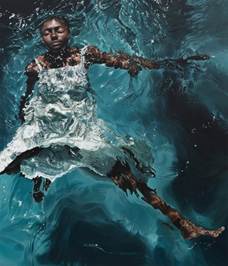
Calida Garcia Rawles (American, 1976–), Radiating My Sovereignty, 2019. Acrylic on canvas, 84 × 72 in.
For Carolyn Kizer and John Woodbridge,
Recalling Our Celebration of George Herbert’s Birthday, 1983
As swimmers dare
to lie face to the sky
and water bears them,
as hawks rest upon air
and air sustains them,
so would I learn to attain
freefall, and float
into Creator Spirit’s deep embrace,
knowing no effort earns
that all-surrounding grace.
This poem is from Oblique Prayers, copyright © 1984 by Denise Levertov, and also appears in Levertov’s The Stream and the Sapphire: Selected Poems on Religious Themes.
