This page contains extracts from the very good article at BAR linked below. The PDF version of it is in his directory in DropBox. The part below in bold is the interviewer’s voice, and the other is Freyne’s.
Jesus of History vs. Jesus of Tradition. BAR interviews Sean Freyne
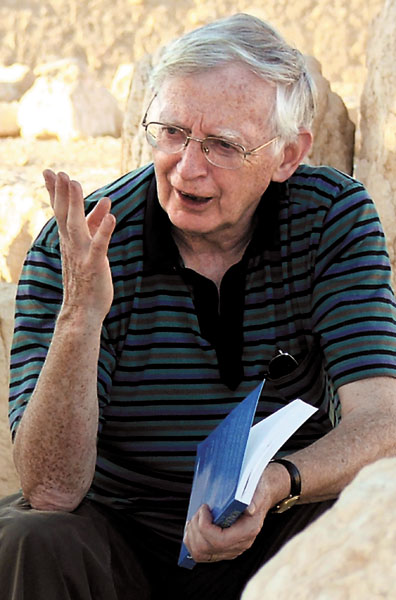
Sean Freyne is director of Mediterranean and Near Eastern Studies, as well as emeritus professor of theology, at Trinity College Dublin. His research focuses on the integration of literary and archaeological sources for understanding the social and religious world of Galilee in Hellenistic and Roman times.
Some people confuse the notion of the historical Jesus with the notion of the actual or the real Jesus. I think the historical Jesus is a construct, a theological construct, really. It’s the figure of Jesus as he is represented in the documents of Christian faith as a historical person.
So Greek culture was not necessarily hostile to the Jewish tradition, which came under the impact of Hellenism in various ways. But it also vigorously resisted abandoning its own distinctive world view. It accommodated itself to Hellenism while at the same time it retained its own distinctive identity. That, to me, is crucial to the understanding of Jesus also.
Archaeology, I think, has shown us that there was indeed a strong element of Hellenization in terms of trade, language, military and administrative strategies, etc. It was to some extent a case of acting Greek without becoming Greek, as somebody has put it.
You seem to be saying that Galilee was Jewish but absorbed Hellenistic culture at the time of Jesus and yet was not overcome or overrun by it.
It didn’t lose its distinctive Jewish identity. In the interior of Galilee, for instance, you do not find any of the things that we associate with a Greek or Roman city in terms of monumental buildings or statues of the gods.
You feel that Jesus was imbued with Jewish culture?
Absolutely. To my mind there’s no question about that. Locating him more precisely within that culture is another question. Jewish culture at the time was not monochromic. There were different varieties of Judaism—diaspora, or Greek-speaking Jews, the Sadducees, proto-rabbinic Jews such as the Essenes and the Pharisaic movement, etc. Where we locate the Jesus movement in this matrix is the big question historically.
What are the alternatives?
Well, for me, one of the important things is to start with Jesus’ relationship with John the Baptist. We know from John’s gospel that, later, the Jesus and the Baptist movements were in opposition, since their disciples were in competition for members (John 3:26). In this gospel the Baptist is apologetically presented as being the first witness to the Christian gospel (John 1:29–34). In the much-earlier synoptic account, Jesus says that “nobody born of women is greater than John the Baptist” (Matthew 11:11; Luke 7:28). These are the words of an admirer of John. Jesus has left his Galilean village culture of Nazareth and joins the Baptist movement in the desert, it would seem.
Now how do we understand the Baptist movement in the desert? I see it as one movement among various strands in Judaism that are beginning to be disaffected, not just politically but religiously. Herod changed the high priesthood. He got rid of the Hasmoneans [the previous Jewish rulers] and brought in replacement high priests from outside, from Egypt and from Mesopotamia.
I think we can see some disaffection here; the symbolic system of the Temple was not functioning as well as it might have in terms of being the religious center for the whole people. Luke presents the Baptist as the son of a country priest (Luke 1:5–8). Now, if John’s the son of a country priest, what’s he doing in the desert, preaching forgiveness of sins? He should be in Jerusalem talking about how people should come there on Yom Kippur. Instead, he’s undermining the system that is functioning in Jerusalem, just as the Qumran people [where the Dead Sea Scrolls were found] are as well, by claiming that they are an alternative temple. We have to see that kind of movement in the first century in this larger context. I would want to locate Jesus as well within that general environment.
The prophet Isaiah was very important for Jesus, as he was for all these renewal movements, including the people at Qumran. The remains of several different Isaiah scrolls have been found in the caves there, including one complete scroll and another nearly complete.
In Isaiah you have a clear sense of the remaking of Israel after the Babylonian Exile and the hopes that that engendered. The servant figure will bring light to the nations as well as restore Israel. There’s a sense of the universal in Isaiah. I tend to see John the Baptist more focused on Israel, and Jesus as adopting a more open and inclusive approach to renewal.
I think Jesus began within the renewal movement that was associated with the desert and with John the Baptist, as I have been saying. And then his strategy changes from John’s. John’s world vision is of an imminent judgment, that God is going to come and separate the good from the wicked, a highly apocalyptic world view. He remains in the desert summoning people to come out and prepare themselves through repentance and baptism. Jesus seems to be less influenced by the apocalyptic view of history. He retains it, but he’s not as influenced by it.
The Isaiah tradition kept being reworked in one way or another. We see it in the Book of Daniel, as well as in 1 Enoch and in the Testament of the Twelve Patriarchs [both in the Apocrypha]. There’s a lot of reworking of the tradition going on. We have no evidence, however, of another movement quite like the Jesus movement. I use the term “Jesus movement” because it’s very difficult to distinguish between Jesus as a historical figure and the movement that emerges in his name in Galilee. I think that Jesus’ first followers continued to imitate his lifestyle, a wandering, charismatic figure. We don’t have any parallels to this.
I think your question is a good one because it points to the problem we have of trying to distinguish between what is theological reflection and its development, on the one hand, and historical realities, on the other. Instead of splitting them apart and saying that’s theology and that’s history, I think the Bible as a whole gives us theologically interpreted history. It’s the same with the origins-of-Israel question that we talked about earlier. There is an ongoing kind of reflection on historical events and rethinking them and reframing them and reinterpreting them, constantly reworking Biblical tradition itself in the process. That’s why it’s so hard to pull out the historical Jesus or the historical Israel and say there they are.
I think the virgin birth is the easier of the two because, although we don’t quite have parallels, we do have some stories very like it. The idea of the birth of a hero like Heracles and Dionysus and the various myths of the newer gods within the Greek pantheon—the newer gods as distinct from the old Zeus and the nature gods. You have this idea of the mingling of the mortal and the immortal going on. So I think there’s a tradition there in Hellenistic religious history where the story of the virgin birth would fit in very well, once people sought to attribute divine status to Jesus.
MLA Citation
“Jesus of History vs. Jesus of Tradition,” Biblical Archaeology Review 36.6 (2010): 36, 38–47.
