The Church of Laodicea in the Bible and Archaeology
A look at Laodicea’s “lukewarm” legacy from Revelation 3:15–16
by Megan Sauter, Published March 12, 2026.
[Tom’s NOTE – This article talks about the evolving, largely Gentile based Christian congregations losing the protection enjoyed by the Jews due to their religious heritage. By denouncing the Jews, the largely gentile congregation was oppressed by the Roman emperors in the Domitian era. See red text below.]
Domitian persecuted those who would not participate in the imperial cult (the worship of emperors and dynastic families). Although Jews were exempt from participating, Christians were not. Fairchild explains, “As part of the Pax Romana, the staunchly monotheistic Jews in the cities of the Mediterranean world were exempt from the requirements of emperor worship. As long as Christianity was considered a sect within Judaism, the Christians in these cities were likewise exempt from emperor worship.”
At first, the Christian Church was composed almost entirely of Jews. However, as more Gentiles (non-Jews) converted to Christianity, the percentage of Jewish people in the Christian Church decreased, and, therefore, Christians’ special status as Jewish monotheists, which permitted them to refrain from emperor worship, was removed.
The Christians at Laodicea were affected by Domitian’s decrees. Their response to this persecution—which even involved their ability to buy and sell—is what causes the author of Revelation to call them “lukewarm.” Fairchild elaborates:
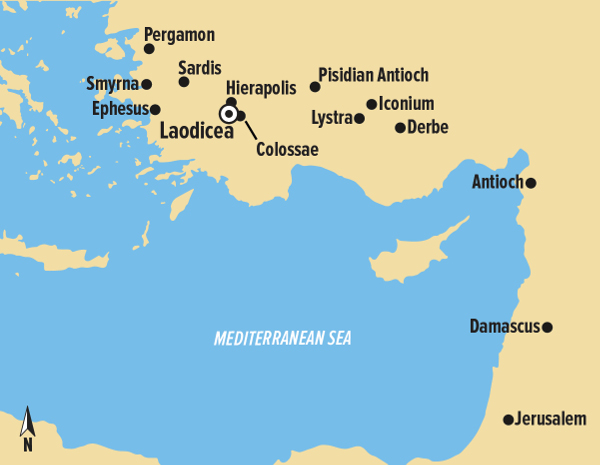
“The difficulties that this placed upon the Christians of Asia were expressed in detail throughout the Book of Revelation. Those who refused to worship the image of the beast (the emperor) were killed. Christians could no longer buy or sell unless they had taken the mark of the beast (Revelation 13). The pressure upon rich Christians to maintain their wealth was intense. Since a great deal of Laodicea’s wealth depended upon trade, the Christian merchants were in a quandary. Would they cooperate with the imperial cult and maintain their trade associations, or would they forswear Domitian and reaffirm their faith in Christ? Many of the Laodicean Christians compromised their faith in such ways that the writer of the apocalypse could say, “I will spit you out of my mouth” (Revelation 3:16).
See his longer article: Laodicea’s “Lukewarm” Legacy: Conflicts of Prosperity in an Ancient Christian City
By Mark R. Fairchild in the March/April 2017 edition.
MLA Citation
Fairchild, Mark R. “Laodicea’s ‘Lukewarm’ Legacy: Conflicts of Prosperity in an Ancient Christian City,” Biblical Archaeology Review 43.2 (2017): 30–39, 67–68.
