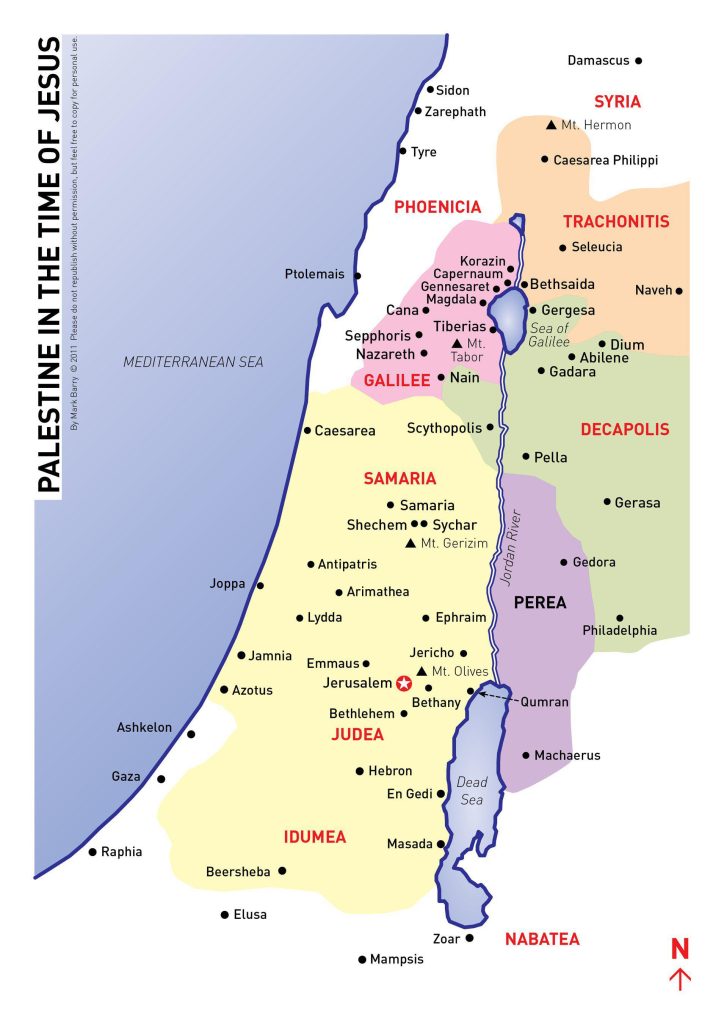
Located three miles northwest of Nazareth, Sepphoris—Zippori in Hebrew—is best remembered for later Jewish history. The city served as the capital of the Galilee under the Jewish Hasmonean dynasty until about 20 C.E., when it was replaced by a new city on the Sea of Galilee, Tiberias, by Herod Antipas. Later, in the second century C.E., the city became a center of Rabbinic Jewish learning and law, as the site where the Sanhedrin (the highest Jewish court) met and where Judah Ha-Nasi compiled the Mishnah, the earliest Rabbinic text. From BAR, Egyptian Scarab Amulet Unearthed at Sepphoris by David Malamud, June 16, 2016.
The following paragraphs are from Wikipedia where there is a lot more info.
Sepphoris (/sɪˈfɔːrɪs/ sif-OR-iss; Ancient Greek: Σεπφωρίς, romanized: Sépphōris), known in Hebrew as Tzipori (צִפּוֹרִי Ṣīppōrī)[2][3] and in Arabic as Saffuriya[4] (صفورية Ṣaffūriya)[a] is an archaeological site and former Palestinian village located in the central Galilee region of Israel, 6 kilometres (3.7 mi) north-northwest of Nazareth.[5] It lies 286 meters (938 ft) above sea level and overlooks the Beit Netofa Valley. The site holds a rich and diverse historical and architectural legacy that includes remains from the Hellenistic, Roman, Byzantine, early Islamic, Crusader, Mamluk and Ottoman periods.
Sepphoris was a significant town in ancient Galilee. Originally named for the Hebrew word for bird, the city was also known as Eirenopolis and Diocaesarea during different periods of its history. In the first century CE, it was a Jewish city,[6] and following the Bar Kokhba revolt of 132–135, Sepphoris was one of the Galilean centers where rabbinical families from neighboring Judea relocated.[7] In late antiquity, Sepphoris appears to have been predominantly Jewish,[8] serving as a spiritual and cultural center, though it also housed a Christian bishopric and maintained a multi-ethnic population.[9] Remains of a synagogue dated to the first half of the fifth century were discovered on the northern side of town.[10]
Since late antiquity, Sepphoris was believed to be the birthplace of Mary, mother of Jesus, and the village where Saints Anna and Joachim are often said to have resided, where today a fifth-century basilica is excavated at the site honouring the birth of Mary.[11]
“How Jewish Was Sepphoris in Jesus’ Time?”
By Chancey, Mark, and Eric M. Meyers. Biblical Archaeology Review 26.4 (2000): 18–25, 27–29, Extract follows from this very good paper.
When Herod died in 4 B.C.E., a Galilean named Judas son of Ezekias led a rebellion directed at Sepphoris and its “royal” palace, or fort and arsenal.11 The Roman legate of Syria, Varus, responded by burning the city to the ground and selling its rebellious inhabitants into slavery.12
The city seems to have recovered quickly, however. Perhaps Josephus exaggerated Varus’s retaliatory attack. Already during the reign of Herod’s son Herod Antipas (who fell heir to Galilee), the city expanded and its acropolis was rebuilt. Josephus describes this city as the “ornament of all Galilee.” “Ornament” refers to more than beauty, however; the Greek word for ornament, proschema, also has a military connotation—fortification or impregnable city.13
Sepphoris was the capital of Galilee until about 20 C.E., when Herod Antipas constructed a new city on the Sea of Galilee, Tiberias, and shifted his capital there.
. . .
Thus the lack of pig bones, the abundance of stone vessels and the presence, at least in our view, of many mikva’ot all support our conclusion that during Jesus’ time Sepphoris was home to a significant Jewish community. This is entirely consistent with Josephus. This conclusion is also supported by the Hellenistic period Hebrew ostracon referred to earlier and by several late Roman period lamp fragments with menorahs (seven-branched candelabra) depicted on their central discus. In addition, numerous mosaic fragments with Hebrew and Aramaic letters have been recovered from the western summit of Sepphoris. All together, the evidence points to a Jewish population in the Hellenistic-Roman period that maintained at least some of the most important religious laws of the Bible and the Mishnah.