NOTE – This post is included here although it is also in pages and posts at this site to demonstrate the use of the term I had never heard Yehud Medinata.
From ChatGPT\Prompt – Provide the location of the Yehud Medinata in ancient Israel and text that cites the dates it existed, how it was founded and its relations to foreign rule. At the end of the text list the sources. Cite the Priests and Prophets involved and any Israeli political leaders.
Here’s a detailed overview of Yehud Medinata (the Province of Judah), a discussion of its origins, duration, and its relationships with foreign rulers and local leaders.
“Yehud Medinata” is an Aramaic term that translates to “the Province of Judah” (or Judea) and was used to refer to the region during the Persian period, particularly after the Babylonian Exile (6th century BCE). This name reflects both the administrative structure imposed by the Persian Empire and the cultural identity of the inhabitants.
Yehud Medinata Location and Overview
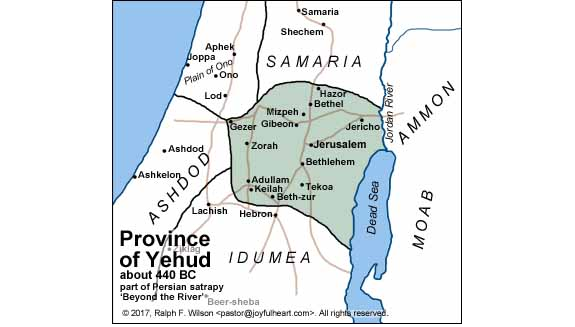
Yehud Medinata was located in the region now known as Israel and the Palestinian territories. Its primary borders encompassed Jerusalem and the surrounding Judean hills. During its time, Yehud was a small, semi-autonomous province under the authority of foreign empires, particularly the Persian Achaemenid Empire.
Historical Background and Foreign Relations
- Founding of Yehud Medinata (c. 539 BCE):
Yehud Medinata was established after the fall of the Babylonian Empire, when Cyrus the Great of Persia conquered Babylon in 539 BCE. This transition brought the former Babylonian territories, including Judah, under Persian control. Yehud Medinata thus became a Persian province as part of the Achaemenid Empire. - Timeline and Duration:
Yehud Medinata persisted as a province from approximately 539 BCE until 332 BCE. During this period, it experienced varying degrees of autonomy but remained subject to Persian administrative structures and taxation policies. - Persian Influence and Religious Reform:
The Persian rulers, beginning with Cyrus, allowed exiled Jews to return to Jerusalem and encouraged the restoration of religious practices and temple worship. Cyrus is famously credited with issuing an edict permitting the return of the Jewish people to their homeland and the rebuilding of the Second Temple in Jerusalem. This policy allowed Yehud Medinata to re-establish itself both as a religious and political center for the Jewish people. - Transition to Hellenistic Rule:
In 332 BCE, Alexander the Great conquered the Persian Empire, bringing Yehud Medinata under Macedonian rule. Although the Persian influence persisted in the religious and administrative culture, Greek influence began to integrate gradually, marking the beginning of the Hellenistic era in Judea.
Priests, Prophets, and Political Figures
Priests and Prophets:
- Ezra (5th century BCE): A scribe and priest who played a significant role in religious reform, emphasizing the Torah as central to Jewish identity in Yehud.
- Nehemiah (5th century BCE): Appointed governor by the Persian king, Nehemiah focused on rebuilding Jerusalem’s walls, restoring social order, and promoting Jewish religious practices.
- Haggai and Zechariah: These prophets encouraged the rebuilding of the Second Temple and voiced support for a return to religious observance among the exiles.
Political Leadership in Yehud:
- Sheshbazzar: The first Persian-appointed governor of Yehud, who laid the initial foundation for the Temple.
- Zerubbabel: A prominent leader and governor in the early post-exilic period, possibly of Davidic lineage, who continued efforts to rebuild the Temple and re-establish the Jewish community in Jerusalem.
- Nehemiah: A later governor known for his dedication to Jewish autonomy within the Persian provincial system and his strong sense of Jewish identity and reform.
Sources
- Briant, Pierre. From Cyrus to Alexander: A History of the Persian Empire. Eisenbrauns, 2002.
- Grabbe, Lester L. A History of the Jews and Judaism in the Second Temple Period, Volume 1: Yehud – A History of the Persian Province of Judah. T&T Clark, 2004.
- Davies, Philip R. Second Temple Studies: 1. Persian Period. JSOT Press, 1991.
- Bickerman, Elias. The Jews in the Greek Age. Harvard University Press, 1988.
- The Hebrew Bible: Books of Ezra, Nehemiah, Haggai, and Zechariah.
