This post contains Claude.ai’s summary of the transcript of JD Crossan’s interview on the History Valley podcast titled Luke Lied: He Never Traveled With Paul And Acts is Fictional!. That title does not represent what I found in the interview. Dom was explaining his view that Luke/Acts must be read as one 2-volume work with specific theological and political motivations. The transcript is in Dom’s Dropbox folder.
Here’s a summary of this Crossan interview on Luke-Acts and Paul:
Core Thesis: Luke-Acts as a Unified “Security” Manifesto – Crossan argues Luke and Acts must be read as one continuous two-volume work (split only due to scroll-length constraints), composed around the start of the second century rather than earlier. He builds his case on the Greek word in Luke’s prologue — asphaleia — which he translates not as “truth” but as “security.” Crossan reads this as Luke’s real thesis statement: the work exists to reassure Roman and would-be Christian readers that Christianity is safe to practice within the Roman Empire, not a subversive, dangerous movement tied to a crucified rebel.
Luke’s Treatment of Paul vs. Peter – Crossan’s central claim is that Luke systematically elevates Peter and diminishes Paul:
- In Acts, Paul never gets to narrate his own conversion/mission in his own voice the way Peter does (Peter’s Gentile-mission story is told three times).
- Nearly everything that happens to Paul (escapes, trials, persecution) happens to Peter first in the narrative — Peter is framed as the true “apostle to the Gentiles.”
- Small factual discrepancies (e.g., who guarded the Damascus gate — Nabataeans per Paul’s own letter in 2 Corinthians vs. “the Jews” per Acts) serve this larger pattern of shifting blame away from Rome and onto Jewish opponents.
The “Perfect Storm of Innocence” – Crossan traces a deliberate parallel structure: both Jesus (end of Luke) and Paul (end of Acts) are declared innocent by escalating levels of Roman authority — military, client kings, and governors. This, he argues, is Luke’s apologetic strategy: Rome is repeatedly shown exonerating Christians, while unrest is blamed on Jewish factions.
On Acts 15 and Harmonization – Comparing Galatians (where Paul calls the Jerusalem leaders “the so-called somebodies”) with Acts 15’s tidy, senate-like council, Crossan sees Luke smoothing over real conflict. He’s skeptical of scholarly attempts to harmonize Paul’s letters with Acts, calling it a “failure of scholarship” driven by theological motives rather than the evidence.
The “We”-Passages – Crossan proposes these first-person sea-voyage sections in Acts are a genuine pre-Lukan source — written by a companion sent to accompany Paul’s Jerusalem collection (likely on behalf of the Philippian church) — rather than evidence Luke himself traveled with Paul. He notes the source’s aim (Paul exonerated by God/providence via shipwreck survival) differs from Luke’s own aim (Paul exonerated by Rome).
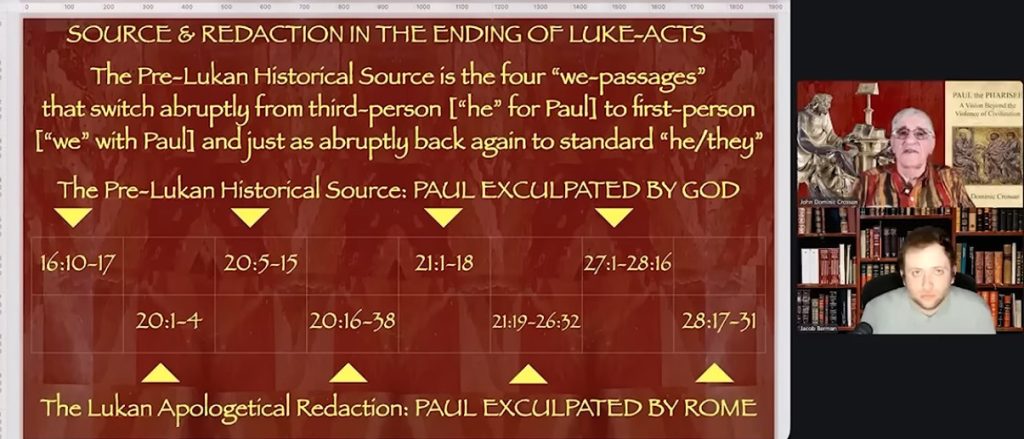
[See the next post on this site for the four “we” passages.]
Paul’s Fate and Broader Point – Crossan states plainly he believes Paul was executed in Rome, not released, and that Acts’ ending is theological framing rather than history. His overarching argument: Luke’s real achievement was making Paul’s genuinely dangerous, anti-imperial letters safe for a Roman audience by subordinating him to Peter and James — a move Crossan sees as an early step toward what would eventually become “Roman-style Christianity.”
