1/28/2026 – This post is an intro to a very good article at BAS titled Machaerus: Where Salome Danced and John the Baptist Was Beheaded by Győző Vörös. A PDF copy is in his directory in Dropbox. [Pronunciation with my amateurish phonics: mac-ear-us.] On 11/12/2026, a summary by Claude.ai was added below the images first posted.
Other elated articles are:
- Anastylosis at Machaerus*** Anastylosis is a Greek term used by architects and archaeologists to refer to the restoration of an ancient structure using only the original architectural elements to the greatest extent possible.
By Győző Vörös - Machaerus: A Palace-Fortress with Multiple Mikva’ot
By Győző Vörös - Restoring Herod’s Throne Niche at Machaerus
By Győző Vörös
Győző Vörös, who has a Ph.D. in architecture, has directed the Machaerus Excavations and Surveys since 2009. He is a Member and Research Director of the Hungarian Academy of Arts and a Research Professor of the Pontifical University Faculty of Biblical Sciences and Archaeology in Jerusalem.
Herod the Great was a notoriously unpopular ruler, and some think that these palace/fortresses were built to provide Herod with a safe haven in case of rebellion. To assure that he would be mourned, he ordered that “all the principal men of the entire Jewish nation, wheresoever they lived,” should be killed on Herod’s death.4 But there was another, outside danger: The Jewish area of Perea, ruled by Herod Antipas after his father’s death, lay east of the Jordan at the border of Nabatea, a potential foe. Were the Nabateans to attack, Machaerus would be the first to face the enemy.
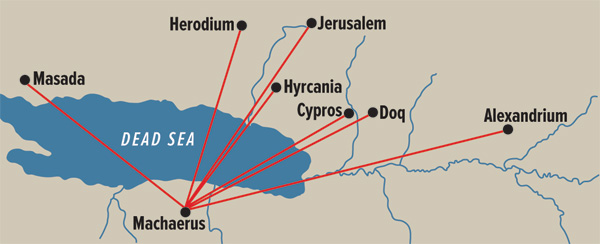
If, however, an attack from the north or the south reached Alexandrium or Masada first, Machaerus would receive a signal by smoke during the day or fire by night. The eastern fortress would then send out flares of its own, visible to all of the other western citadels. Even Jerusalem was visible from Machaerus. The smoke of the sacrificial offerings could be seen rising from the altars of the Jerusalem Temple.
MLA Citation – Vörös, Győző. “Machaerus: Where Salome Danced and John the Baptist Was Beheaded,” Biblical Archaeology Review 38.5 (2012): 30–41, 68.
Extract – The second letter to discuss is Lachish #4. While this letter, unfortunately, does not include the names of either the sender or its recipient, it does contain several important reports. Most intriguing is the mention that the sender is watching the signal fires of Lachish, for they cannot see Azekah. The exact meaning and implication of this statement are debated, but it does resemble Jeremiah 6:1, which mentions the use of signal fires to warn of the invading Babylonian army, providing a plausible date for this text.
Extract from The Lachish Letters, A Judahite archive from the First Temple period by Nathan Steinmeyer May 05, 2023.
Some of the images from the article are below.


Claude.ai’s Summary of the article
Summary: “Machaerus: Where Salome Danced and John the Baptist Was Beheaded”
Győző Vörös, Biblical Archaeology Review 38.5 (2012): 30–41, 68
Biblical and Josephan background
Vörös opens with the gospel account of John the Baptist’s death (Matt 14:1–12; Mark 6:17–29). Josephus supplements it: Herod Antipas married Herodias, his brother’s wife, John denounced the union as unlawful, and Josephus says John was taken in chains to Machaerus and killed there (Ant. 18.119). Vörös notes that Origen (Contra Celsum 1.47) and Eusebius (Hist. eccl. 1.11) treated Josephus’s report as corroborating the Gospels.
Strategic importance
Machaerus was one of at least seven Hasmonean-origin fortresses (Herodium being the exception, built by Herod), stretching from Alexandrium in the north to Masada in the south. As the only one east of the Dead Sea, it would face an eastern or Nabatean attack first and could signal the western fortresses by smoke or fire. Jerusalem was visible from it. Pliny the Elder called it the strongest citadel in Judea after Jerusalem (Nat. Hist. 5.15–16).
Excavation history
- The site’s location was forgotten in antiquity; Seetzen rediscovered the citadel in 1807, and Abel identified the lower city in 1909.
- Vardaman conducted a brief trial dig in 1968, which was cut short, possibly because of his report’s conclusions.
- Corbo and Piccirillo of the Studium Biblicum Franciscanum excavated in 1978–81 and 1992–93, but died without producing a final report.
- Vörös’s Hungarian Academy of Arts team, working with Jordan’s Department of Antiquities, resumed in 2009, using ground-penetrating radar and eddy current detectors.
Key findings
- Intact walls 30 feet high in the western bastion, and a 50-foot-deep Hasmonean cistern reused in Herod’s time.
- Three periods of occupation: Alexander Jannaeus (c. 90 B.C.), Herod the Great (c. 20 B.C.), and Jewish rebels during the First Revolt (66–72 A.D.).
- Herod’s palace had a garden, a Roman-style bath, a triclinium with a second floor, and a peristyle courtyard.
- Vörös argues Salome “must have danced” in the peristyle courtyard, where a semicircular apse marks the throne position. This is an inference, not a demonstrated fact.
- The re-erected columns were wrongly restored as Ionic; the drums and column prints show they were Doric.
- Mosaics and decoration parallel Masada and Herodium, with some mosaics apparently from the same workshop.
The Roman siege and the “twist”
Machaerus parallels Masada: rebel occupation, a Roman circumvallation wall, camps, and a siege ramp (by Legio X Fretensis under Lucilius Bassus). Per Josephus (J.W. 7.190–209), Bassus scourged a captured young rebel, Eleazar, and raised a cross to threaten him. This prompted negotiations in which the citadel’s defenders were allowed to leave safely, so the ramp was never finished, unlike at Masada, where the rebels died by suicide. Vörös says the unfinished ramp supports the “essential veracity” of Josephus. The lower city did not benefit: its 1,700 men were slain and the women and children enslaved. Vörös suggests John was probably imprisoned in the lower city, which he says deserves fuller excavation.
Critical notes
- Vörös links the archaeology to the Gospel story with some confidence (“must have danced”), but the identification of the exact room is plausible reconstruction rather than evidence.
- The Josephus passages are relied on heavily; the unfinished ramp confirms a siege, not the details of the Eleazar episode.
- The article is a popular piece by the excavation director, so it presents the team’s interpretations rather than a final publication.
Sources: Vörös, Győző. “Machaerus: Where Salome Danced and John the Baptist Was Beheaded.” Biblical Archaeology Review 38.5 (2012): 30–41, 68; Josephus, Antiquities 18.119; Jewish War 7.177, 7.190–209; Pliny, Natural History 5.15–16.
