Below is a response to a post at BSA regarding who or what God is and how we perceive Him/Her. The OP asked, “Are we in the process of creating god?” After Andrew’s response, the focus turned to concerns about AI.
Response by Andrew M Koke – Historian
I’ve gone down this wormhole a bit and don’t see a problem. Isn’t it a condition of humanity that if we want to have a relationship with something, that something must be thought of/interpreted as human-like? Don’t we anthropomorphize our pets, our plants, our inanimate objects, our planet, and our gods? I can’t experience any reference point other than a human reference point.
If that is the case, all gods are gods in our image because we have no other point of reference. We give gods human emotions (anger, love), human motives (to teach, to care), human relationships (father), human foibles (temptation, jealousy), human afterlife (where an afterlife provided by god looks conspicuously similar to human life). We have no other place from which to stand and survey. To me, of course any god is made in our image. That doesn’t mean that a god isn’t real, only that we can only understand it through our lens, thereby making it a god in our image. What that god really is ontologically, is unknowable. We only know what that god is like to a human.
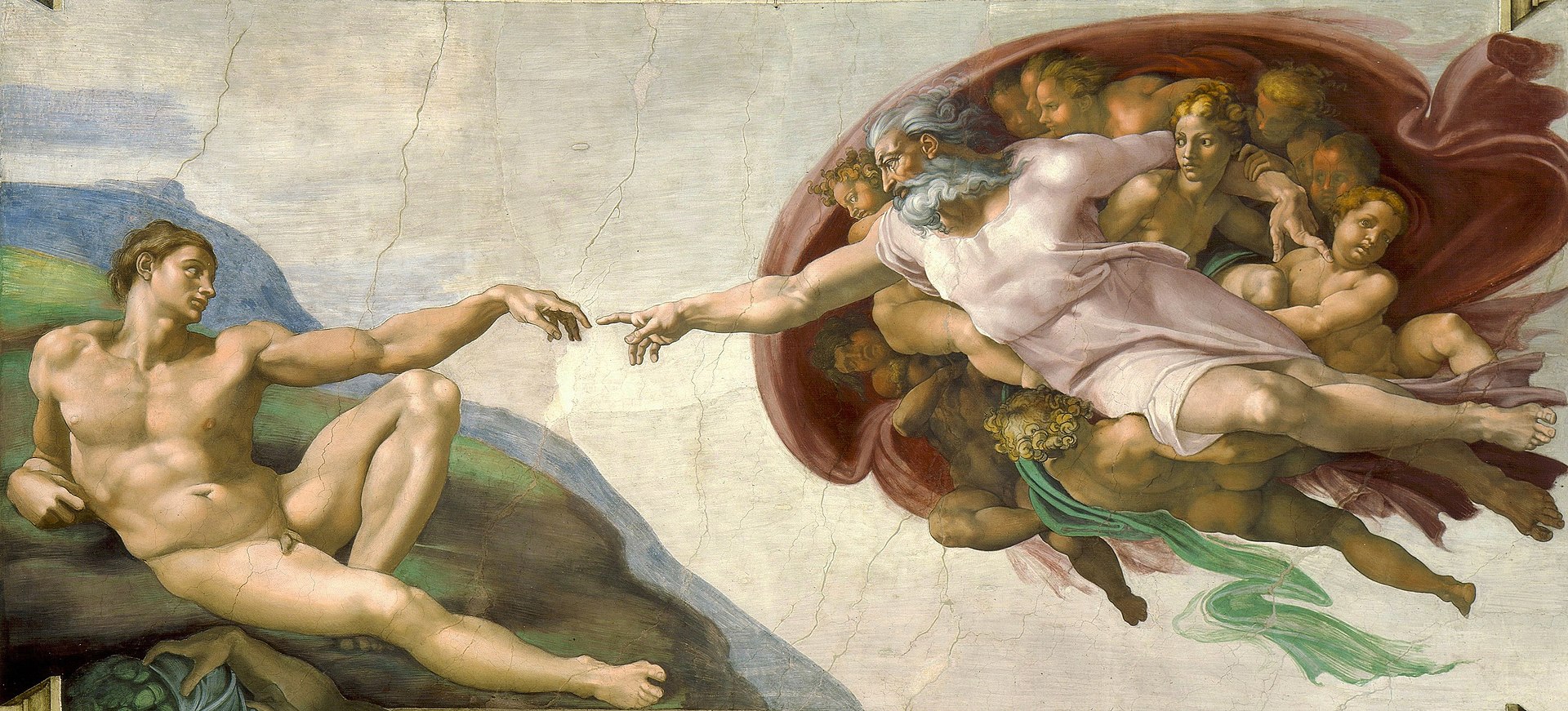
I’m reminded of that clever medical history article by Frank Meshberger MD from 1990, where he posited that the flowing robes of god seen in Michelangelo’s “Creation of Adam” look like a brain. He’s right. They do look like a brain, nice and pink, viewed from the side. Was Michelangelo hiding in plain sight an opinion that would have been apostasy, that Yahweh came from the brain of humans?
Bring on the AI god and AI scripture! If an actual artificial intelligence (not just a language model, but a real AI) develops its own religion, that will tell us something about humanity . How fascinating to see a religion not created by humans. It will be the closest thing to an alien religion we’ll ever see, and we’ll see past our own limitations more clearly as a result. Maybe.
