The post primarily contains information from an extensive article at BAS by Karel van der Toorn. The article was saved as a PDF file in the BAS directory in DropBox as downloaded from Egyptian Papyrus Sheds New Light on Jewish History
Note the links at the bottom of the post to very good articles at BAS titled Did the Ark Stop at Elephantine? and A Jewish Curse Text from Elephantine.
From Claude.ai on 10/17/2025. Prompt: Evaluate the attached file [as cited above in Dropbox] and provide an executive summary of talking points from the salient points.
Executive Summary: Papyrus Amherst 63 and Ancient Jewish History – Key Talking Points
1. Extraordinary Discovery and Significance
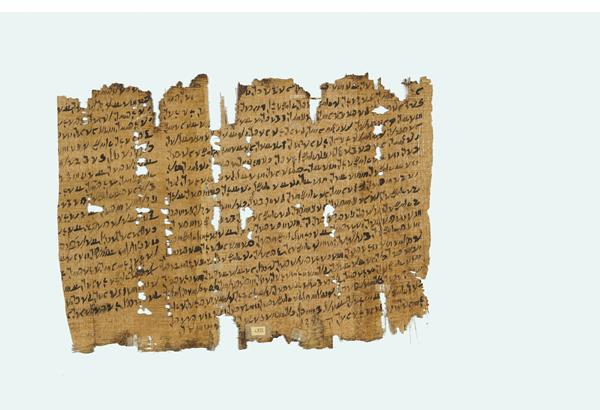
- Papyrus Amherst 63 contains three Israelite psalms from the 7th-6th centuries B.C.E., including a variant of Psalm 20 and two psalms never included in the Hebrew Bible
- The manuscript took over 120 years to decipher due to its unique combination of Aramaic text written in Egyptian Demotic script
- Provides unprecedented insight into pre-monotheistic Israelite religion and the northern kingdom’s religious practices
2. Origin and Context
- Discovered at Luxor in the late 19th century; manuscript dates to 4th century B.C.E. but contains texts from 7th-6th centuries B.C.E.
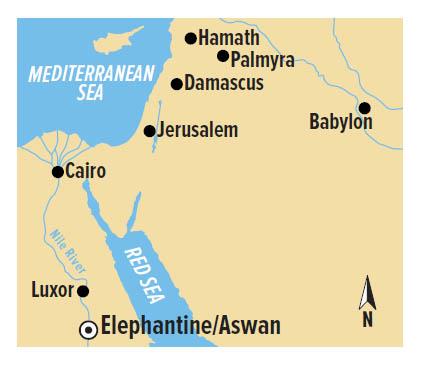
- Connected to Aramaic-speaking mercenary communities (Jewish, Syrian, and Babylonian) stationed at Elephantine Island and Syene (Aswan) during Persian rule of Egypt (525-404 B.C.E.)
- Represents a deliberate compilation pooling religious literature from three distinct communities
3. Religious Revelations
- Documents worship of “Yaho” (Yahweh) as “king of the gods”—a polytheistic framework predating strict monotheism
- Reveals identification of Yaho with the Aramaic deity Bethel and references to Yaho as “our bull,” connecting to King Jeroboam’s golden calf at Bethel
- Shows northern kingdom (Israel) religious practices distinct from Judean traditions—no references to Zion, Messiah, or Davidic kingship
- Depicts festive worship including banquets with “a thousand bowls” and animal sacrifices
4. Historical Migration Narrative
- Contains historical accounts of refugees from Samaria’s destruction (721 B.C.E.) and Hamath’s conquest (720 B.C.E.)
- Evidence suggests these communities first gathered in Palmyra as a “fortress of palms” before migrating to Egypt around 600 B.C.E.
- Migration driven by Babylonian military expansion; communities found employment as mercenaries in Persian-controlled Egypt

5. Theological Implications
- Demonstrates continuity between Canaanite religion (Baal worship) and Israelite practices through the deity Bethel, described as “Destroyer of the Sea” with attributes parallel to Baal
- Elephantine Jews worshiped Yaho alongside Eshem-Bethel, Anat-Bethel, and Herem-Bethel—showing religious syncretism
- Challenges traditional narratives of ancient Israelite religious purity and isolation
6. Cultural Integration
- Shows Aramaic cultural orientation of diaspora Jewish communities, including language and literary traditions
- The compilation likely commemorated a temple inauguration in Palmyra during a New Year’s festival in the 7th century B.C.E.
- Fourth-century scribes preserved these ancient texts despite poor comprehension, maintaining cultural memory across centuries
Bottom Line: Papyrus Amherst 63 fundamentally expands our understanding of ancient Israelite religion, revealing a polytheistic framework, northern kingdom distinctiveness, and extensive cultural interaction between Jewish, Syrian, and Babylonian communities before the development of strict monotheism.
MLA Citation for the original article is: van der Toorn, Karel. “Egyptian Papyrus Sheds New Light on Jewish History,” Biblical Archaeology Review 44.4 (2018): 32–39, 66, 68.
Extracts are below.
Side by Side: Papyrus Amherst 63 and Psalm 20
| Papyrus Amherst 63, column XII, lines 11–19 | Psalm 20 (author’s translation) |
|---|---|
May Yaho answer us in our troubles. May Adonay answer us in our troubles. Be a bow in heaven, Crescent! Send your messengers From all of Rash! And from Zaphon, May Yaho help us. May Yaho give to us Our heart’s desire. May the Lord give to us Our heart’s desire. Every wish, may Yaho fulfill. May Yaho fulfill, May Adonay not diminish Any request of our heart. Some by the bow, some by the spear— Behold, as for us, my Lord, our God is Yaho! May our Bull be with us. May Bethel answer us tomorrow. Baal-Shamayin shall bless the Lord: “By your loyal ones I bless you!” End. | To the leader. A Psalm of David. May Yahweh answer you in the day of trouble! May the name of the God of Jacob protect you! May he send you help from the sanctuary, and give you support from Zion. May he remember all your offerings, and regard with favor your burnt sacrifices. Selah May he grant you your heart’s desire, and fulfill all your plans. May we shout for joy over your victory, and in the name of our God set up our banners. May Yahweh fulfill all your petitions. Now I know that Yahweh will help his anointed; he will answer him from his holy heaven with mighty victories by his right hand. Some take pride in chariots, and some in horses, but our pride is in the name of Yahweh our God. They will collapse and fall, but we shall rise and stand upright. Yahweh will give victory to the king; answer us when we call. |
Did the Ark Stop at Elephantine? by Bezalel Porten at BAS
This article is very detailed, including the map above captioned “Map showing location of Elephantine and the course of the Nile”.
A Jewish Curse Text from Elephantine by Nathan Steinmeyer, October 27, 2023
Evidence of Yahweh worship [in a temple outside Jerusalem] from Late Period Egypt.
