This post contains a 1000-word summary by Claude.ai of a lecture and Q&A by Bart Ehrman at the BSA here. The lecture and Q&A was a little more than hour and is IMHO a very good overview of the events from Constantine’s origins to his death. The 9,000-word transcript is in his directory in Dropbox.
Here is a summary of the document — a lecture and Q&A by biblical scholar Bart Ehrman on the conversion of Constantine — in approximately 1,000 words:
The Conversion of Constantine: A Summary
Bart Ehrman’s lecture begins by situating Constantine’s conversion within one of the most turbulent periods in Roman history: the “Crisis of the Third Century” (roughly 230–280 CE). During this stretch, the Roman Empire endured over 38 emperors in 50 years, most of whom were assassinated, along with civil wars, barbarian invasions, and breakaway states. The political instability created conditions in which emperors sought supernatural legitimacy — and it was in this context that the persecution of Christians emerged and intensified.
Persecution Before Constantine
Emperor Decius (reigned 249–251) required all Roman citizens to perform a public sacrifice to the gods and obtain a certificate proving they had done so. While not targeting Christians specifically, the decree caught them in its net, leading to martyrdoms and imprisonments.
His successor Valerian (reigned 257–260) went further, explicitly targeting Christians — though he was ultimately captured by the Persians and died in exile.
The most severe persecution came under Diocletian (reigned 284–305), who issued four decrees between 303 and 304 CE prohibiting Christian gatherings, confiscating scriptures, and mandating the execution of leaders who refused to recant. Though intended as empire-wide, the persecution was primarily enforced in the east due to the practical impossibility of communicating and policing across such a vast territory. In addition, the army was stationed at the potential trouble spots on the borders to repel barbarians, and there was no national police force.
The Tetrarchy and Constantine’s Rise

Diocletian also restructured imperial governance by creating the Tetrarchy — a system of four co-rulers (two senior “Augusti” and two junior “Caesars”) designed to ensure competent succession by merit rather than bloodline. However, the system broke down when Constantius, the western Caesar and Constantine’s father, chose his son Constantine as his successor — violating the spirit of the arrangement. When Constantius died in 306 CE, Constantine became ruler of the western empire. A usurper named Maxentius complicated matters by seizing Rome and the Italian Peninsula, setting the stage for the decisive confrontation.
The Battle of the Milvian Bridge
Constantine marched his troops over the Alps and down into Italy. Maxentius, rather than defending Rome’s walls, crossed the Tiber on a pontoon bridge to meet Constantine in battle — a fatal mistake. The bridge collapsed during the retreat, and Maxentius drowned. This Battle of the Milvian Bridge (October 28, 312 CE) was the moment traditionally linked to Constantine’s Christian conversion.
Three Accounts of the Vision
Ehrman outlines three ancient accounts of Constantine’s religious transformation, none of which fully agree:
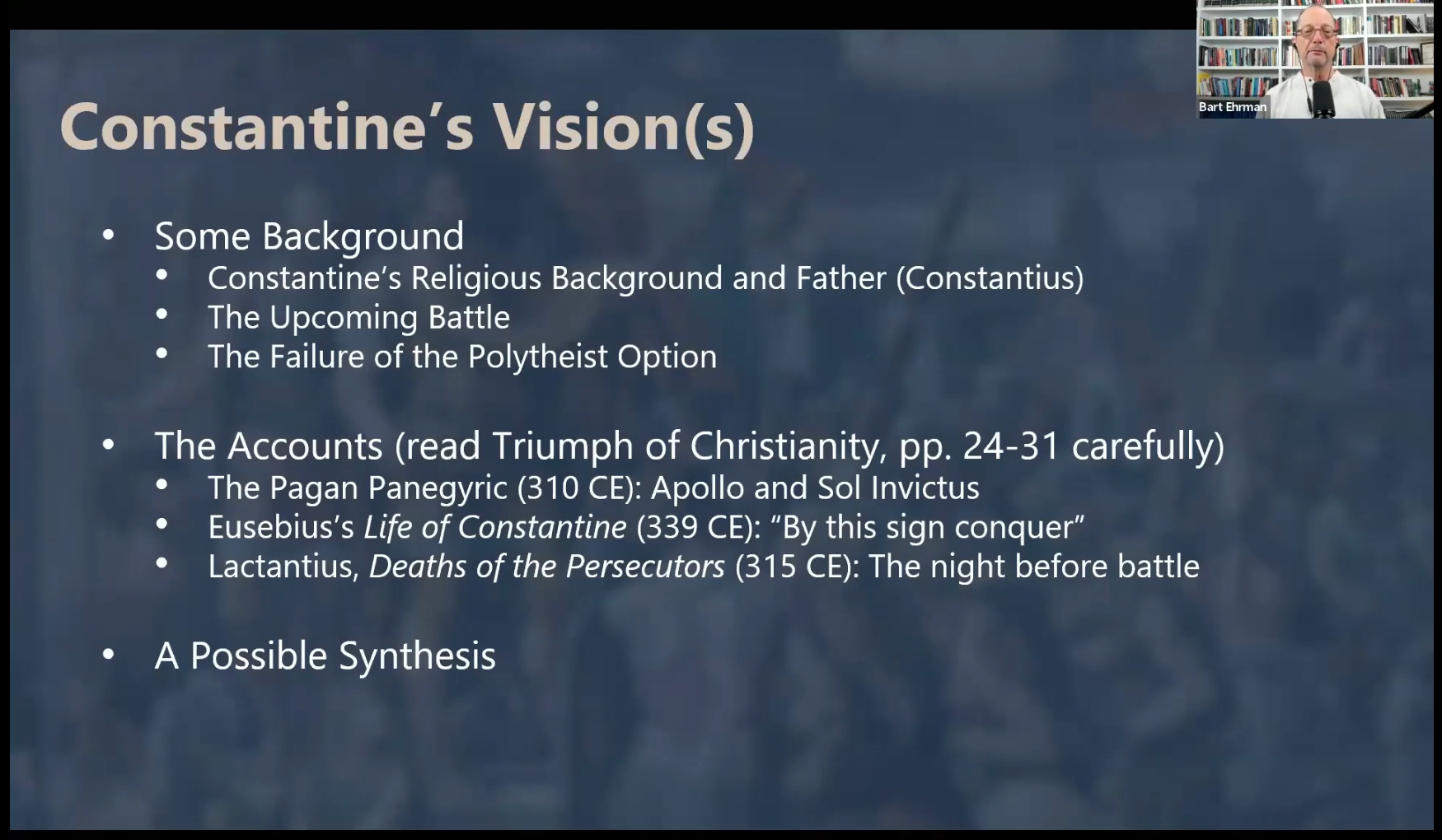

- The Apollo Vision (310 CE): Before the Milvian Bridge, a pagan orator’s panegyric recorded that Constantine visited a temple of Apollo following a military victory in Gaul. There, he reportedly had a vision of Apollo promising long life and identifying Constantine as his earthly incarnation. Ehrman believes this may have been the moment Constantine became a henotheist — a devotee of a single supreme god, Sol Invictus (the Unconquered Sun).
- Eusebius’s Account (written ~339 CE): The church historian Eusebius, writing in his Life of Constantine, reported that while en route to battle, Constantine and his army saw a luminous cross-like sign in the sky with the words “By this, conquer.” That night, Christ appeared to Constantine in a dream, showing him the same symbol — the Chi-Rho (☧), the first two letters of “Christos” in Greek. Constantine had advisors explain the Christian faith, was given scriptures to read, and entered battle carrying the labarum (the Chi-Rho standard). His decisive victory convinced him that Christ was the most powerful God.
- Lactantius’s Account (written ~315 CE): Lactantius, a rhetorician appointed as tutor to Constantine’s son Crispus, gave a shorter account: Christ appeared to Constantine in a dream the night before battle and instructed him to have his soldiers paint the sign of Christ on their shields. They did, won the battle, and Constantine attributed the victory to Christ’s protection.

Ehrman reconciles these accounts by suggesting that something genuinely happened in 310 during the Apollo episode — likely a dream that turned Constantine into a henotheist devoted to Sol Invictus. Then, prior to the Milvian Bridge, he came to identify Sol Invictus (see definition below) with Christ, concluding that Christians had always been worshipping the true supreme God under a different name.
Was the Conversion Genuine?
A central question in scholarship since the 19th century is whether Constantine’s conversion was sincere or purely political. Arguments for political motivation include:
- his continued use of pagan imagery (Sol Invictus) on coins after converting;
- his extraordinarily brutal rule, including the murders of a nephew, his eldest son Crispus, and his own wife Faustina;
- and his delay of baptism until his deathbed in 337 CE.
Ehrman, however, now rejects the political interpretation.
- At the time of conversion, Christians numbered only around five million in an empire of sixty million — hardly an advantageous constituency.
- He also notes that the Sol Invictus imagery on coins was consistent with Constantine’s belief that Sol Invictus and Christ were the same deity.
- Deathbed baptism was, in fact, common among Christian rulers who knew their public duties would require morally compromising acts; delaying baptism was a calculated strategy, not evidence of unbelief.
Moreover, Constantine actively promoted Christianity he:
- ended the Diocletianic persecution,
- granted the church legal status and financial benefits,
- freed clergy from civic obligations,
- funded the construction of basilicas, and
- wrote a sermon — the Oration to the Saints — that Ehrman finds compelling evidence of sincere faith.
Constantine’s Legacy
Ehrman is careful to dispel several popular myths.
- Constantine did not make Christianity the official religion of Rome — that was Emperor Theodosius at the end of the 4th century.
- He did not determine which books would be included in the New Testament.
- And while his conversion opened the door for elites to become Christian (which accelerated the church’s growth by drawing wealthy patrons away from pagan institutions), Ehrman argues in his book The Triumph of Christianity that Christianity was already growing fast enough to eventually dominate the empire regardless.
- Constantine was an important catalyst, but not an indispensable one.
The document is a transcript of a lecture and Q&A with Bart Ehrman, moderated by Megan, and was transcribed by TurboScribe.ai.
Sol Invictus – From ChatGPT.
Sol Invictus is a Latin phrase that translates into English as “the Unconquered Sun.”
- Sol = “Sun”
- Invictus = “unconquered,” “undefeated,” or “invincible”
In Roman religion, Sol Invictus referred to a sun god who was honored especially during the later Roman Empire. The title emphasized the sun’s constant return and victory over darkness, symbolizing endurance, power, and renewal.
The cult of Sol Invictus became particularly prominent under the emperor Aurelian (reigned AD 270–275), who officially promoted the worship of the Unconquered Sun as an imperial cult and established a major temple for the deity in Rome. [Constantine became ruler in 306 CE.]
The phrase and cult are often discussed in connection with the Roman festival of the sun on December 25, which some historians compare with later Christian traditions, though the historical relationship between the two is debated.
