Canaanite Worship at Lachish—New Details Emerge by Itamar Weissbein
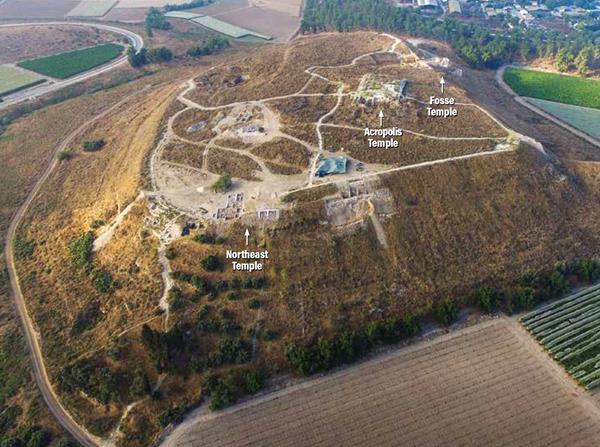
Extract – Situated in the southern part of the Judean foothills (the Shephelah), Tel Lachish controlled a main road leading from the Mediterranean coastal plain to the mountains of Hebron and Jerusalem in ancient times. In the Hebrew Bible, Lachish is known as an important Canaanite city-state, which joined a coalition of Canaanite kings led by the king of Jerusalem against the invading Israelites. After a miraculous victory, Joshua and the Israelites chased the Canaanites to their cities and destroyed them. Lachish, we are told, was captured “on the second day,” and its population was killed (Joshua 10:32
). Later in the Bible, Lachish reappears as an important Judahite city, fortified by Rehoboam, son of Solomon (2 Chronicles 11:9). The city features prominently in relation to the Assyrian campaign to Judah in 701 B.C.E. (2 Kings 18) and as one of the last fortified cities that stood against the Babylonians before Judah’s final destruction in 586 B.C.E. (Jeremiah 34:7).
Sennacherib’s Siege of Lachish – Study reveals how Assyria conquered the Judahite city by Nathan Steinmeyer, February 19, 2026
Perhaps no event recorded in the Hebrew Bible is better supported by archaeology and external evidence than Sennacherib’s siege of Lachish in 701 B.C.E. The siege of Lachish is documented in multiple Assyrian texts and reliefs and is also clearly visible in the site’s archaeology.

Located southwest of Jerusalem in the Judean foothills, Lachish was the second most important city in Judah during the First Temple period. The city was conquered in 701 B.C.E. as part of the Assyrian advance to Jerusalem in response to King Hezekiah withholding Judah’s tribute and inciting a regional rebellion against Assyrian control. The events of the campaign are recorded in numerous royal Assyrian inscriptions as well as several letters from Assyrian and Judahite soldiers. The events are also described in several biblical texts, including Isaiah 36–37, 2 Kings 18, and 2 Chronicles 32.
Extract from The Lachish Letters, A Judahite archive from the First Temple period by Nathan Steinmeyer May 05, 2023.
The second letter [ostraca] to discuss is Lachish #4. While this letter, unfortunately, does not include the names of either the sender or its recipient, it does contain several important reports. Most intriguing is the mention that the sender is watching the signal fires of Lachish, for they cannot see Azekah. The exact meaning and implication of this statement are debated, but it does resemble Jeremiah 6:1, which mentions the use of signal fires to warn of the invading Babylonian army, providing a plausible date for this text.
