This post contains extracts from two great articles at BAR that provide a summary of information about the three kingdoms.
Who Were the Ammonites, Moabites and Edomites in the Bible? Ancient Israel’s neighbors east of the Jordan at BAR by Megan Sauter, June 17, 2025.
Her post has summary statements (extracted below) about the three kingdoms, and she provides a link to a more extensive article: Ammon, Moab and Edom: Gods and Kingdoms East of the Jordan by Joel S. Burnett, December 2016. Extracts from Burnett’s article follow the three paragraphs below.
Who were the Ammonites?
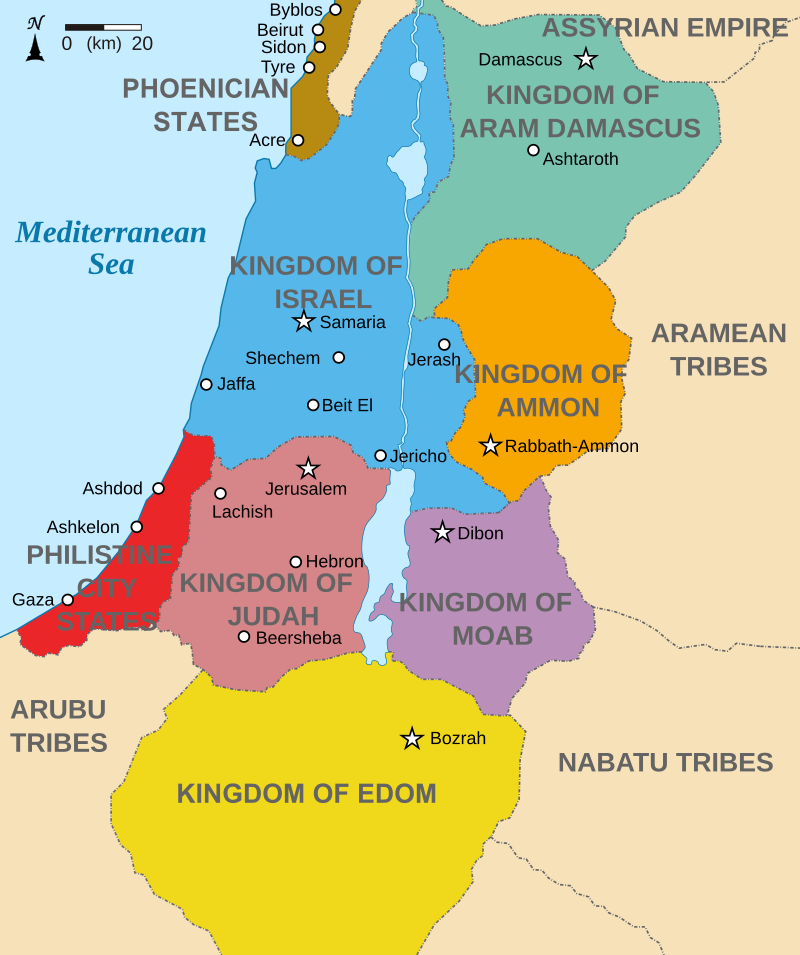
In the Bible, they are described as being descendants of Ben-ammi, who was the son of Lot (Abraham’s nephew) and Lot’s younger daughter (Genesis 19:38). The capital of the Iron Age kingdom of Ammon was Rabbah, which is located at modern-day Amman, Jordan. Burnett describes the boundaries of Ammon: “The Ammonite heartland comprised the north-central Transjordanian Plateau encircled by the upper Jabbok … within a 12.5-mile radius of its capital at the headwaters of the Jabbok.” The Ammonites’ primary deity was the god Milcom. Depictions of Milcom have been uncovered through archaeological excavations—as have representations of Ammonite kings, such as the monumental statue uncovered at Rabbah in 2010.
Who were the Moabites?

In the Bible, the Moabites are said to have descended from Moab, the son of Lot and his oldest daughter (Genesis 19:37). The kingdom of Moab stretched “north and south of the Arnon River” with its capital at Dibon. The Moabites worshiped the god Chemosh, who may be depicted in the Balua‘ Stele (dated to the end of Late Bronze Age). The most famous Moabite king—from the archaeological record at least—is Mesha. The large inscription he left behind is the longest Moabite text. Dating to the ninth century B.C.E., the Mesha Stele describes how King Mesha rescued the Moabites from Israelite rule
Who were the Edomites?
In the Bible, the Edomites are the descendants of Esau, Jacob’s twin and Isaac’s oldest son (Genesis 36). The Edomites controlled an area east of the Arabah, from the Zered to the Gulf of Aqaba. Their capital was Bozrah, which sat in the northern part of their territory. Although no name of an Edomite deity is given in the Bible, archaeologists know from inscriptions that the Edomites’ principal deity was Qaus (or Qos). Several Edomite places of worship and cultic figurines have been uncovered. One of the most notable is the depiction of an Edomite goddess wearing a three-horned headdress from the site of Qitmit, Israel.
The kingdoms of Ammon, Moab and Edom fought with the Israelites and the Judahites over territory. The Bible presents things from the Israelites’ and Judahites’ point of view, and archaeological discoveries help show us the other side. By looking at what these ancient peoples wrote and left behind, we are able to better understand their perspective. We now have a fuller picture of their kings, gods and daily life.
The paragraphs below were extracted from Burnett’s article.
In his section titled Edom, there is the following paragraph that warrants more research.
The Hebrew Bible’s mysterious silence regarding Qos, or any Edomite deity for that matter,22 along with Yahweh’s associations with the territory of Edom and its vicinity in Biblical poetry (Judges 5:4; Habakkuk 3:3, 7) and the Biblical traditions of Edom’s “brotherhood,” may reflect a possible close connection—if not an original equation—between Israelite Yahweh and Edomite Qos.
The following paragraphs are in the closing of his article.
How do these kingdoms compare with Israel and Judah on the other side of the Jordan River? As we have seen, Israel, Judah and these Transjordanian kingdoms are similar in many respects. Each had its own national god. Each was a tribal kingdom. Each battled against the others over territory and boundaries. Israel even claimed territory east of the Jordan.
Yet from Israel we do not have a single piece of monumental sculpture comparable to those from Ammon and Moab. When it comes to inscriptions, the disparity is even more dramatic. The great inscriptions confirming the history (even the very existence) of Israel and Judah and shedding light on national (and international) religious life come from kings and kingdoms other than Judah and Israel—most important, the Mesha Stele, the Tel Dan Stele and the Balaam inscription from Deir ‘Alla.
Go to the archaeological section of the Israel Museum in Jerusalem. There is not a single piece of impressive Iron Age sculpture from Judah or Israel. Even more surprising—not a single lengthy Hebrew inscription from this period exists.
Why is this the case? Is there some cultural reason that Israel has not produced great visual Iron Age art? And why aren’t there long inscriptions? Is it simply the luck of the archaeological draw? Or is there some deeper cultural or historical distinction between the kingdoms west and east of the Jordan? Could it have something to do with the fact that we also have no Ammonite, Moabite or Edomite Bible?
MLA Citation – Burnett, Joel S. “Ammon, Moab and Edom: Gods and Kingdoms East of the Jordan,” Biblical Archaeology Review 42.6 (2016): 26–40, 66.
