Extracts from the PDF version of the article in Tamas Visi’s directory in Dropbox titled The Chronology of John the Baptist and the Crucifixion of Jesus of Nazareth: A New Approach by Tamás Visi of the Kurt and Ursula Schubert Centre for Jewish Studies, Palacký University, Olomouc; Thomas-Institute, University of Cologne.
1 The Date of John the Baptist’s Death (4)
Admittedly, Josephus or his source could have committed mistakes in defining the chronological sequence of the events. However, in the present case, this is very unlikely. People often remember incorrectly dates, but they are much better in remembering dramas (see below, section 3.1). Josephus’ account is a carefully sewn narrative: it is not just a sequence of unrelated or loosely connected events but a chain of causes and effects. The order of the events cannot be changed without ruining the inner logic of the plot. We cannot be certain that Josephus himself was able to determine the years in which the events took place, but we have no Reasons to doubt that he related the events in the correct order. (12)
Moreover, it is very difficult to detach the narrative from the death of Tiberius (which we know to have taken place in 37 CE). The unexpected death of the emperor was a dramatic turn of the unfolding narrative, since it prevented Vitellius from carrying out the planned military attack against Aretas. Josephus preserves an anecdote about Aretas’ consulting a diviner before Vitelius’ attack. The diviner allegedly replied that Vitellius would never enter Petra because of the death of a ruler. The story might be just a folktale, but inventing such a tale makes no sense, unless the war indeed took place shortly before Tiberius’ death in 37 CE. Therefore, the relationship between the two events cannot be dismissed as a “confusion” on Josephus’ part. (12-13)
1.4 Summary
The events described in AJ 18.109–115 took place in 35–36 CE. Among these events were both Herod Antipas’ marrying Herodias and the war against Aretas. The Gospel of Mark connects John’s death to Antipas’ marrying Herodias, while Josephus associates it with the defeat of Antipas’ army. Therefore, both of the sources suggest that John the Baptist was executed in 35 or 36 CE. The Gospel of Mark and Josephus harmonize in this respect, despite the many differences between them in other respects. (14)
2 The Date of Jesus’ Death
People hearing this claim responded: “It took forty-six years to build this temple, and will you raise it up in three days?” (John 2.20) This sentence implies that the conversation took place forty-six years after Herod the Great started to rebuild the sanctuary in Jerusalem. According to Josephus, Herod’s building project begun in the eighteenth year of his reign meaning 20–19 BCE. Although the core buildings of the temple-complex were finished during Herod’s lifetime the building project continued for eight more decades. One
could say that “it took forty-six years to build this temple” around 26–28 CE. Therefore, if the chronological information assumed in the Gospel of John is correct, Jesus’ mission must have begun during the early years of Pilate’s mandate in Judea, and the crucifixion must have taken place before the middle of the period, that is to say, between 28–30 CE. (16)
Similar conclusion follows from the much-quoted statement in the Gospel of Luke that John the Baptist began his mission “in the fifteenth year of the reign of Tiberius Caesar,” that is 29 CE. Historians often attempt to calculate the date of Jesus’ crucifixion on the basis of this claim: depending on one’s assumption about the length of time that must have passed between the beginning of John the Baptist’s prophetic activities and the crucifixion of Jesus, scholars usually put Jesus’ death between 30 CE and 33 CE. (16)
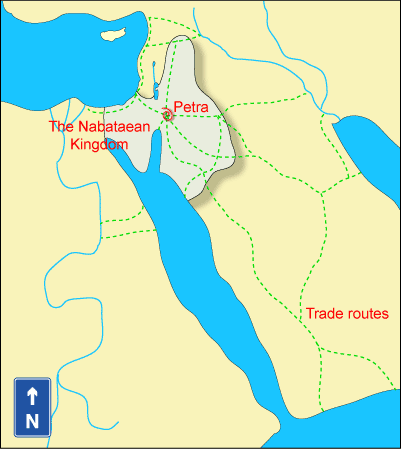
The implications of Pauline chronology corroborates these conclusions too. Paul’s conversion certainly occurred after Jesus’ crucifixion; therefore the date of the former is a terminus ad quem of the latter. Moreover, since Paul persecuted “the church” before his conversion, the “church,” that is, the community of the Jesus-believers, must have been visible and influential enough to provoke fierce hostility from its opponents. The relevant passages in Galatians and Acts suggest that a community of Jesus-believers had come into existence in Damascus, and perhaps in other places in the Nabatean kingdom (referred to as “Arabia” in Galatians) by the time Paul became a Jesus-believer. It is very unlikely that Jesus’ followers built up such a wide and visible network of communities in less than a year after their master’s death. We cannot tell how many years passed between Jesus’ death and Paul’s conversion, but an estimation of three to six years is fair enough. (16-17)
Thus, all in all, the traditional dating of Jesus’ crucifixion between 30 CE and 33 CE indeed seems to be close to the truth. The data which can be inferred from the gospels are corroborated by the implications of Pauline chronology. Thus, we have cumulative evidence for this date: even though it is possible that some of the chronological clues in the the New Testament are misleading or inaccurate, it is extremely unlikely that all of them are wrong. Therefore, we can rule out the possibility that Jesus was crucified as late as 35
or 36 CE. (18)

In sum, Mark 6.14–16 provides weak evidence for the chronological precedence of John’s execution to Jesus’ crucifixion. The evidence is weak, because it is unclear whether it reflects an early tradition of the Jesus believers or is a creation of Mark serving his literary purposes. As opposed to this, the date of John’s execution is supported by two independent sources that contain two chronological pegs, namely Herod’s marrying Herodias and the war against Aretas, both pointing to 35–36 CE (see section 1.1 above). Taken as historical evidence, Mark 6.14–16 is not reliable enough to challenge the conclusion that John must have been beheaded in 35 or 36 CE. (30)
4 Conclusion
As has been stated at the beginning of this paper, at least one of the following
three propositions must be false:
- Jesus died ca. 29–33 CE.
- John the Baptist died ca. 35–36 CE.
- John the Baptist died earlier than Jesus.
This paper has argued that while (1) and (2) are both supported by strong historical evidence (see sections 1 and 2 above), the evidence for (3) is weak. In particular, the Gospel of John does not state that the Baptist died earlier than Jesus, and there are further reasons to believe that this idea is a specific theological construction of the synoptic gospels (see 3.4. and 3.6 above). Moreover, since first-century Jewish society at large had difficulties in remembering dates of historical events (see 3.2), it is possible that neither the exact date nor the chronological sequence of the two executions had been remembered by the time the first extant gospels were written (see 3.3). Therefore, the synoptic gospels’ claim that John the Baptist died earlier than Jesus should be considered weak evidence (cf. 3.5). Seeing that (1) and (2) are supported by strong evidence, whereas (3) is supported by weak evidence, the idea that (1) and (2) should be considered true, whereas (3) is false, recommends itself. For these reasons a secular historian cannot but conclude that John the Baptist Was executed after Jesus was crucified.
