This page contains Comments and Responses to the post in BAR immediately below.
Geographically Puzzled
The article on Sodom (“Where Is Sodom? The Case for Tall el-Hammam,” BAR 39:02) was well reasoned and provocative, but it left me geographically puzzled.
It is true that as Abraham and Lot looked down from the area near Ai and Bethel on to the Plain of the Jordan, Sodom would be north of the Dead Sea. The other long-suggested location of Sodom south of the Dead Sea would not be in the Plain of the Jordan.
However, the Bible says as the angels were taking Lot and his family from Sodom, he wanted to go to Zoar rather than the mountains since it was so close. On my Biblical map, Zoar is south of the Dead Sea. Is Zoar mislocated or were there two cities named Zoar?
Also, the article said nothing about the event that left the layer of ash and heat-damaged items in 1600 B.C., both north and south of the Dead Sea. I know God is capable of sending fire from heaven, but I think he prefers to use the universe he created to do that type of work for him. Are there any clues?
Shirley S. Reed
Holt, Michigan
Steven Collins responds:
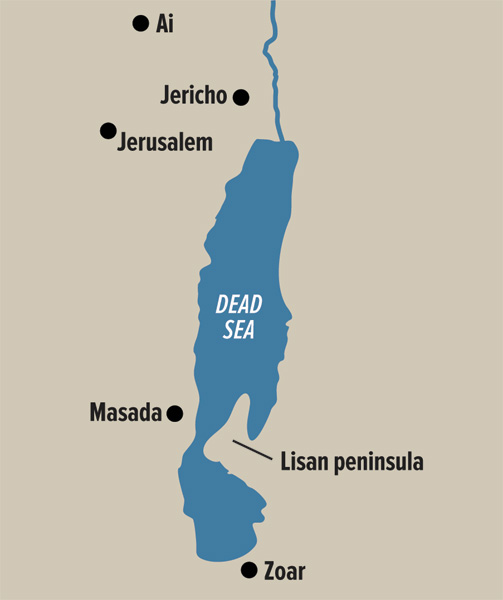
The location of Zoar south of the current Dead Sea, as is typically pictured on Bible maps (as shown above), is wrong. This location is based on the sixth-century C.E. Madaba mosaic map, which does shows Zoar south of the Dead Sea. But at that time the Dead Sea was at a historic low. In the sixth century, the Dead Sea was only half as large as it was later (until recently when the southern half again dried up). In times of low water levels, the southern half of what we know as the Dead Sea dried up. So “south of the Dead Sea” in the sixth century (as portrayed on the Madaba map) is not the same as “south of the current Dead Sea.”

The southern half of the Dead Sea, even when it is full, is very shallow, unlike the deep northern basin. Even when the southern half is inundated, a tongue of land, or peninsula, juts out into the southeastern part of the sea. This tongue is known as the Lisan (which means “tongue” in Hebrew). It is shown on all modern maps of the Dead Sea. But on the Madaba map, the tongue isn’t there, which is one way we know that the Dead Sea included only the northern half at that time.
So, south of the Dead Sea at the time of the Madaba map doesn’t mean the same thing as south of the Dead Sea in the modern period.
And nothing in the Bible places Sodom south of the Dead Sea. Indeed, careful comparison and analysis of Deuteronomy 2:4–5, 9, 34:1–3 and Joshua 13:8–28 reveals that Zoar was the southern geographical marker of the Reuben/Gad Transjordan tribal allotment located at the Arnon Gorge (Wadi Mujib), as well as the northern border of Moab. Both Moab and Edom were off limits to Israelite conquest (by divine decree), making the traditional location of Zoar on the border between Edom and Moab impossible! It’s also conceivable that Zoar was a tent-enclave (Zoar means “insignificant” in Hebrew) that moved around relative to the purposes of its clan leaders. The southern location of Biblical Zoar has to be wrong. (For details, see Steven Collins and Latayne Scott, Discovering the City of Sodom [New York: Howard Books, 2013] ).
As for “the event,” let me just say that we continue to find significant evidence that some kind of “airburst” (of cosmic origin) occurred over the kikkar (the area of the cities of the kikkar, including Sodom) sometime between 1750 and 1650 B.C.E. The magnitude of the event was somewhere between the Tunguska, Siberia, airburst of 1908 and the one in 2013 that exploded over southern Russia. All of the phenomenological language of destruction preserved in Genesis 19 is consistent with this kind of cosmic impact. The evidence on the ground also supports such a cataclysmic, targeted destruction. (See also my comments to the following question.)
Was Hammam Heat Caused by a Meteor?
Could Dr. Collins elaborate more on what destroyed Tall el-Hammam? What could cause the devastation he describes (especially as mentioned in his endnote 9)? Although some of the science is beyond me, is Dr. Collins implying that the cause was not a fire that lasted for days, but a sudden flash of heat so hot as to turn pottery surfaces into glass? With the recent news from Russia [the meteor that exploded over Russia in February 2013], might it have been a “heavenly” body?
Regardless, excellent detective work.
Sean Anderson
Fredericksburg, Virginia
Steven Collins responds:
As noted in my previous answer, textual and scientific evidence points in the direction of a cosmic airburst. Indeed, if the February 2013 event over Russia had been slightly larger or had entered on a steeper trajectory, the physical damage and loss of human life would have been cataclysmic.
Based on the hard evidence at and around Tall el-Hammam, we believe that the disintegration of a cosmic body (comet fragment or small asteroid?) put an end to the sophisticated Bronze Age civilization of the Jordan Disk (kikkar) between 1750 and 1650 B.C.E. (We’re still working with the diagnostic ceramics and other dating methods.)
According to laboratory analysis, the heat index required to produce desert glass and melt the surface of fired pottery in the manner we’re observing exceeds 8,000 degrees Kelvin, or about 14,000 degrees Fahrenheit. This is commensurate with that of cosmic airbursts.
