This page contains significant comments to a post in the Bible Nerds section titled Were Yahweh and El, the Chief god of the Canaanite Pantheon, Good Buddies? at Biblical Studies Academy stemming from the OP by Ron Gamache dated 12/29/2024.
Following is a paragraph with the question from the Original Post; Can the biblical scholars on this blog help me to understand why the Old Testament authors/redactors made Baal and Asherah mortal enemies of Yahweh, but they seem to have passively overlooked the chief Canaanite god, El (the father of years with his hoary beard)?
Below are posts primarily by Michael Waddell who provides scholarly input the the issues. Below his comments are other comments that contain interesting info I wanted to capture.
Michael L Waddell Dec 29, 2024, 7:51 PM. Title at University of Cincinnati is Software Apps Developer.
This is an important question, and I’d like to treat it with the detail it deserves. I’ll start with some basics, and if you already know all this first part, I’ll have to beg your patience.
“El” is simply the word for “god” in many Canaanite languages, but “El” could also be the the name of a specific God, the creator of the mankind. You had to tell the difference from context. (We have the same ambiguity in English, where you can say “God is great”, meaning the specific monotheistic deity, and “Zeus is a god”, meaning Zeus is in the category of a god.) Many Canaanite gods were called El-this or El-that, and these were sometimes used as nicknames for El, but they were sometimes the names of separate gods who interacted with El, and it wasn’t always clear. For instance, the Bible refers to “El Shaddai”, which might mean “El (God) of the Mountain”… but no one is quite sure what Shaddai means. He seems to have been worshipped separately from El, but that’s debated.
Ugaritic texts describe El as the aging creator deity, married to Asherah. El was honored and respected, but not particularly active in myths. His son Ba’al, the storm god, was much more popular, and some myths seem to portray a young Ba’al as usurping El’s throne — not by opposing his father, but by doing what El could not. This is clearly based on the idea of a young prince taking over from the respected but elderly king. Later myths even show Asherah as married to Ba’al, rather than to El, hinting that Ba’al had completely replaced El in the minds of those authors.
So far, none of this is specific to Israel. I’m currently reading Jacob Wright’s “Why The Bible Began”, and he goes into how this Canaanite hodgepodge became the monotheistic Hebrew scriptures as we now have them. The early Israelites and Judahites worshipped many gods, which included El, Asherah, Ba’al, El-Shaddai, and others. At some point Yhwh was introduced to the pantheon, but the details are unclear and fiercely debated. Yhwh was very popular, both in Israel and in Judah, but as one god in a pantheon. There was also a “Yhwh-alone” faction who thought that the people of Israel should only worship Yhwh, and not any other gods. They were probably a small minority, and they only intermittently had influence of the kings of Judah. But their writings survive in the prophetic books of the Hebrew Bible.
They were zealous, but they faced some almost insurmountable difficulties. Nearly everyone worshipped El, and Asherah was extremely popular as well. Many of famous Israelite ancestors were known to have worshipped El-Shaddai. And worst of all, the priests of Ba’al were extremely influential in the royal court, especially the court of the Northern Kingdom of Israel. How could the Yhwh-alone party gain any traction? (From the accounts of 1 and 2 Kings, it appears very few monarchs heeded them.)
First, they tried syncretism. Yes, the patriarchs had worshipped El-Shaddai, but that was just another name for Yhwh! This innovation is apparent in verses like Exodus 6:2-3, where God says “I am Yhwh. I appeared to Abraham, Isaac, and Jacob as El Shaddai, but by my name Yhwh I did not make myself known to them.” Then they insisted that Yhwh and El were the same God. In many parts of the Torah you find the Shema: “Listen, O Israel! Yhwh is El. Yhwh is one.” If the Torah can be said to have a thesis statement, this is it.
And then, the unthinkable happened. First the Northern Kingdom of Israel was destroyed, its king killed, its temples burned, its people scattered. Then later, the Southern Kingdom of Judah suffered the same fate. Israel’s gods had not saved them. Why? This may have been the most important question in the history of monotheism, and the Yhwh-alone party had an answer. It had been because the people had worshipped other gods alongside Yhwh, and that caused Yhwh to abandon them. The kings should have never allowed the priests of Ba’al to have any influence. If they were ever able to return to their homeland, they would do it right the next time, worshipping Yhwh as the only god. Forty years later, they had their chance, and Judaism as we know it was born.
The bit about Asherah is a special case… but this comment is long enough, so I’ll deal with that in a separate post. [immediately below]
Michael L Waddell – Dec 29, 2024, 8:16 PM
Regarding Asherah in particular, I’d like to just quote an extended passage from Jacob Wright’s “Why the Bible Began” (though the whole book is well worth reading). The passage begins by reproducing an image of the Kuntillet Ajrud inscription, and then has the following text:
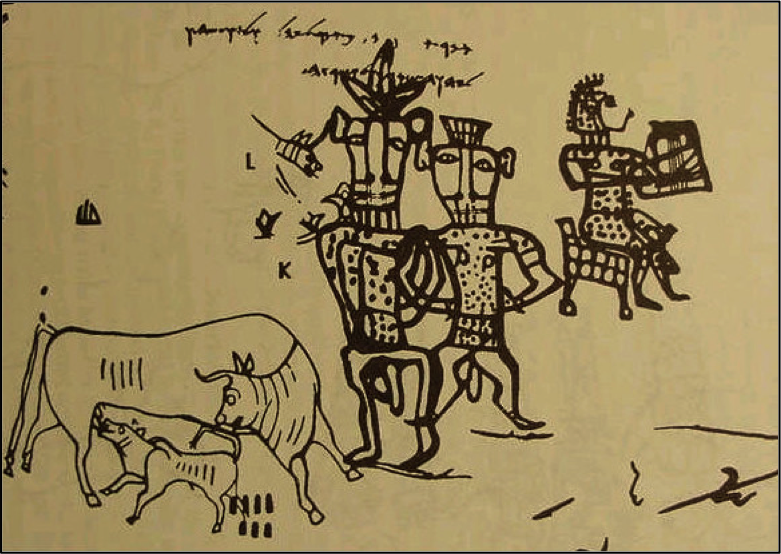
YHWH AND HIS WIFE
In 1975-1976 archeologists working at an isolated fortress (Kuntillet Ajrud) in the northern Sinai Desert discovered Hebrew writings related to Yhwh. … The inscriptions appear to be scribal exercises, and several lines read, “I have blessed you by the Yhwh of Samaria.” The references to the capital of the Northern kingdom leave no doubt that many in Israel (especially elites) venerated Yhwh. However, this deity is not alone; he’s accompanied by “his Asherah.”
Asherah is a well-attested West Asian deity. As the consort of the highest god El, who presided over a larger pantheon, she occupied a position of prominence. In the Bible, she is often paired with Baal. Both El and Baal are attested in these inscriptions, with blessings pronounced in their names. However, Asherah is no longer El’s or Baal’s consort but Yhwh’s. The evidence suggests that in being promoted to Israel’s national deity, Yhwh had usurped El’s (and Baal’s) place of honor in the pantheon.
These finds are undeniably shocking and scandalous. The coupling of Yhwh with another deity flies in the face of the Bible’s stringent requirements to worship Yhwh alone and its vehement opposition to the veneration of other gods. But then again, such stringency and vehemence would not have been necessary had this veneration not been widespread.
The Bible admits as much, especially with regard to Asherah. According to the Palace History, Ahab had set up her symbol in Samaria and Jehu maintained it even after his political putsch and religious reforms (1 Kings 16:33, 2 Kings 13:6). For the reign of the Judean king Josiah, this history recounts a reform (c.620 BCE) in which the king removed Asherah’s sacred vessels from the temple and destroyed a sector of the city where a guild of women wove her ritual garments (2 Kings 23:4, 7). Asherah worship was thus firmly entrenched in both Samaria and Jerusalem.
What led to the banishment of this goddess was not some sort of entrenched, macho opposition to a female deity in the societies of ancient Israel and Judah. After all, many macho cultures in antiquity, from Athens to Assyria, had goddesses as their chief deities. Moreover, Asherah had all along been only the consort, with limited power next to Yhwh, and by pairing her with Yhwh (not El), worshippers were affirming Yhwh’s preeminence.
The biblical ban on worshipping Asherah along with other male deities was part of an effort to focus on a single transcendent entity that could unite the nation. If Yhwh were allowed to have a consort, then communities would continue thinking in terms of conventional Canaanite cosmologies. The intimate relationship between one people and one deity, which is foundational to the biblical concept of covenant, meant that the longstanding union between Yhwh and Asherah had to be dissolved. As they constructed this new covenantal order, the biblical authors annulled the union and envisioned a new marriage between Yhwh and Israel.
Michael L Waddell Dec 30, 2024. 5:22 PM
Bill Kuykendall – If there are any gods that exist and guide history and make bushes burn, their actions would have to be described as “supernatural”, operating literally outside of the laws of nature. But historians have to craft theories that don’t resort to the supernatural. If you want to know how the Nazis were defeated, a supernatural answer could be that God just wanted them defeated, and at a spiritual level you could be right. But a historian has to find naturalistic explanations.
In the same way, how do we explain the origin of the Hebrew people and monotheism and the Hebrew scriptures, without resorting to supernatural explanations? Archaeology reveals that other Canaanites worshipped El, Ba’al, Asherah, and others. We don’t know how YHWH worship was introduced, but a popular theory is that it was imported from either Edom or Egypt. Anyway, the Hebrew people worshipped YHWH along with all these other gods. When their kingdoms were destroyed, they had to explain why. Some influential writers (both times) concluded that worshipping YHWH is good, but that you can’t worship other gods as well, and that’s why disaster happened. We know these writers as the Hebrew prophets. But in order to convince most people of this, they had to claim that El and El-Shaddai and YHWH are all one god. (That way people could still worship El the way they had been before… only now they should call him by his real name YHWH.) Later still, when the Hebrew scriptures were written, these teachings were recorded in the text, and that’s why the Hebrew Bible looks the way it does.
This theory doesn’t require one to believe in YHWH or any other God (although it doesn’t prevent one from believing these things either). It should be convincingly plausible for the Christian and atheist and Hindu alike.
Ron Gamache – Jan, 3, 2025 at 8:06 PM
I would like to thank all the biblical scholars on this blog, for providing excellent input to my post on the connection, between Yahweh and the Canaanite god, El. It appears that we all agree that Yahweh and Baal are mortal enemies in the Old Testament, but that El, the chief god of the Canaanite pantheon, does not appear to be a threat to Yahweh, in the eyes of the biblical authors/redactors.
Archaeologists have made several discoveries, documenting the cataclysmic Bronze Age Collapse around 1177 BC; that spread across the Mediterranean Sea and through western Canaan. Large groups of people from western Canaan ran for their lives, significantly increasing the population of the hill country in eastern Canaan. Prior to the Collapse, the Hittites in the north and Egypt in the south maintained an “iron grip” on the land of Canaan.
After the Collapse, the Hittite empire was destroyed, Egypt had to relinquish its hold on Canaan to protect its northern borders; and many flourishing cities near the coast, such as Ugarit, were destroyed. Historians and archaeologists have evidence that groups of different Sea Peoples from the Aegean, such as the Philistines, were partly responsible for the collapse, but there appear to be other natural disasters, making the Bronze Age Collapse a “perfect storm.”
When the iron grip of the Hittites and Egyptians was removed from Canaan, lesser-known historical nations (with names of people in the Bible); such as the Israelites (Jacob’s descendants), Moabites (Lot’s descendants by his older daughter), Ammonites (Lot’s descendants by his younger daughter), and the Edomites (Isaac’s descendants by his son, Esau) emerged from the ashes to fill the vacuum. Recent DNA studies have shown that all these different people are descended genetically from the Canaanites, including the Israelites. These nations also share a common northwest semitic language and alphabet, that can be traced to the Phoenician Canaanites.
In the 1920’s, Ugarit was accidently discovered, and archaeologists have been excavating the site, off and on since its discovery. Religious texts written on tablets in a form of Akkadian cuneiform were discovered recounting the Baal Cycle. These texts tell the story of how El, the chief god in the Canaanite pantheon, and his wife, Asherah, had 70 children (gods). The number “70” was a highly symbolic number, representing “perfection and completeness” in both ANE civilizations, and in the Bible. In the Bible, the number 70 is used at least 66 times.
Deuteronomy 32:8-9 appears to provide a key link between the number “70” in the Baal Cycle and in the Pentateuch. Before the discovery of the ruins at Ugarit in the 1920’s, this connection was unknown to biblical scholars.
The transition from worshipping the Canaanite gods to worshipping Yahweh, which happened over centuries driven by the changing theological views of Israel’s scribes in Canaan, can clearly be seen in certain places of the Old Testament. A classic example is the transmission history of Deuteronomy 32:8-9; that deals with the allocation of the nations.
According to Deuteronomy: A Commentary by Jack Lundbom, Deuteronomy 32:8-9 reads as follows:
“When the Most High gave the nations an inheritance,
When he separated the sons of man,
He fixed the boundaries of peoples to the numbers of the sons of God.
Indeed, Yahweh’s portion is His people, Jacob, his allotted inheritance.
My understanding is that in the minds of early Israelite scribes, the nations may have been originally fixed in relation to the 70 sons (gods) of El, the chief Canaanite god at Ugarit, and it appears as though Yahweh, one of El’s 70 sons, was allotted Israel. The Jewish Study Bible on page 419 removed the word “allotted” and replaced it with “Own Allotment”, with the explanation that this change was made to avoid any inference that the chief Canaanite god, El, assigned Israel to Yahweh.
As the theological views of Israel’s elitist scribes in Canaan moved from polytheism towards monotheism, Yahweh physically replaced the chief Canaanite god El, by taking over El’s name, appearance (Ancient of Days with his hoary beard in Daniel 7:9), and position; as the chief God ruling over 70 other gods/angels (sons of El), and He assigned specific nations to the 70 angels, while keeping Israel for Himself.
Yahweh, with His 70 angels, is reflected in Deuteronomy 32:8; in the Greek Septuagint, Dead Sea Scrolls (4QDeut j), and Catholic Bibles. Israel’s scribal religious thinking continued to evolve in the proto-Masoretic text, as reflected in Protestant Bibles; where this verse replaced the “70 sons of El” with “Israel’s numbers” (perhaps the 70 male descendants of Noah’s sons in the Table of Nations in Genesis Chapter 10?), which many biblical scholars agree is a later scribal gloss.
What the Bible appears to be telling us, in certain Old Testament verses, is that Israel’s origins as a nation can be located somewhere in southern Canaan, and not in Egypt. What do you think?
From other comments:
Willie Pankey Dec 30, 2024 Ron, you raise a good question I haven’t thought of before. You’re right about El and the O.T. Worship of the Canaanite god El does not seem to have been widespread in biblical Israel. As a result, the common prophetic polemics directed against the worship of Baal are not found against El in the Old Testament. It is possible that El was mainly a mythological character and not the focus of religious service, which would explain the lack of biblical polemic against El. If a god was not actively worshiped in his homeland, he posed no threat of seduction to the followers of the God of the Bible. Perhaps it’s because El does not always play a forceful role in the Ugaritic myths and legends. Some have suggested that El at Ugarit was in his twilight, and others believe that Baal was in the process of supplanting El in Ugaritic religion. I guess the old boy got the boot from the younger up-and-coming gods.
Ron Gamache Dec 30, 2024 – Willie Pankey – Willie, I think that you hit the nail on the head. Baal trying to supplant El, obviously put them at odds with each other. Yahweh stepping into El shoes automatically puts Him at odds with Baal, which is so prevalent in the Bible. Of course, Yahweh had to outdo Baal at his own game, by commanding myriads of angels from His home in the mountains, and wielding thunder and lightning while riding the clouds, just like Baal.
O V Dec 29, 2024 – A few points from “The Early History of God” by Mark Smith. Smith uses the Ugaritic ritual texts as much as the Hebrew literature in his analysis. In the late Bronze and early Iron ages there was a convergence of Israeli and Canaanite both in their language and in the deities they worshipped. Israel most likely broke away from the Canaanites rather than always being a separate culture that resisted assimilation. YHWH hadn’t even really arrived on the scene yet. This happened with the rise of the Israel monarchy, and this is when differentiation displaced convergence. Really isn’t any evidence for the Exodus from Egypt. This story was constructed after the fall of the northern kingdom. Jacob Wright a good source for this phase.
