Below is a summary by Claude.ai of the transcript of C.J. Cornthwaite’s YouTube video, Luke Knew Josephus. This is the verse that convinced me. The transcript is in his Dropbox directory.
The Key Text: Acts 21 and the “Egyptian” Pericope
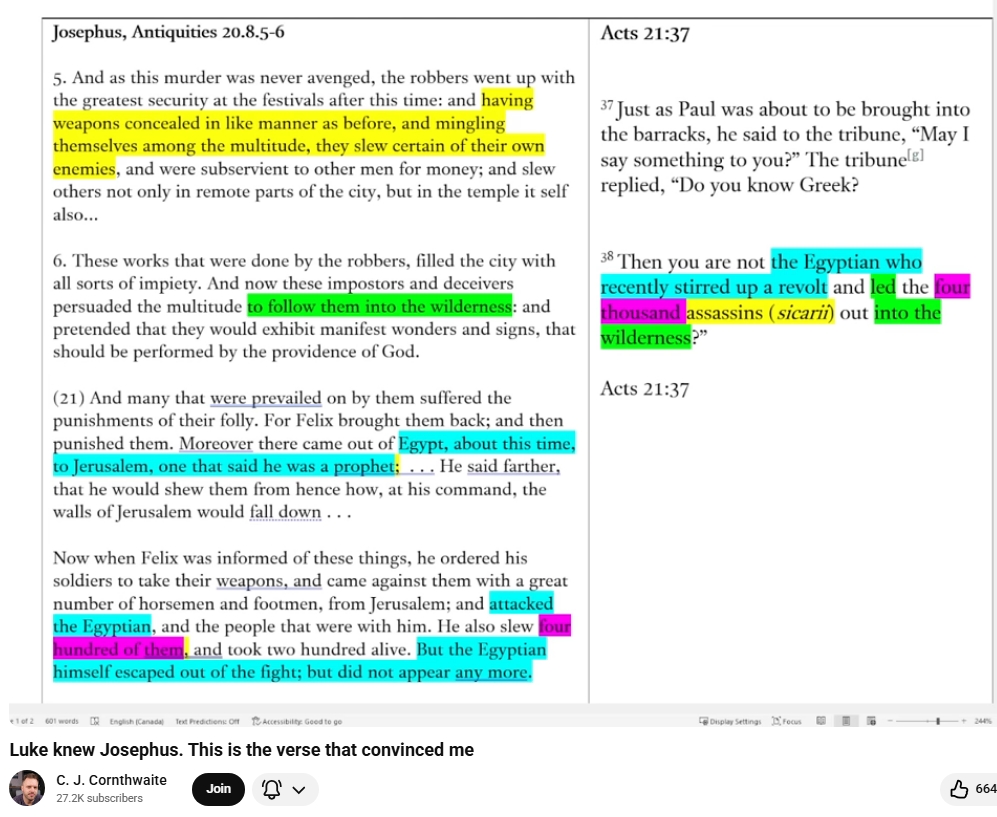
Cornthwaite’s central exhibit is Acts 21, where a Roman tribune confronts Paul with the question of whether he is “the Egyptian who recently stirred up a revolt and led the 4,000 assassins (Sicarii) out into the desert.” Cornthwaite argues this single verse is a compressed — and garbled — conflation of three distinct episodes found in close proximity in Josephus’s Antiquities of the Jews, Book 20, Chapter 8.
The Three Josephan Elements Luke Mashes Together
In Josephus, these are separate narrative threads:
- The Sicarii — dagger-wielding assassins who blend into crowds at festivals and stab enemies; Josephus describes them in detail as a distinct faction.
- The Wilderness Deceivers — false prophets and messianic pretenders who lead crowds into the wilderness promising signs and wonders; these are explicitly distinguished from the Sicarii.
- The Egyptian — a specific figure who claims prophetic authority, promises the walls of Jerusalem will fall at his command, is routed by Felix (with 400 killed and 200 captured), and then escapes and disappears.
The Compositional Error That Proves the Direction of Borrowing
Cornthwaite’s key analytical point is that the author of Acts fuses these three separate figures/events into a single composite character — “the Egyptian who led the Sicarii into the desert” — which is not what Josephus says at all. In Josephus, the Egyptian leads crowds toward Jerusalem’s walls; the wilderness motif belongs to the false prophets; and the Sicarii are a separate group entirely. The number “4,000” in Acts also appears distorted — Josephus records 400 killed and 200 captured in the Egyptian episode, none of whom are called Sicarii.
This compositional slippage is the linchpin of his argument: the Acts author, working from a half-remembered or hurriedly read passage of Josephus, grabbed proximate elements from the same section of text and stitched them into a single plausible-sounding reference. The result is internally incoherent when checked against Josephus, but sounds historically grounded to a reader who doesn’t know Josephus.
Why the Borrowing Cannot Run the Other Direction
Cornthwaite addresses the counterargument — that Josephus might have copied from Acts — directly and on logical grounds: Josephus’s account is richer, not poorer. He provides three differentiated stories with distinct details, motivations, outcomes, and numbers. There is no mechanism by which an author would read the vague, compressed, conflated reference in Acts and then expand it into three separate, detailed, internally consistent episodes. The information flow must run from the more detailed source (Josephus) to the derivative, condensed, and error-prone one (Acts).
The Broader Implication
For Cornthwaite, this passage is paradigmatic of Luke-Acts’ entire historical method: the author is not practicing careful historiography but is mining Josephus for atmospheric historical detail, deploying it loosely to give the narrative a veneer of credibility. This, he argues, also settles the dating question — since Josephus wrote in the 90s CE, Luke-Acts must postdate him, ruling out Pauline-era authorship and, with it, the tradition of Luke as Paul’s traveling companion.
