From ChatGPT 11/23/2024.
Jump to the second chat below “The Transition from Ptolemaic and Seleucid Rule in Judea to the Hasmonean Dynasty, the Qumran Community, and Rome’s Conquest including the Pharisees and Sadducees.”
Jump to a concise chronological list of events.
The Transition from Seleucid Rule in Judea to the Hasmonean Dynasty and Rome’s Conquest
Introduction
The history of Judea during the Hellenistic period is marked by significant political, religious, and cultural upheaval. The transition from Seleucid domination to Hasmonean independence and eventual Roman conquest represents a pivotal era in Jewish history. This paper outlines the Seleucid influence, the Hasmonean revolt, the establishment of Hasmonean sovereignty, and Rome’s ultimate annexation of Judea.
Seleucid Rule in Judea
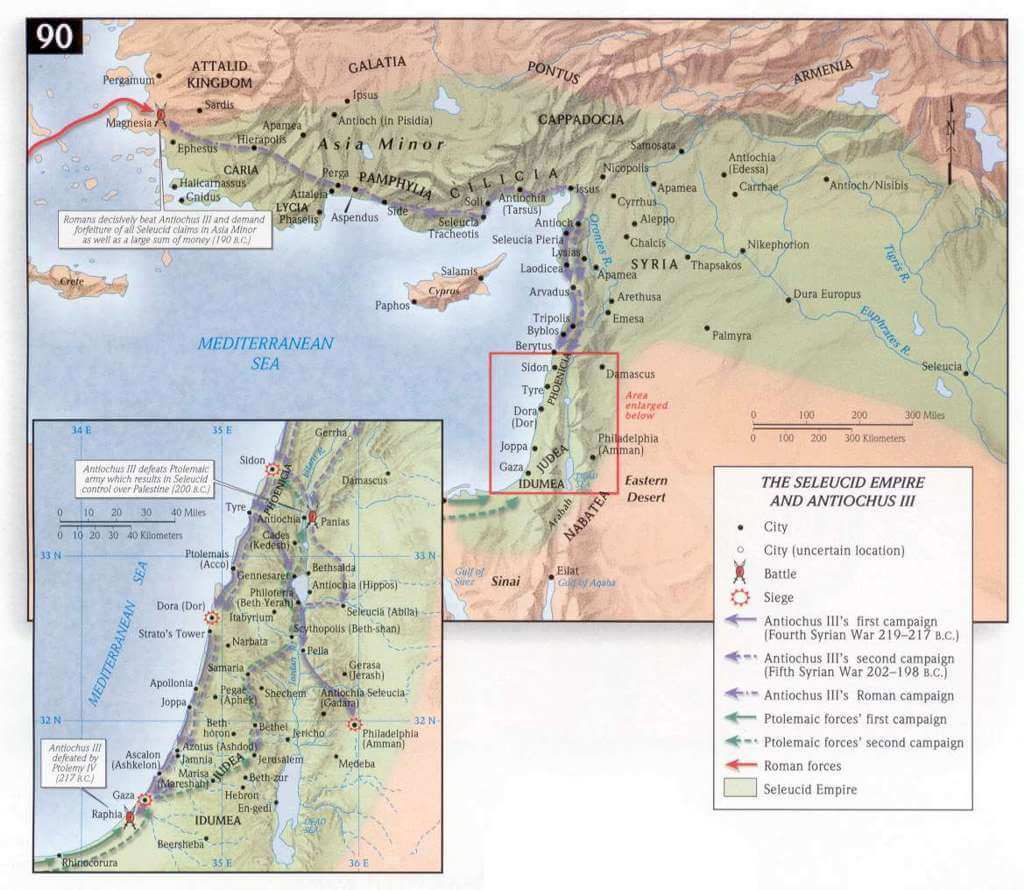
After Alexander the Great’s empire fractured after his death in 323 BCE, Judea fell under Ptolemaic rule until c. 200 BCE, when the Seleucid Empire gained control following the Battle of Panium. The Seleucid kings, particularly Antiochus III and his successors, implemented policies that sought to Hellenize Judea. The extent of this Hellenization varied but often conflicted with Jewish traditions, particularly under Antiochus IV Epiphanes (r. 175–164 BCE).
Antiochus IV’s decrees against Jewish religious practices, such as prohibiting circumcision and Sabbath observance, along with the desecration of the Second Temple (including erecting a statue of Zeus and sacrificing swine on the altar), sparked widespread resentment. These actions catalyzed the Maccabean Revolt.
The Maccabean Revolt and the Rise of the Hasmonean Dynasty
The Maccabean Revolt (167–160 BCE) was led by Mattathias, a priest from the village of Modi’in, and his sons, particularly Judas Maccabeus. The revolt began as a guerrilla campaign against Seleucid forces and Hellenized Jews. Key victories, such as the recapture of Jerusalem and the rededication of the Temple in 164 BCE (commemorated in the festival of Hanukkah), demonstrated Jewish resistance’s effectiveness.
Following Judas’s death in 160 BCE, leadership passed to his brothers, Jonathan and Simon. Simon secured political independence for Judea in 142 BCE, marking the establishment of the Hasmonean dynasty. Under the Hasmoneans, Judea expanded territorially and strengthened its political autonomy, though internal strife and disputes over the high priesthood were recurring issues.
Hasmonean Expansion and Decline

The Hasmonean period (142–63 BCE) saw territorial growth under rulers like John Hyrcanus (r. 134–104 BCE) and Alexander Jannaeus (r. 103–76 BCE). They expanded Judea’s borders through military campaigns and forced conversions, including the Idumeans. However, their reign also witnessed tensions between Pharisees (advocates of traditional Jewish law) and Sadducees (aligned with Hellenistic practices and the priestly elite), leading to civil discord.
The internal strife culminated during the reign of Queen Salome Alexandra (r. 76–67 BCE) and her sons, Hyrcanus II and Aristobulus II. Their rivalry over the throne led to a civil war that weakened the Hasmonean state and opened the door for foreign intervention.
Roman Conquest of Judea
In 63 BCE, the Roman general Pompey intervened in the Hasmonean civil war. Initially acting as an arbiter between Hyrcanus II and Aristobulus II, Pompey seized the opportunity to assert Roman control. After a three-month siege, Pompey captured Jerusalem, entered the Holy of Holies in the Temple (an act that shocked the Jewish populace), and placed Hyrcanus II as a puppet ethnarch under Roman oversight.
Judea became a client kingdom of Rome, and the Hasmonean dynasty’s influence waned. In 37 BCE, Herod the Great, a Roman-appointed king of Idumean descent, supplanted the Hasmoneans entirely. Under Herod and his successors, Judea was firmly integrated into the Roman Empire, eventually becoming the Roman province of Judaea in 6 CE.
Conclusion
The transition from Seleucid rule to Hasmonean independence and Roman conquest reflects a turbulent period in Judea’s history. The Maccabean Revolt demonstrated Jewish resilience against Hellenistic oppression, while the Hasmonean dynasty represented both a revival of Jewish sovereignty and the seeds of internal division. Ultimately, Rome’s intervention reshaped the region, marking the end of Hasmonean rule and setting the stage for centuries of Roman domination.
Sources
- Grabbe, Lester L. An Introduction to First Century Judaism: Jewish Religion and History in the Second Temple Period. T&T Clark, 1996.
- Bickerman, Elias. The Jews in the Greek Age. Harvard University Press, 1988.
- Josephus, Flavius. Antiquities of the Jews and The Jewish War. Translated by William Whiston.
- Tcherikover, Victor. Hellenistic Civilization and the Jews. Jewish Publication Society, 1959.
- Schürer, Emil. A History of the Jewish People in the Time of Jesus Christ. Revised and edited by Geza Vermes et al., Continuum International Publishing Group, 1973.
Another ChatGPT adding in Qumran and the Teacher of Righteousness.
The Transition from Ptolemaic and Seleucid Rule in Judea to the Hasmonean Dynasty, the Qumran Community, and Rome’s Conquest including the Pharisees and Sadducees.
Introduction
The history of Judea during the Hellenistic and early Roman periods reflects a dynamic interplay of political change, religious development, and social conflict. This paper explores Judea’s transitions from Ptolemaic and Seleucid rule to Hasmonean independence, the rise of sectarianism with groups like the Pharisees and Sadducees, the emergence of the Qumran community, and Rome’s eventual domination. These transitions reveal the complexities of Jewish identity and governance during this turbulent era.
Ptolemaic Rule in Judea
Following Alexander the Great’s death in 323 BCE, Judea came under Ptolemaic control as part of the Ptolemaic Empire based in Egypt. From c. 320 to 200 BCE, the Ptolemies governed Judea primarily for its economic value, relying on the high priesthood and local Jewish elites to maintain stability.
Events and Context
- Economic Policies: The Ptolemies extracted heavy taxes from Judea, utilizing its agricultural output and trade routes. However, their administration left religious practices largely untouched, maintaining a degree of local autonomy.
- Hellenization: Hellenistic influences spread through education, language, and culture, but in Judea, these were more evident among the urban elite than the rural population. The coexistence of Hellenism and Judaism set the stage for later religious and cultural conflicts.
- Geopolitical Competition: The Ptolemies and the Seleucids fought over Coele-Syria, including Judea, leading to periodic instability. Judea ultimately fell to Seleucid control after the Battle of Panium in 200 BCE.
Seleucid Rule in Judea
Under Seleucid rule, Judea experienced increasing Hellenization, culminating in the reign of Antiochus IV Epiphanes (r. 175–164 BCE). His imposition of Greek religious practices and desecration of the Temple catalyzed the Maccabean Revolt (167–160 BCE), a defining moment for Jewish resistance.
Antiochus IV and the Crisis
Antiochus IV sought to unify his empire through Hellenistic culture and religion, but his suppression of Jewish practices—such as Sabbath observance and circumcision—and the desecration of the Temple provoked widespread rebellion. His policies alienated many Jews, particularly traditionalists who resisted Hellenization.
The Maccabean Revolt and the Hasmonean Dynasty
The Maccabean Revolt, initiated by the priest Mattathias and led by his sons, particularly Judas Maccabeus, resulted in the rededication of the Temple in 164 BCE (celebrated as Hanukkah) and the establishment of the Hasmonean dynasty in 142 BCE under Simon. The Hasmoneans expanded Judea’s borders and centralized power but also created internal divisions that would persist.
The Pharisees and Sadducees: Context and Conflict
The rise of the Pharisees and Sadducees during the Hasmonean period reflects deeper societal divisions over how to respond to Hellenistic influence, interpret Jewish law, and structure governance.
The Pharisees
The Pharisees, whose name likely means “separated ones,” were a lay movement emphasizing strict observance of the Torah, oral traditions, and ritual purity. They were seen as champions of the common people, opposing both Hellenistic assimilation and the Sadducees’ aristocratic dominance. Their theology included beliefs in resurrection, angels, and divine judgment, which were absent from Sadducean doctrine.
The Sadducees
The Sadducees were a priestly, aristocratic group aligned with the Temple leadership and the Hasmonean rulers. They rejected oral law, emphasizing the written Torah as the sole authority, and denied the Pharisaic doctrines of resurrection and the afterlife. Their political alignment with the ruling elite made them a target of Pharisaic criticism, especially as corruption in the high priesthood grew under the Hasmoneans.
Conflict
Tensions between the Pharisees and Sadducees intensified during the reign of Alexander Jannaeus (r. 103–76 BCE), who openly sided with the Sadducees and brutally suppressed Pharisaic opposition. This division contributed to broader societal instability, weakening the Hasmonean state and inviting foreign intervention.
The Qumran Community and the Teacher of Righteousness
Amid the divisions between Pharisees, Sadducees, and the general population, the Qumran community emerged as a separatist group likely linked to the Essenes. Dissatisfied with the corruption of the Hasmonean rulers and the Temple priesthood, they retreated to the wilderness near the Dead Sea.
Beliefs and Theology
The Qumran sect viewed themselves as the “Sons of Light,” awaiting divine intervention to vindicate their community against the “Sons of Darkness,” which included the Hasmonean leadership and their supporters. Their apocalyptic worldview and strict communal rules are preserved in the Dead Sea Scrolls.
The Teacher of Righteousness
Central to the Qumran ideology was the “Teacher of Righteousness,” a charismatic leader who opposed the “Wicked Priest,” often identified with a Hasmonean high priest such as Jonathan or Simon. The Teacher’s conflict with the Hasmonean rulers exemplifies the sect’s disillusionment with the merging of religious and political power.
Roman Conquest of Judea
The Hasmonean civil war between Hyrcanus II and Aristobulus II opened the door for Roman intervention. In 63 BCE, Pompey the Great captured Jerusalem, effectively ending Hasmonean independence. Rome installed Hyrcanus II as a puppet ruler, with real power held by Antipater, father of Herod the Great.
Herod, supported by Rome, supplanted the Hasmoneans entirely in 37 BCE. His reign marked the integration of Judea into the Roman Empire, culminating in its transformation into the province of Judaea in 6 CE.
Conclusion
Judea’s history during the Hellenistic and early Roman periods reflects a series of profound transitions. The Ptolemaic and Seleucid rulers introduced Hellenistic culture, while the Hasmoneans reasserted Jewish sovereignty at the cost of internal unity. Sectarian divisions, particularly between the Pharisees, Sadducees, and groups like the Qumran community, underscored the challenges of maintaining religious and political cohesion. The eventual Roman conquest brought an end to Hasmonean autonomy, reshaping Judea and laying the groundwork for later religious and political developments.
Sources
- Grabbe, Lester L. An Introduction to First Century Judaism: Jewish Religion and History in the Second Temple Period. T&T Clark, 1996.
- Bickerman, Elias. The Jews in the Greek Age. Harvard University Press, 1988.
- Josephus, Flavius. Antiquities of the Jews and The Jewish War. Translated by William Whiston.
- Tcherikover, Victor. Hellenistic Civilization and the Jews. Jewish Publication Society, 1959.
- Schürer, Emil. A History of the Jewish People in the Time of Jesus Christ. Revised and edited by Geza Vermes et al., Continuum International Publishing Group, 1973.
- VanderKam, James C., and Peter Flint. The Meaning of the Dead Sea Scrolls. HarperSanFrancisco, 2002.
- Collins, John J. Beyond the Qumran Community: The Sectarian Movement of the Dead Sea Scrolls. Eerdmans, 2010.
- Feldman, Louis H. Jew and Gentile in the Ancient World: Attitudes and Interactions from Alexander to Justinian. Princeton University Press, 1996.
- Goodman, Martin. The Ruling Class of Judea: The Origins of the Jewish Revolt Against Rome AD 66–70. Cambridge University Press, 1987.
